OpenAI has terminated its exclusive agreement with Microsoft, allowing Amazon Bedrock to directly utilize OpenAI models.
OpenAI and Microsoft have revised their partnership agreement, easing Microsoft's exclusive rights. While Microsoft remains OpenAI's primary cloud partner and OpenAI products will primarily be available on Azure, OpenAI will now be able to offer its products to customers through other cloud providers, including Amazon Bedrock.
The next phase of the Microsoft OpenAI partnership | OpenAI
https://openai.com/index/next-phase-of-microsoft-partnership/
The next phase of the Microsoft-OpenAI partnership - The Official Microsoft Blog
https://blogs.microsoft.com/blog/2026/04/27/the-next-phase-of-the-microsoft-openai-partnership/
OpenAI ends its exclusive partnership with Microsoft - Ars Technica
https://arstechnica.com/ai/2026/04/no-longer-exclusive-microsoft-agrees-to-let-openai-see-other-cloud-providers/
The relationship between Microsoft and OpenAI strengthened significantly after Microsoft invested $1 billion (approximately 159 billion yen) in OpenAI in 2019. In September 2020, Microsoft acquired an exclusive license for OpenAI's large-scale language model (LLM), GPT-3. Furthermore, in January 2023, Microsoft invested several billion dollars (hundreds of billions of yen) in OpenAI, establishing a long-term partnership.
Microsoft announces it has invested hundreds of billions of yen in OpenAI and entered into a long-term partnership - GIGAZINE
With this revision, Microsoft will retain its licenses for OpenAI's intellectual property, models, and products until 2032. However, these licenses will become non-exclusive, allowing OpenAI to deploy its models and products through major cloud providers other than Microsoft Azure.
On the other hand, this does not mean that the relationship between Microsoft and OpenAI is ending. Microsoft will remain OpenAI's primary cloud partner, and OpenAI products will first ship on Azure unless Microsoft is unable or unable to provide the necessary features. Furthermore, as a major shareholder of OpenAI, Microsoft will continue to be directly involved in OpenAI's growth.
The revenue sharing structure has also been revised; Microsoft will cease paying revenue share to OpenAI, while OpenAI will continue to share revenue with Microsoft until 2030.
we have updated our partnership with microsoft.
— Sam Altman (@sama) April 27, 2026
microsoft will remain our primary cloud partner, but we are now able to make our products and services available across all clouds.
will continue to provide them with models and products until 2032, and a revenue share through…
According to the IT news site Ars Technica, this percentage remains the same at 20%, but an undisclosed upper limit has been placed on the total amount, and it will be separated from OpenAI's technological advancements. This change to 'separate it from technological advancements' is seen as a response to the so-called 'AGI clause' that was noteworthy in the previous contract.
Ars Technica explains that the revision effectively rectifies the previous system, which could have resulted in the termination of the exclusive contract if OpenAI reached AGI (Artificial General Intelligence).
Prior to the announcement of this revision, OpenAI had reportedly signed a $50 billion (approximately 7.95 trillion yen) deal with Amazon, planning to run some of its OpenAI models on AWS. According to Ars Technica, Microsoft had hinted at legal action regarding this contract with Amazon, but this contract revision may legally resolve the issue.
Microsoft is reportedly considering legal action over a $50 billion deal between Amazon and OpenAI - GIGAZINE
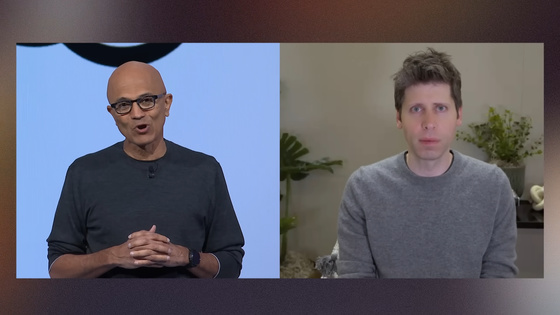
Within OpenAI, it was also perceived that their relationship, limited to Azure, was restricting their ability to expand to enterprise customers. According to internal information obtained by CNBC , OpenAI's Chief Revenue Officer, Dennis Dresser, stated that 'while our partnership with Microsoft has been the foundation of our success, it has limited our ability to meet the needs of customers like Amazon Bedrock.'
Amazon CEO Andy Jassy also expressed optimism that OpenAI models would be available directly from Amazon Bedrock in the coming weeks. He said this would make it easier for developers to choose the right model for their specific needs.
Very interesting announcement from OpenAI this morning. We're excited to make OpenAI's models available directly to customers on Bedrock in the coming weeks, alongside the upcoming Stateful Runtime Environment. With this, builders will have even more choice to pick the right…
— Andy Jassy (@ajassy) April 27, 2026
Microsoft and OpenAI have described this revision not as an end to their partnership, but as 'simplification and increased flexibility in their relationship.' The two companies have indicated that they will continue to cooperate in areas such as expanding large-scale data center capacity, jointly developing next-generation silicon, and AI-powered cybersecurity.
Related Posts:





in AI, Web Service, Posted by log1i_yk