The EU has decided to repeal 'Chat Control 1.0,' which allowed voluntary scanning of private messages. From April 4, 2026, major technology companies such as Meta, Google, and Microsoft will be prohibited from scanning private messages within the EU.

In Europe, as part of efforts to combat child sexual abuse content (CSAM), there is a framework called ' Chat Control ' that requires scanning communications on messaging apps and social media. It has now been revealed that Chat Control 1.0, the provisional rules for Chat Control, will finally be abolished.
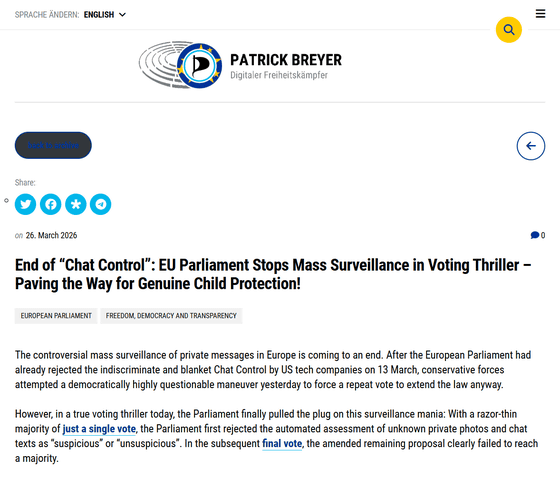
End of “Chat Control”: EU Parliament Stops Mass Surveillance in Voting Thriller – Paving the Way for Genuine Child Protection! – Patrick Breyer
https://www.patrick-breyer.de/en/end-of-chat-control-eu-parliament-stops-mass-surveillance-in-voting-thriller-paving-the-way-for-genuine-child-protection/
Fight Chat Control - Protect Digital Privacy in the EU
https://fightchatcontrol.eu/
Chat Control is a framework being considered by the EU to address CSAM (Communications, Social Security, and Malware) issues. There are two versions of the Chat Rules: the provisional 'Chat Control 1.0' and the new 'Chat Control 2.0,' each with significantly different scopes of enforcement. 'Chat Control 1.0' is a bill approved by the European Parliament in 2021 that allows companies to voluntarily scan emails and messages. It is left entirely to the discretion of companies and does not legally mandate message scanning.
A law requiring companies to check social media interactions for child pornography has been passed in the EU, but it has also drawn criticism that it 'may actually harm children' - GIGAZINE

On the other hand, 'Chat Control 2.0' is being considered as a formal legal regulation in the EU, which would mandate the scanning of all communications on social media platforms that allow text-based communication. Chat Control 2.0 has drawn much criticism from the media and experts as a more severe privacy infringement system than Chat Control 1.0.
Why is the 'Chat Control Act,' which would allow the government to censor all private chats and files, dangerous and pointless? - GIGAZINE


The European Parliament has decided to abolish the Chat Control 1.0 system. The vote, held on March 26, 2026, local time, saw 307 votes in favor of abolition, 306 against, and 24 abstentions, resulting in a narrow majority in favor of abolition .
You did it! 🥳
— Tuta ( @tuta.com ) March 26, 2026 20:57
European Parliament just decided that Chat Control 1.0 must stop.
This means on April 6, 2026, Gmail, LinkedIn, Microsoft and other Big Techs must stop scanning your private messages in the EU. #PrivacyWins 💪
[image or embed]
As a result, Chat Control 1.0 will be completely deactivated on April 4, 2026. Consequently, companies such as Meta, Google, and Microsoft will have to stop indiscriminately scanning the private chats of EU citizens. Regarding this outcome, Patrick Breyer, a former Member of the European Parliament and advocate for the protection of internet privacy, said, 'Digital privacy in the EU is finally being restored!'
However, Breyer says that discussions on Chat Control 2.0 are continuing within the EU, and the tripartite talks on this matter remain under intense pressure.
The tripartite discussions are about whether to legally mandate age verification for messaging services, chat services, and app stores. Breyer points out that if this is implemented, users will be required to present identification or undergo facial recognition, effectively making anonymous online communication impossible and putting vulnerable people such as whistleblowers and persecuted individuals at serious risk.

Chat Control 1.0, which expires on April 3rd, authorizes the indiscriminate mass scanning of private messages that American companies such as Meta are voluntarily conducting. The actions permitted under Chat Control 1.0 are: 'scanning of known images and videos (so-called hash scans)', 'automatic evaluation of unknown images and videos', and 'automatic analysis of text content such as private chats'.
The AI-based analysis of unknown images and text is highly prone to errors, and the method of indiscriminately scanning large quantities of known material has also sparked considerable debate. The unreliability of the algorithms used for scanning and the fact that the scanning relies on opaque overseas databases rather than EU criminal law have also been criticized. Because the algorithms do not consider context or the presence or absence of criminal intent (for example, consensual sexting between teenagers), there is a possibility that chats unrelated to crime may be exposed.
Related Posts:







in Software, Web Service, Posted by logu_ii