The EU's blocked private message scanning plan, 'Chat Control,' has been revised and resurrected as 'Chat Control 2.0'

EU's 'Chat Control 2.0' Sparks Fierce Privacy Backlash
https://reclaimthenet.org/the-disguised-return-of-the-eus-private-message-scanning-plot
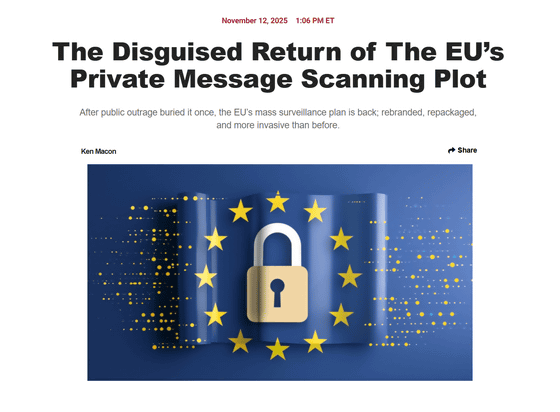
CHAT CONTROL 2.0 THROUGH THE BACK DOOR – Breyer warns: “The EU is playing us for fools – now they're scanning our texts and banning teens!” [updated] – Patrick Breyer
https://www.patrick-breyer.de/en/chat-control-2-0-through-the-back-door-breyer-warns-the-eu-is-playing-us-for-fools-now-theyre-scanning-our-texts-and-banning-teens/
In order to combat child sexual abuse content (CSAM) , which is visual depictions of minors in sexually explicit photos and videos, the EU has been discussing chat controls as a framework for detecting and reporting CSAM.
The chat control initiative called for all service providers, including messaging apps like Signal, WhatsApp, and Telegram, to bypass encryption and view message content. However, this would undermine end-to-end encryption and was criticized as a flawed proposal by people who don't properly understand the encryption mechanism.
The EU's 'Chat Regulation Law' is a dangerous bill that disables encryption not only for messaging apps but also for a wide range of digital services under the guise of child sexual abuse content countermeasures - GIGAZINE

Chat controls were repealed by the Council of the European Union on Thursday, October 30, 2025.
EU again abandons 'chat control' measures aimed at combating child sexual abuse content - GIGAZINE

However, it has been revealed that Chat Control 2.0 will be revised and proposed again by the European Commission, the EU's executive body. Patrick Breyer, a former member of the European Parliament and legal scholar, has warned about Chat Control 2.0.
Breyer argued that the European Commission had quietly begun working on Chat Control 2.0 after the revocation of Chat Control, in response to Reclaim The Net, a group that advocates for free speech and privacy.
Breyer described Chat Controls 2.0 as 'a bill that uses misleading terms like 'risk mitigation' and 'child protection' to gain sweeping new surveillance powers.'
'Chat Control 2.0 is transforming what should be a voluntary framework into a system that forces providers of all services, including chat, email, and messaging, to monitor their users,' Breyer said of the European Commission's Chat Control 2.0 initiative. 'This is political deception of the highest order.'
'Following public outcry, several EU member states, including Germany, the Netherlands, Poland and Austria, said 'no' to indiscriminate chat moderation. But now chat moderation is coming back through the back door in a disguised, more dangerous and more comprehensive form than ever before. People are being deceived,' Breyer said.

The European Commission's Chat Control 2.0 text states that service providers will be obligated to take 'all appropriate risk mitigation measures' to prevent abuse on their platforms. While the Commission describes this as a 'flexible safety requirement,' Breyer pointed out that 'it could be used as a loophole to justify requiring companies to scan all private messages, even those protected by end-to-end encryption.'
They warn that this provision could lead to the introduction of client-side scanning, which inspects content on a user's device before a message is sent, i.e. before it is encrypted.
Unlike the retracted Chat Controls, Chat Controls 2.0 will also be able to analyze text and metadata, and use algorithms and AI to monitor conversations and flag 'suspicious' content.
'Imagine your phone scanning every conversation you have with your partner, daughter, or therapist, and leaking that information to the authorities if the words 'I love you' or 'I see you.' This isn't child protection; it's a digital witch hunt,' Breyer said.
Breyer also noted that existing systems of this nature have already proven flawed, with a similar system implemented by German police proving that half of the cases flagged were unrelated to the crime.

Breyer also pointed out that Chat Control 2.0 could have a significant impact on online identity and anonymity. Indeed, Chat Control 2.0 would require users to verify their age when creating accounts on messaging and email services. This would likely require official ID or biometric verification.
Breyer said such a measure 'effectively marks the end of anonymous online communication and is a disaster for whistleblowers, journalists, political activists, and others seeking help who rely on the protections of anonymity.'
Breyer also criticized provisions restricting the use of messaging apps and social media with chat functions by minors under the age of 16, saying, 'This is digital isolation rather than education, protection by exclusion rather than empowerment. It is paternalistic, unrealistic, and educationally nonsensical.'
Breyer called on EU governments, including Germany, the Netherlands, Poland, the Czech Republic, Luxembourg, Finland, Austria and Estonia, which have so far resisted chat controls, to continue blocking the regulations.
Related Posts:



in Web Service, Posted by logu_ii