Claude Code uses approximately 33,000 tokens for initial data before instructions are given, and approximately 75,000 tokens in a practical configuration.
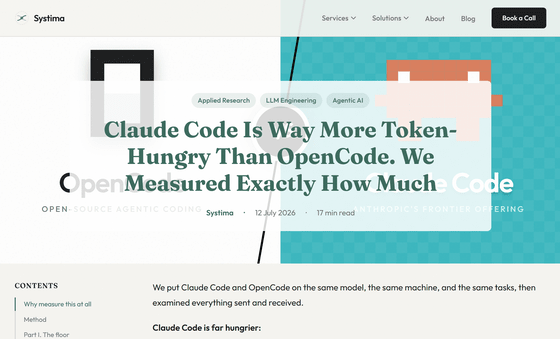
Systima, an AI consulting firm, has published measurement results showing that Anthropic's AI coding assistance tool, 'Claude Code,' uses approximately 33,000 tokens before processing user input, and this number increases to approximately 75,000 tokens in environments where a server compatible with the 'Model Context Protocol (MCP),' a common standard for connecting AI and external tools, and instruction files are added. The open-source AI coding assistance tool 'OpenCode,' which was used as a comparison, uses approximately 6,900 tokens, meaning Claude Code's initial load was about 4.7 times higher.
Claude Code Sends 4.7x More Tokens Than OpenCode Before Reading Your Prompt | Systima Blog
When using an AI coding assistance tool, in addition to a system prompt describing the tool's role and operating rules, explanations of the functions used for reading and writing files and executing commands are sent each time. The more functions the AI can utilize, the longer the explanation becomes, and the more tokens are consumed in ways that are not visible to the user.
Systima ran Claude Code and OpenCode on the same computer with the same AI model and measured the number of tokens using a relay server that recorded the data sent by both to the model. The test used Claude Code 2.1.207 and OpenCode 1.17.18, with Claude Sonnet 4.5 specified as the AI model. In an empty working environment with the MCP server and personal settings removed, the command 'Reply with exactly: OK' was entered.
The data sent by Claude Code in its initial request amounted to approximately 32,800 tokens. Breaking this down, it included system prompts and 27 tool descriptions, with tool descriptions alone accounting for approximately 24,000 tokens. In contrast, OpenCode's initial request, including 10 tool descriptions, totaled approximately 6,900 tokens. Even with all tools disabled, the Claude Code system prompt reportedly used around 6,500 tokens, while OpenCode used approximately 2,000 tokens.

The initial load of approximately 33,000 tokens affects not only the simple price difference but also the amount of information the AI can handle at once. While resent input may be processed more cheaply through prompt caching, using the cache does not reduce the amount of context window space it occupies. When using a context window of 200,000 tokens, Claude Code is using approximately one-sixth of its total space even before loading the code or conversation. As conversations become longer, summarizing past content becomes necessary, leading to additional token consumption.
In actual development environments, instruction files such as 'CLAUDE.md' that contain project-specific rules are sometimes installed. When Systima added a 72KB instruction file that was used in an actual development repository, approximately 20,000 tokens were added per request in both Claude Code and OpenCode. Since instruction files are basically sent to the model with each request, the length of the file has a significant impact on token usage.
Connecting an MCP server that allows AI to control external services and development tools increases the initial load because the MCP needs to explain the names and arguments of the functions the AI can use to the model. Each small MCP server adds approximately 1,000 to 1,400 tokens, and connecting five servers adds approximately 5,000 to 7,000 tokens.
Systima examined a practical configuration including instruction files, MCP servers, and plugins, and found that Claude Code was sending approximately 75,000 tokens before the user even entered instructions. The number of tools used was 118, and the total size of the transmitted data reached 311KB. Depending on the configuration, the initial request could amount to around 75,000 to 85,000 tokens.

However, tools with a high initial load don't necessarily consume more tokens throughout the entire process. In a test involving repeated file creation and program execution, Claude Code called multiple tools at once, resulting in only three requests and a total of approximately 121,000 input tokens. OpenCode, on the other hand, called each tool individually, making nine requests and consuming a total of approximately 132,000 tokens, surpassing Claude Code. This suggests that even with a low initial load, the difference can narrow as the number of requests to the model increases.
Furthermore, when Claude Code divided the work between two subagents, each subagent read its own system prompts and tool descriptions, and the parent agent read the processing results again. As a result, the total number of input tokens increased significantly from approximately 121,000 tokens when processed directly to approximately 513,000 tokens.
The measurement results compare Claude Code and OpenCode in a specific environment, and the values will vary depending on the model, version, and the MCP server being connected to. Systima states that when operating an AI agent, it is important not to just look at the pricing screen, but to record the data actually sent to the model and check the load while adding instruction files and MCP servers one by one.
Related Posts:





in AI, Posted by log1d_ts