Microsoft has announced 'Project Solara,' a new platform for AI agent-dedicated devices, creating an agent-centric system using an Android-based OS rather than Windows.
At its developer event, '
Composing a new platform for agent-first devices - Command Line
https://commandline.microsoft.com/project-solara-build-2026/
Project Solara: A new vision for agent-first computing - YouTube
Project Solara is an initiative by the Applied Sciences Group, led by Microsoft's Steven Bathiche, and is based on the idea that AI agents will become a 'new unit of programming' and a 'new human-machine interface.' Microsoft explains that the form of computers has become more specialized and moved closer to the user and the task at hand, from mainframes and PCs to smartphones and smartwatches.
Microsoft describes Project Solara as 'aiming to create an agent-first experience tailored to the user's agent, task, and environment.' Here, the agent is not simply an AI that answers questions, but rather an entity that maintains context across multiple apps, services, and devices, coordinates tasks, and acts based on the user's intent at the right time.
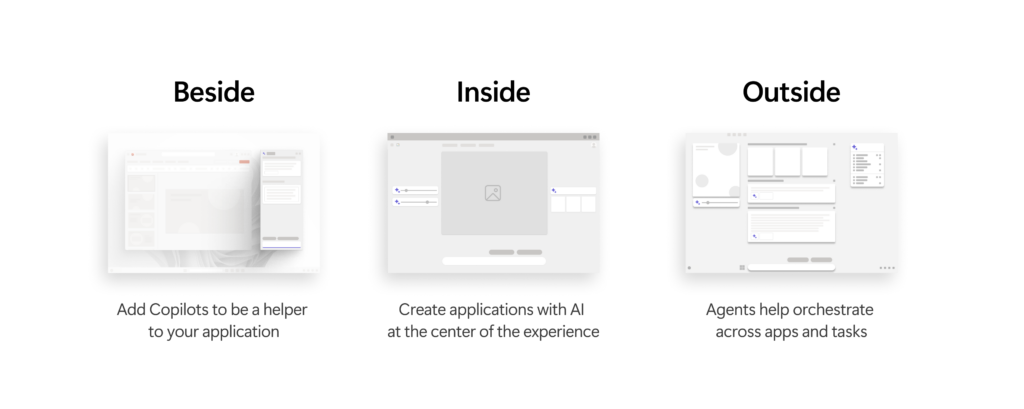
Microsoft explains that there are three stages in the evolution of AI applications. The first is 'Beside AI,' which assists existing apps like Copilot; the second is 'Inside AI,' which changes the operation model of the app itself, like Office's Researcher and Agent Mode; and the third is 'Outside AI,' which works across multiple apps, workflows, and devices. In this evolutionary process, Project Solara is based on the premise of shifting from the experience of 'opening an app' to the experience of 'calling on intelligence.' Microsoft explains that this is 'a shift from graphical UI-centric operation that follows buttons and menus to operation where the user expresses intent and the agent infers across work environments and workflows.'
Project Solara is not based on Windows, but on the Microsoft Device Ecosystem Platform (MDEP), which is based on
Project Solara's device-side components include an 'agent shell' that dynamically loads and coordinates multiple cloud-based agents. Furthermore, it envisions features such as Microsoft Intune, which IT administrators can manage similarly to PCs and mobile devices; Entra ID, which can utilize existing Microsoft accounts; biometric authentication for Hello for Business; and privacy features like a physical microphone mute button and clear indication of recording/listening status.
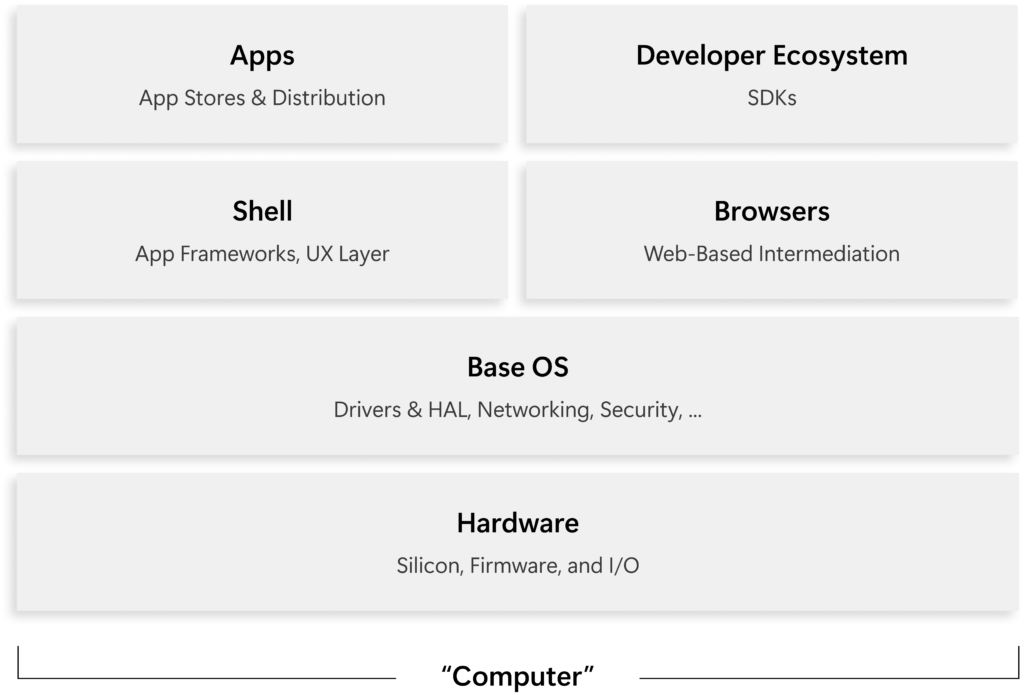
Another important technical concept is 'just-in-time UI.' This is the idea that an agent will adapt the display and user experience to the device, screen size, content, and operating mode (voice, visual, touch, etc.) without developers having to redesign the UI for each new screen size or input method. However, as of the time of writing, Project Solara is positioned somewhere between traditional responsive UI and fully generative UI, and the plan is to start with semi-structured methods such as Adaptive Cards and known content types. Microsoft states that 'the future where AI completely generates UI frame by frame is not yet here.'
Microsoft highlights enterprise-ready solutions with privacy, security, control, and trust, agent-driven interactions with a just-in-time UI, and scalability that allows for the introduction of custom agents as pillars of Project Solara. For enterprises in particular, it is considered crucial to integrate multiple agents into a consistent experience while respecting data, domain, identity, and organizational boundaries.
Microsoft envisions a world where different specialized agents exist for different purposes and organizations, such as coding, analytics, communications, healthcare, and field work, and Project Solara does not rely on a single all-purpose agent. Therefore, Microsoft is also working on technologies such as 'agent dispatchers' that call the appropriate agent when needed, and 'agent task managers' that manage the work of agents.
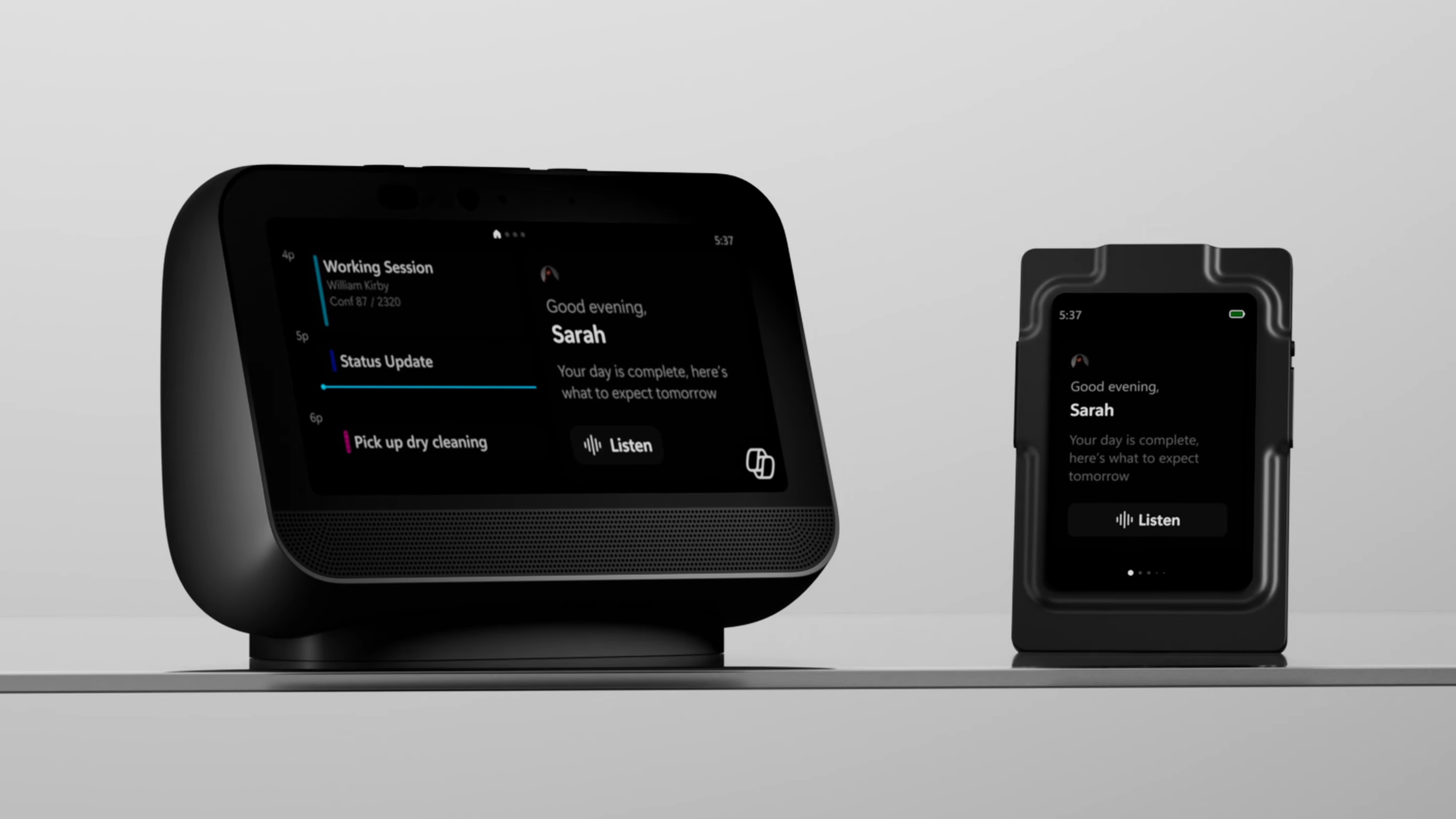
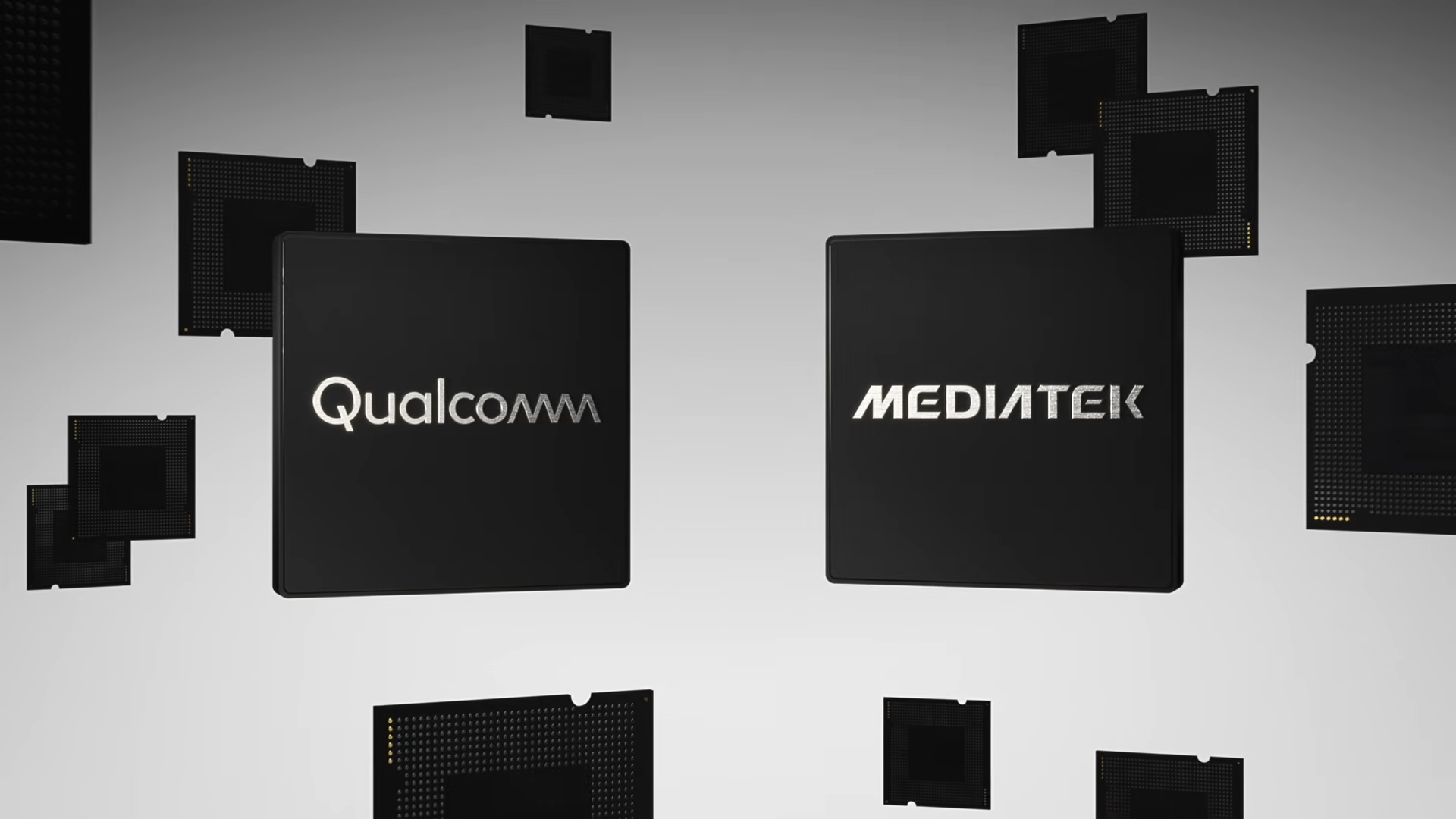
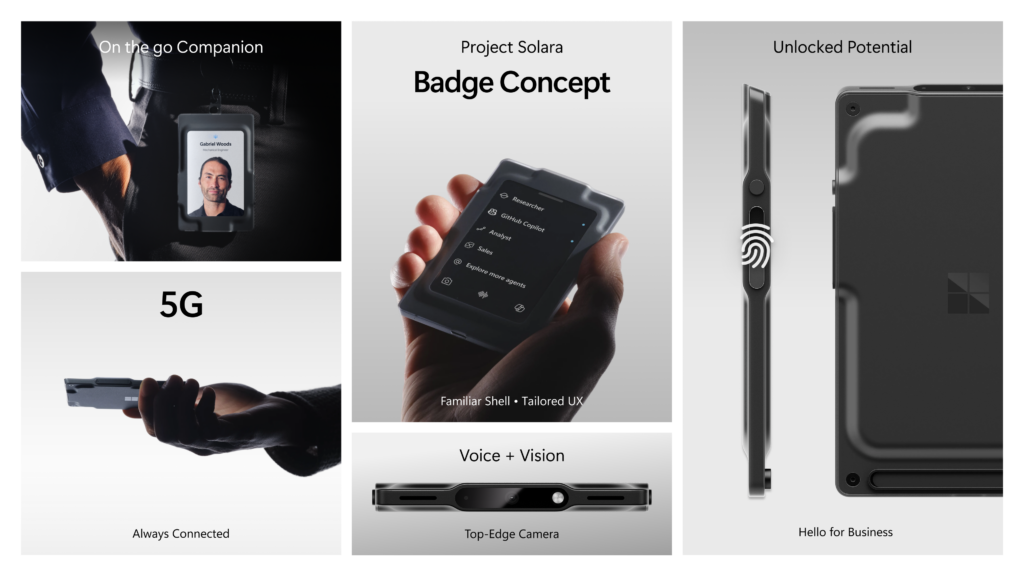
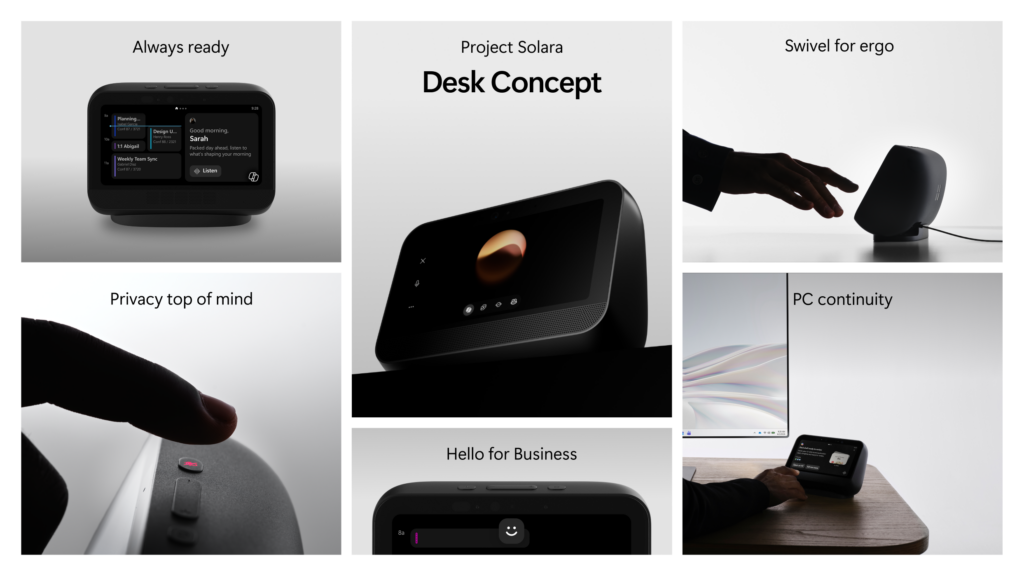
Furthermore, Microsoft has presented two reference designs to test the implementation of Project Solara: a portable 'Badge Concept' and a stationary 'Desk Concept.' Qualcomm is collaborating as the silicon partner for the former, and MediaTek for the latter.
Badge Concept is a small, wearable device similar to an access card or employee ID. It incorporates a Qualcomm chip for wearable devices and features a touchscreen, fingerprint authentication, camera, microphone, speaker, and 5G connectivity, allowing users to access agents immediately after authentication and record and transcribe conversations.
Desk Concept is a smart display-like device designed to be placed on a desk. It features facial recognition, a touchscreen, microphone, speaker, UWB sensor, and USB-C port, and can be used as a standalone device or as an auxiliary device for a Windows PC or a Windows 365 client.
Hundreds of employees at Microsoft are already trying out Badge Concept and Desk Concept. They are expected to work in conjunction with Microsoft 365 Copilot, Researcher, Facilitator, and Priority Agent for uses such as daily briefings, meeting recordings, action item extraction, and organizing important notifications.
Furthermore, Microsoft is also planning to apply Project Solara to GitHub Copilot and Dragon Copilot, an AI assistant for healthcare settings. For developers, a roadmap for building agents using extensions to Microsoft 365 Copilot, Copilot Studio, Microsoft 365 Agents SDK, and Microsoft Agent Framework has also been provided.
Microsoft plans to begin private pilots of agent-first devices using Project Solara with several companies, including AccuWeather, Best Buy, CVS Health, Levi's, and Target, by 2026. It should be noted that Project Solara is still in its early stages, and the two devices announced are not intended for commercial sale, but rather serve as reference designs for manufacturers and developers.
Related Posts: