The number of biomedical papers containing 'AI-fabricated references' is projected to increase more than 12-fold in the three years from 2023, reaching a ratio of 1 in 277 papers by 2026.

In recent years, it has become commonplace for scientists to use AI in their research and paper writing, but in the process, there are cases where AI creates false research findings or includes fictitious references that do not exist. A study of the references included in 2.5 million biomedical papers revealed that a total of 2,810 papers contained false citations.
Fabricated citations: an audit across 2·5 million biomedical papers - The Lancet
Nearly 3,000 peer-reviewed medical papers have fake citations, a Columbia Nursing AI-assisted audit finds | Columbia School of Nursing
https://www.nursing.columbia.edu/news/nearly-3-000-peer-reviewed-medical-papers-have-fake-citations-columbia-nursing-ai-assisted-audit-finds
AI hallucinations in research, legal filings, and books are growing and getting harder to fix | Fortune
https://fortune.com/2026/05/24/ai-hallucinations-scientific-research-authors-medical-journal-treatment/
Maxim Topaz, an associate professor at Columbia University's School of Nursing and Data Science Institute, researches AI to help doctors and nurses make better decisions, and he himself uses AI tools to proofread his scientific papers. However, a few weeks after submitting his latest paper, he received a notice from the journal that it was scheduled to be published in, stating that 'fictitious sources were listed in the bibliography.'
Topaz told the overseas media outlet Fortune, 'I was very embarrassed. I'm an AI researcher, so I'm well aware of AI hallucinations . If this can happen to me, an AI expert, what can happen to other people?'
Therefore, Topaz and his research team investigated approximately 2.5 million biomedical papers published between January 1, 2023 and February 18, 2026, which are indexed in PubMed Central, a database used by clinicians and researchers worldwide. Using an AI-powered automated verification system, they checked approximately 97 million citations contained in these papers and found that 2,810 papers contained a total of 4,046 'fictitious references.'
While not all fictional references were generated by AI, their number increased more than twelvefold between 2023 and 2026, with a particularly sharp increase in 2024, shortly after the widespread adoption of AI tools. 'It's natural to think that AI is linked to the surge in fictional references,' Topaz says.
The graph below shows the number of hypothetical references per 10,000 papers on the vertical axis and the year on the horizontal axis. From 2023 to mid-2024, the number remained below 4 per 10,000 papers, but from mid-2024 onwards, that number increased sharply, reaching 57 in January 2026.
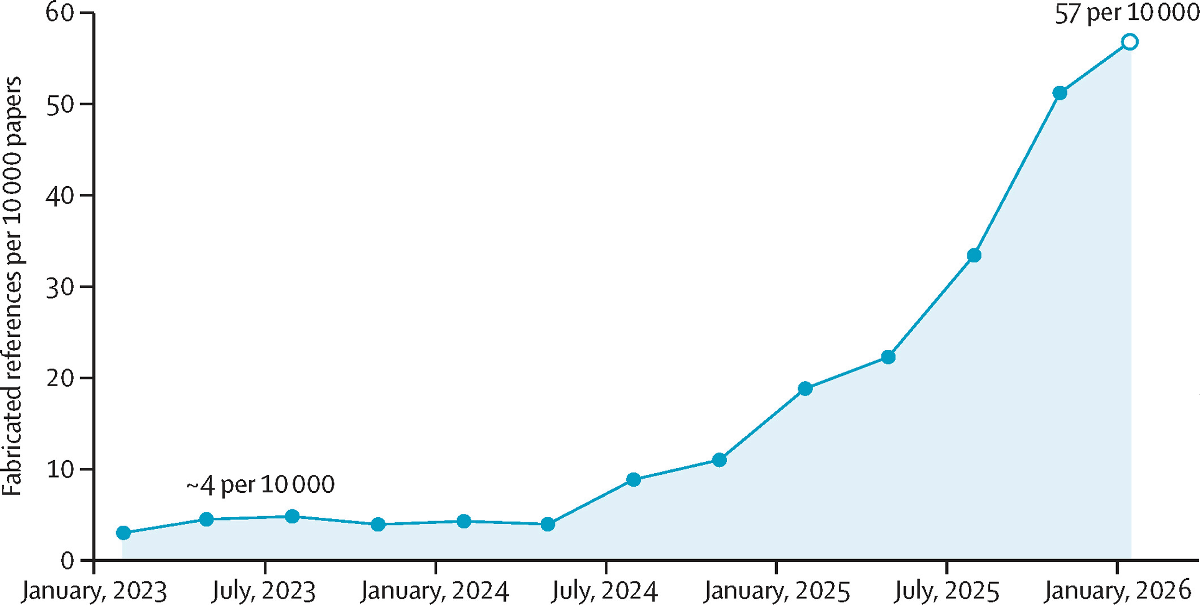
In 2023, one fictitious reference was found for every 2,828 papers, but this increased to one for every 458 papers by 2025. In the first seven weeks of 2026, it was one for every 277 papers. 'I think this is just the tip of the iceberg,' Topaz said.
Medicine is a field of research that develops through accumulation; clinical trials cite various prior studies, systematic reviews integrate the results of various clinical trials, and ultimately, medical guidelines are created by citing these reviews. Therefore, fabrication that occurs in the early stages of the process does not end there, but is reflected in later stages of the process.
Topaz stated, 'This is the chain of evidence, and it's how we care for and treat people. If you put a fictitious study at the bottom of that chain, the whole structure takes over. Healthcare professionals and clinical guideline writers have no way of knowing that the evidence they are relying on doesn't exist. For example, in one paper we investigated, 18 out of 30 references were fake. Some of these citations have already been cited in other papers and have been included in systematic reviews that guide clinical care.'
The majority of papers found in the study contained only one or two fictitious references, suggesting that the fabrication was not intentional. However, the academic publishing industry was unprepared to cope with the surge in fictitious references, and 98.4% of the papers found in the study that contained fictitious references were not retracted by their publishers.
Based on their findings, the research team recommends that publishers verify the references in their papers. They also call for indexing services to add metadata to their records to allow for the assessment of reference accuracy, and for major research ethics databases to systematically track false references.
Experts other than scientists are also using AI, and its negative effects are becoming apparent everywhere. According to research , many legal professionals use AI tools for legal research and document creation, but there have been numerous reports of 'non-existent precedents generated by AI' being included in court documents.
Furthermore, the book ' The Future of Truth: How AI Reshapes Reality,' published in 2026 by American author Stephen Rosenbaum , sparked controversy due to the inclusion of numerous inappropriate quotes generated by AI. Rosenbaum admitted that the errors were due to the use of AI in writing, but stated that he intends to continue using AI in the future.
Olga Tokarczuk , the Polish Nobel laureate in Literature in 2018, also faced significant backlash after publicly stating that she used AI in her research for writing. It has also been pointed out that three out of the five winning works for the 2026 Commonwealth Short Story Prize, a prestigious international literary award, are 'highly likely to have been written using generative AI.'
Three out of five short story award-winning works are suspected to have been written using AI-generated texts - GIGAZINE
Related Posts: