ChatGPT 5.5 Pro can perform doctoral-level mathematical research in one hour, leading mathematicians to suggest it 'changes the minimum standard for human research.'
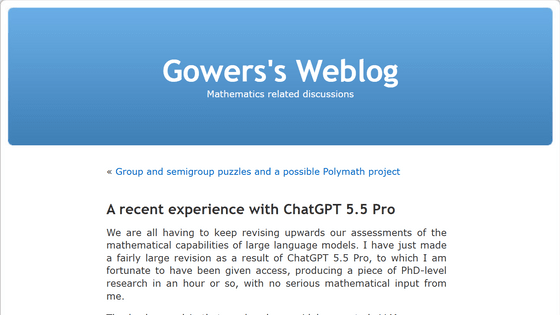
Mathematician Timothy Gowers has posted an article detailing his experience using ChatGPT 5.5 Pro for mathematical research. According to Gowers, ChatGPT 5.5 Pro produced doctoral-level combinatorial research results in about one to two hours, with almost no mathematical guidance.
A recent experience with ChatGPT 5.5 Pro | Gowers's Weblog
Gowers attempted a problem concerning the size of the 'union' formed when a set of integers A is repeatedly added together. Roughly speaking, the problem is 'how wide a range of integers is needed to create a union of a desired size using a set of k integers?'
In the previously known construction, the range of integers required was quite large. ChatGPT 5.5 Pro first improves the exponential upper bound to a quadratic upper bound for the basic case h=2. This is achieved by cleverly using the already known ' Sidon set ,' a set whose summation results are unlikely to overlap.
Furthermore, Gowers tried to see if a similar improvement could be made for the more general case of h. This part builds on existing research by MIT student Isaac Rajagopal. ChatGPT 5.5 Pro attempts to improve upon that discussion and ultimately comes up with the idea of improving the exponential upper bound to a polynomial upper bound.
Rajagopal reviewed the results and assessed them as 'almost certainly correct.' What was particularly important was that it wasn't just a simple computational substitution, but involved the idea of creating a set that 'behaves like a geometric sequence, but with elements of a size roughly equivalent to a polynomial.' Rajagopal said that ChatGPT 5.5 Pro found something in less than an hour that he himself would have been proud to come up with after thinking about it for a week or two.
Gowers described the results obtained by ChatGPT 5.5 Pro as 'of a quality that would be sufficient as a chapter in a doctoral dissertation on combinatorics, considering they were found in less than two hours.' Of course, it's not a grand theorem that will go down in the history of mathematics, and it is true that it relied heavily on Rajagopal's existing research. However, he argues that it was not merely a rephrasing or mechanical calculation, but rather an extension of the existing framework that was non-trivial.
What Gowers particularly emphasizes is that if a human doctoral student were to try to reach the same result, they would first need to thoroughly read Rajagopal's paper, look for areas for improvement, become familiar with the necessary algebraic methods, and then find a new structure. In other words, what ChatGPT 5.5 Pro did was not merely 'find existing answers through a search,' but was quite close to the reading, refining, and construction process that researchers actually go through.

Therefore, Gowers believes that teaching research to early-stage doctoral students will become even more difficult in the future. Until now, it was possible to give students relatively easy problems that no one had solved yet, as a first step in their research. However, if AI is now capable of solving such 'easier unsolved problems,' the minimum requirement for human researchers may shift from 'solving unsolved problems' to 'proving that AI alone cannot solve them.'
However, Gowers does not believe that this means human mathematicians will become unnecessary. Rather, he sees that since even novice researchers can use AI, what will become important going forward is 'the ability to collaborate with AI to advance research that AI cannot do alone.' Gowers himself has recently been doing a lot of collaborative work with AI, and says that while AI is not yet at the stage of coming up with groundbreaking ideas, it is certainly making useful contributions.
Gowers believes the meaning of mathematical research will also change. For example, he says, 'In the future, it may become more difficult to obtain the kind of honor where your name is permanently immortalized in theorems and definitions.' Even if a mathematician solves a major problem after a long collaboration with AI, if the AI handled the technical work and key ideas, it is questionable whether it can be called a great achievement by that mathematician.
Nevertheless, Gowers believes there is still value in tackling difficult mathematics. He points out that grappling with problems develops a 'problem-solving sense' that cannot be obtained simply by reading other people's answers, and just as excellent programmers are better at using AI coding, those with experience actually solving difficult mathematical problems will have an advantage in mathematical research using AI. He concludes his post by saying, 'While future mathematical research may not yield the same rewards as previous generations, the skills honed through research-level mathematics are likely to be a powerful asset for the world to come.'
Related Posts: