Who exactly are these 'health and wellness influencers' that so many people rely on as sources of health information?
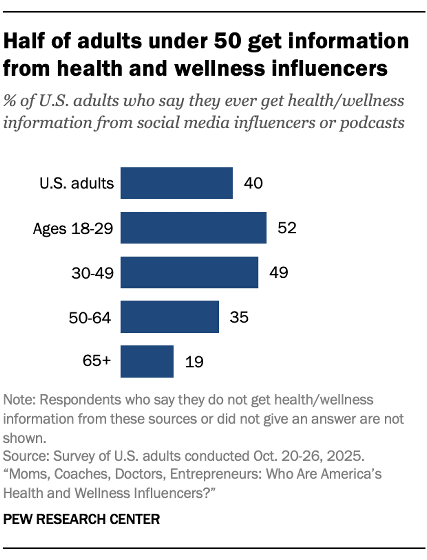
Everyone wants to be healthy, but since most people can't manage their health effectively on their own, they turn to others for help. It's been revealed that 40% of Americans, and half of adults under 50, get their medical and health information from social media. The Pew Research Center conducted a survey on who these influencers are and has published the results.
Moms, Coaches, Doctors, Entrepreneurs: Who Are America's Health and Wellness Influencers? | Pew Research Center
Health and wellness influencers dominate social media. A new report shines a light on who they actually are. | Vox
https://www.vox.com/good-medicine-newsletter/487970/health-and-wellness-social-media-influencers-pew-report
According to the Pew Research Center, about half of Americans struggle to know which health information is accurate, and most people encounter conflicting advice about their health. In this confusing situation, 40% of adults, and half of those under 50, rely on influencers.
Half of adults under 50 get information from health and wellness influencers | Pew Research Center
https://www.pewresearch.org/data-labs/2026/05/07/moms-coaches-doctors-entrepreneurs-who-are-americas-health-and-wellness-influencers/pl_2026-05-07_wellness-influencers_0-01/
The Pew Research Center identified 6,828 influencers with at least 100,000 followers on YouTube, TikTok, and Instagram who regularly post about health and wellness, and analyzed their social media profiles.
The results showed that 41% of the 'influencers' identified themselves as some kind of medical professional, while others identified themselves as coaches (31%) or entrepreneurs (28%). Two-thirds of the 'influencers' were women, but this type of 'influencer' was particularly represented by male influencers with specific backgrounds, such as 'doctors.' Many were making good use of their own life experiences, and female influencers in particular tended to leverage their experience as 'parents.'
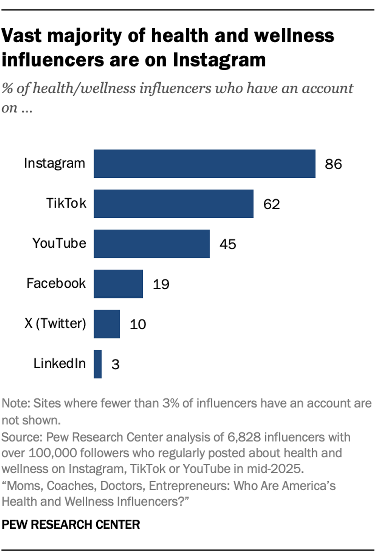
Health and wellness influencers tend to be more active on platforms that focus on images and videos rather than text. 86% have accounts on Instagram, 62% on TikTok, and 45% on YouTube, but only 19% have Facebook accounts and 10% have X accounts. Furthermore, few influencers are active on a wide range of platforms, with an average of two accounts.
Vast majority of health and wellness influencers are on Instagram | Pew Research Center
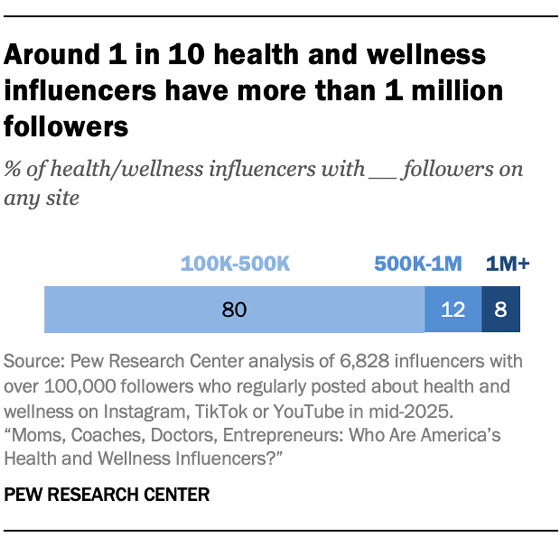
The Pew Research Center defined influencers surveyed as those with '100,000 followers,' but 8% of those influencers had over 1 million followers. 46% of influencers with a large number of followers were male, which is a high percentage compared to the overall influencer population.
Around 1 in 10 health and wellness influencers have more than 1 million followers | Pew Research Center
When asked why they use influencers as a source of information, 41% cited 'wanting to change their health or lifestyle' as their motivation. Among young people, 33% said they watch health influencers as entertainment. On the other hand, two-thirds of respondents said they started watching an influencer simply because they 'happened to come across the information.'
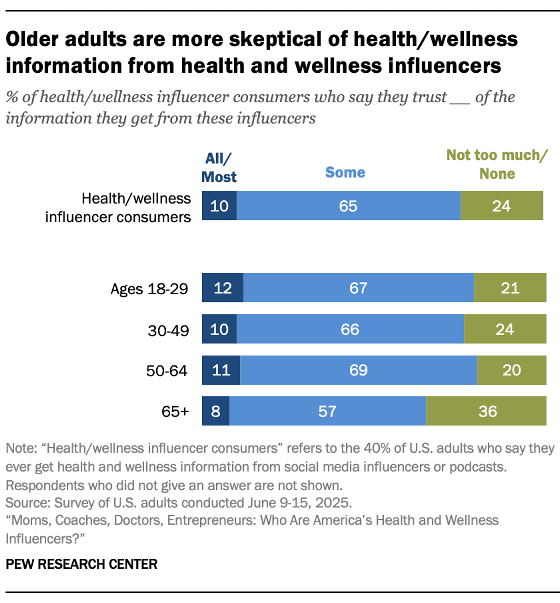
When asked if they trust information from influencers, only about 10% answered 'completely/mostly,' while 60% answered 'partially.' More than 30% of older people answered 'not trust at all.'
Older adults are more skeptical of health/wellness information from health and wellness influencers | Pew Research Center
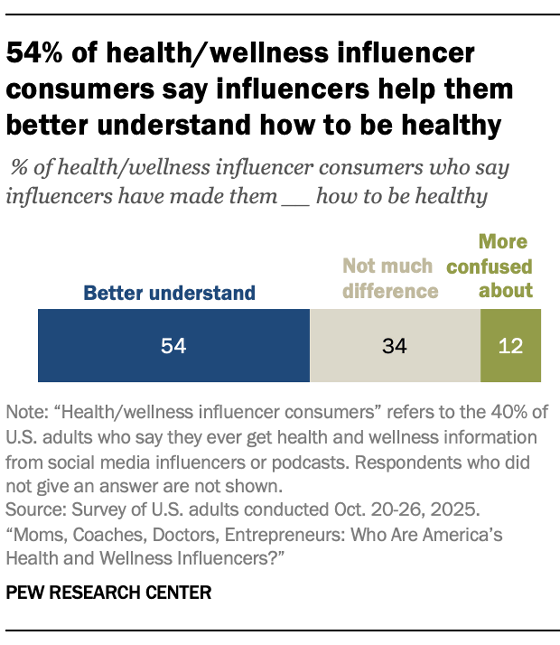
54% of people who obtained health and wellness information from influencers, social media, podcasts, etc., said it helped them 'gain a deeper understanding of how to become healthy.' 12% said it 'increased their confusion about how to become healthy,' and 34% said there was no change.
54% of health/wellness influencer consumers say influencers help them better understand how to be healthy | Pew Research Center
https://www.pewresearch.org/data-labs/2026/05/07/trust-in-health-and-wellness-influencers/pl_2026-05-07_wellness-influencers_2-02/
Related Posts:


in Note, Posted by logc_nt