This graph clearly shows the enormous scale of AI data center investment, amounting to approximately 146 trillion yen in just six years.
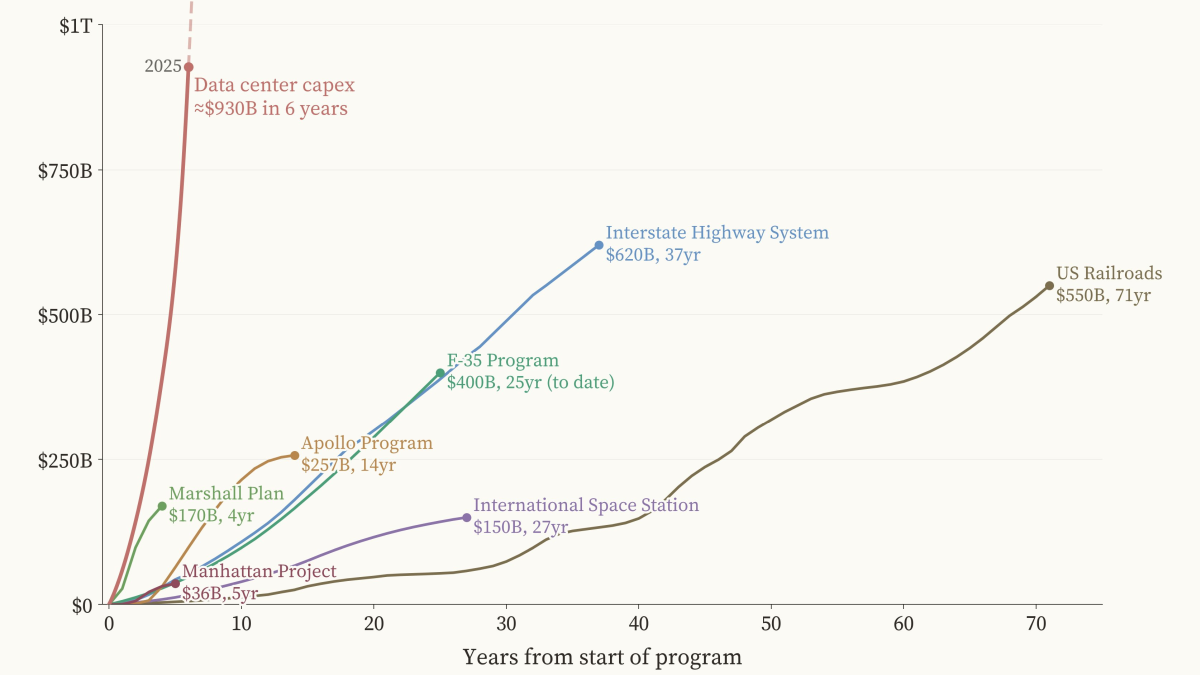
Major technology companies such as Amazon, Microsoft, Google's parent company Alphabet, Metatron, and Oracle are rapidly expanding their investments in data centers to support computing resources for AI. A graph posted on X by Forethought researcher Fin Moorhouse shows that these large cloud companies' data center investments are on a scale far exceeding even historically massive projects in the United States.
Fin Moorhouse (@finmoorhouse) / X
https://x.com/finmoorhouse
On April 17, 2026, Moorhouse posted a graph on X comparing the investment amounts of companies operating large-scale cloud services and data centers, so-called ' hyperscalers ,' to historically massive American projects such as the Apollo program and the Manhattan Project .
The hyperscalers have already outspent the most famous US megaprojects pic.twitter.com/D54qD8kO61
— Fin Moorhouse (@finmoorhouse) April 17, 2026
This graph shows costs on the vertical axis, with inflation-adjusted figures to account for price differences across eras. The unit is billions of dollars (approximately 160 billion yen). The horizontal axis shows the number of years since the project began. From this graph, we can see that investment in data centers reached approximately $930 billion (approximately 146 trillion yen) in 2025, six years after the project began.
The comparison points cited are historically massive American projects. The graph shows that the Apollo program cost approximately $257 billion (approximately 40 trillion yen) over 14 years, the Manhattan Project cost approximately $36 billion (approximately 5.6 trillion yen) over 5 years, the Marshall Plan cost approximately $170 billion (approximately 27 trillion yen) over 4 years, the International Space Station cost approximately $150 billion (approximately 24 trillion yen) over 27 years, the F-35 program will cost approximately $400 billion (approximately 63 trillion yen) over 25 years until 2025, the Interstate Highway Network (USA's interstate highway network) will cost approximately $620 billion (approximately 97 trillion yen) over 37 years, and American railroads will cost approximately $550 billion (approximately 86 trillion yen) over 71 years.
Investment in data centers already surpasses these well-known mega-projects by 2025. Furthermore, the dotted line in the planned figures for 2026 shows that data center investment is expected to increase even further.
However, the data center investment figures in this graph are estimates of the portion of global capital expenditures made by Amazon, Microsoft, Alphabet, Meta, and Oracle that are believed to have been used for data centers. They do not represent only actual data center expenditures. Furthermore, Chinese hyperscalers are not included in the calculations.
Moorhouse also posted a graph that shows the same investment amount from the perspective of 'how large it was compared to the US GDP for that year.'
I agree the spending is more modest as a share of US GDP at the time — here's the graph pic.twitter.com/FpLiaSP5kH
— Fin Moorhouse (@finmoorhouse) April 17, 2026
This graph shows that data center investment is projected to be approximately 3.3% of GDP per year by 2025. '% of GDP per year' is a unit calculated by determining what percentage of US GDP each year's expenditure represents and then summing these up year by year.
When viewed as a percentage of GDP, data center investment, including the planned figures for 2026, will be even larger. However, compared to the size of the US railroads (207.4% of GDP per year over 71 years), the interstate highways (9.0% of GDP per year over 37 years), and the Marshall Plan (6.4% of GDP per year over 4 years), while the amount of data center investment stands out, it becomes clear that past mega-projects like railroads and interstate highways were also a very heavy burden when compared to the overall size of the US economy at the time.
This graph has also been a hot topic on Hacker News , and while some reactions suggest that data center investments appear somewhat modest when viewed as a percentage of GDP, it also highlights just how massive the railway investments were. However, others point out that the nature of expenditures differs between past mega-projects and AI data center investments. One comment states that while railways, bridges, tunnels, and dams are often used for 50 to 100 years or more, GPUs, which make up a large portion of AI data centers, are depreciated in about 6 years, so the current investments appear even larger when viewed on an annual basis.
Furthermore, some argue that past massive investments, such as those by NASA, have produced technological by-products that are used in everyday life. Conversely, there is also the view that even if AI hits a wall, a large amount of GPU computing resources will remain, which could potentially be used as other useful computing resources, such as CPU emulation or the conversion of conventional algorithms for GPUs.
How to view GPUs is also a subject of debate. One user argues that 'GPUs are not the project itself, but more like the shovels used in the gold rush.' Another user counters that 'shovels are cheap, and you can cross a bridge even without them after it's built, but without GPUs, data centers and models are useless,' suggesting that GPUs are more like the steel framework that makes up a bridge than the shovels themselves.
On the other hand, there are also cautious views on this comparison itself. Some point out that this is not a single national project, but rather the sum of expenditures used in hundreds or thousands of computing resource-related projects. There are also warnings that the cost of creating visually appealing graphs has decreased significantly, and that graphs found on social media should not be taken for granted as accurate.
Related Posts:






in AI, Posted by log1b_ok