The prediction market 'Polymarket' shows that only 0.1% of users capture 67% of the total profits, creating a situation where 'the most frequent traders are the most successful.'

Prediction markets like Polymarket and Kalshi advertise that even ordinary users have the opportunity to predict future events and make huge profits. However, according to an analysis by the Wall Street Journal (WSJ), in reality, a small number of highly skilled traders reap the majority of the profits, while many ordinary users suffer losses.
Why Almost Everyone Loses—Except a Few Sharks—on Prediction Markets - WSJ
https://www.wsj.com/finance/investing/polymarket-kalshi-betting-profits-prediction-markets-eb23ac11
Trading volume across prediction markets is expanding rapidly. According to data from The Block, the combined trading volume of Polymarket and Kalshi increased from $1.8 billion (approximately 280 billion yen) a year ago to $24.2 billion (approximately 3.78 trillion yen) in April.
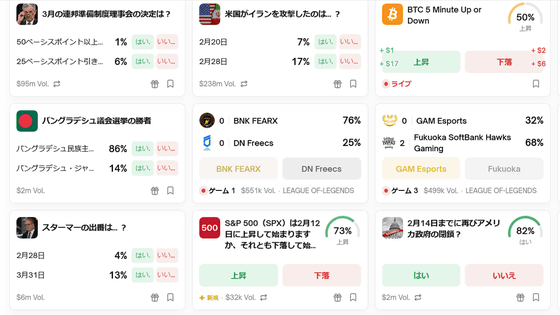
Prediction markets are systems where you trade 'yes' or 'no' about future events. Typically, contracts are bought and sold where you pay $1 (approximately 158 yen) if you are correct, and nothing if you are wrong. The contract price reflects how the market views the probability of that event occurring. On the other hand, there is no 'bookmaker' in this market; users trade with each other. The platform earns a commission for transactions, and professional traders use methods similar to those of Wall Street traders, such as accumulating profits from small price fluctuations.

The Wall Street Journal analyzed 1.6 million Polymarket accounts that traded since November 2022. The results showed that 67% of the profits were concentrated in just 0.1% of accounts, with fewer than 2,000 accounts collectively generating nearly $500 million (approximately 78 billion yen).
Similarly, at Kalshi, the number of users losing money far outnumbering those winning. Elizabeth Deanna, a spokesperson for Kalshi, stated, 'Based on data from the past month, there are 2.9 users losing money for every one user making a profit.'
According to the Wall Street Journal, the winners are professionals and trading firms that use vast amounts of data and algorithms. These traders purchase external real-time data, use computers to predict price movements, and execute trades and manage risk faster than humans.
Those who are particularly successful are users with extremely high trading frequency. A graph published by the WSJ shows that the top 0.1% of traders who trade most frequently on Polymarket have the highest success rate, while in lower trading frequency brackets, less than half of traders tend to make a profit.
Michael Boss, a former professional poker player with a background in statistics, reportedly makes 60 trades per minute on Kalshi, adjusting his buy and sell prices 30 times per second. Boss has earned over $668,000 (approximately 104.4 million yen) on Kalshi, mainly through sports-related trading, and states that ordinary users 'simply have no chance of winning.'
Furthermore, the company co-founded by current university student Jonathan Stoll-Ryan is among the top 5 companies in terms of cryptocurrency trading volume on Kalshi, spending over $200,000 (approximately 31 million yen) annually on live data, AI coding agents, and servers, and using algorithms to execute tens of thousands of transactions per day.

In contrast, many ordinary users are said to be making emotional decisions based on intuition, social media, and publicly available information. According to a WSJ analysis, more than 70% of Polymarket users have incurred losses, with typical users losing between $1 (approximately 155 yen) and $100 (approximately 15,800 yen), while the worst-performing 10% of traders lost an average of $4,000 (approximately 630,000 yen).
The Wall Street Journal also analyzed over 35,000 completed trades on Kalshi. Their findings revealed that 'yes' trades, which are advertised as having a 50% win rate, actually only hit around 40% of the time on average. Furthermore, the common user strategy of 'buying 'yes' at the first price seen' results in an average loss of 11% of the stake.
This bias stems from a 'long-shot bias,' which causes the overestimation of unlikely events. Kalshi acknowledges this tendency in the mention market, but explains that the mention market does not represent the pricing of the entire platform, and that pricing is more accurate in the four hours immediately preceding an event.
On the other hand, some argue that 'prediction markets are vulnerable to insider trading.' The U.S. Commodity Futures Trading Commission has demonstrated its federal authority over prediction markets and is cracking down on insider trading. Polymarket has stated that it is cooperating with the Department of Justice's crackdown, and Kalshi also says it prohibits insider trading and imposes penalties on violators.
Related Posts:






in Web Service, Posted by log1i_yk