Research reveals that betting behavior on gambling platform 'Polymarket' predicts economic indicators, earnings announcements, and political events with better accuracy than analysts
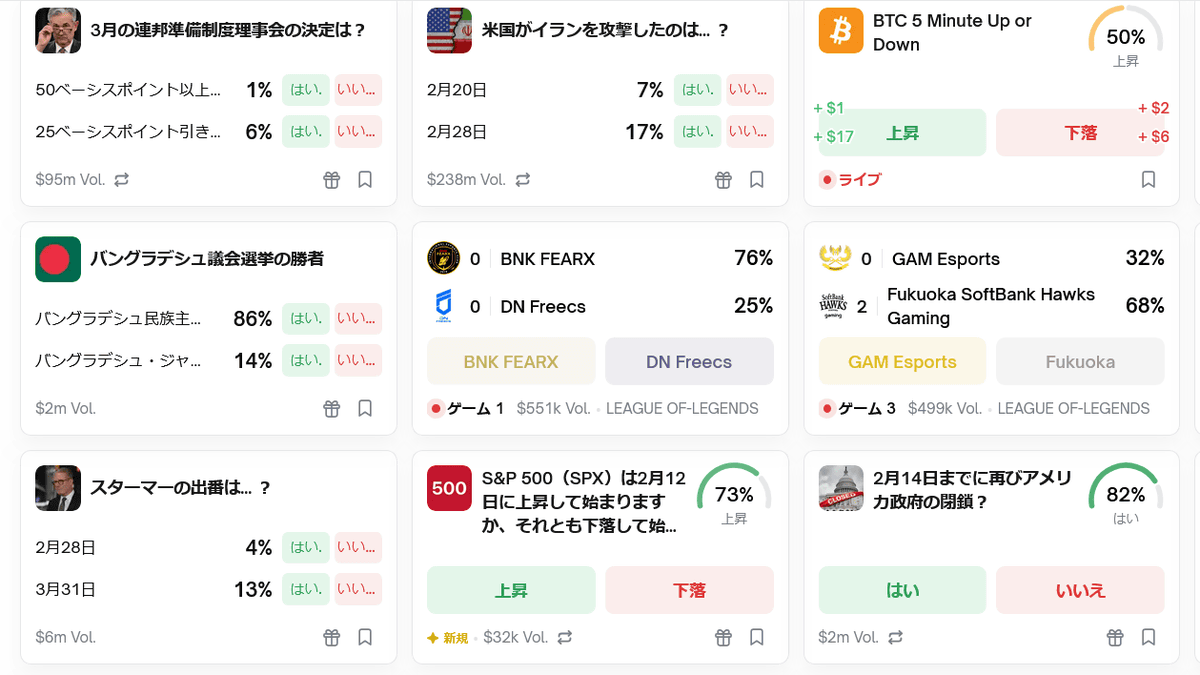
There are several online gambling platforms known as 'prediction markets' that allow people to bet on everything from the outcome of sporting events to the outcome of presidential elections. Economists from London Business School and Yale University analyzed the behavior of one of these platforms,
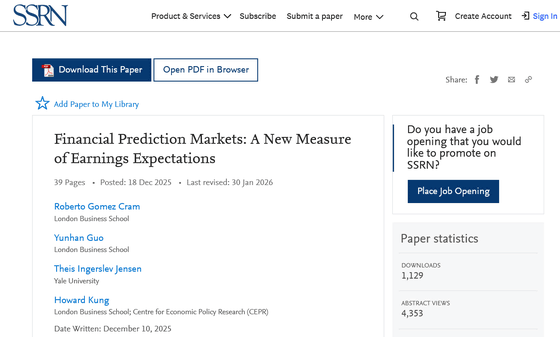
Financial Prediction Markets: A New Measure of Earnings Expectations by Roberto Gomez Cram, Yunhan Guo, Theis Ingerslev Jensen, Howard Kung :: SSRN
https://papers.ssrn.com/sol3/papers.cfm?abstract_id=5933475
Kalshi and Polymarket Create New Competition for Professional Economists - The New York Times
https://www.nytimes.com/2026/02/11/business/economy/forecasts-prediction-markets-economy.html
Professor Tyce Jensen of Yale University points to incentive factors as the reason why Polymarket participants tend to make more accurate forecasts than stock analysts. Professional analysts may have conflicts of interest, such as trading fees from their companies, and may have incentives such as 'the more optimistic they are, the higher their fees will be.' Furthermore, professional analysts tend to avoid publishing extreme forecasts because they are more likely to be embarrassed if they make forecasts that are significantly off the market forecast.
On the other hand, average users of prediction markets may be less susceptible to the biases that professional analysts tend to fall into. 'The beauty of prediction markets is that you have to put your money where your mouth is,' Jensen explained. 'So you have a stronger incentive to express your true beliefs.'
Additionally, prediction markets have been found to have the following characteristics compared to analyst forecasts: 'higher forecast accuracy,' 'gradually reflecting new information from earnings announcements in prices,' 'unlike the conservative and synchronized reactions often seen in analysts, they more quickly incorporate short-term price fluctuations,' and 'take the lead in price discovery (the market's ability to determine what level is an appropriate price).'
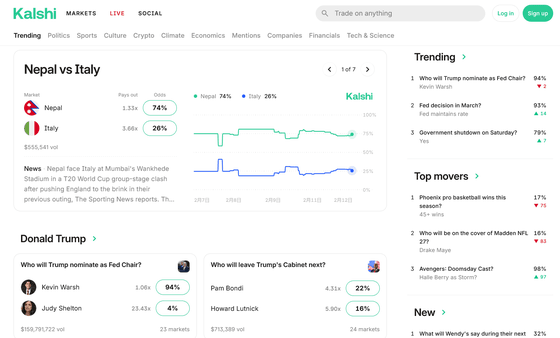
A similar trend has been observed with Kalshi , a prediction market platform primarily used in sports betting. A pre-peer-reviewed paper (PDF file) published by the National Bureau of Economic Research (NBER) in January 2026 reported that Kalshi had consistently made economic predictions with accuracy on a par with highly trained forecasters for approximately five years since its launch. It has also been shown to outperform experts in predicting inflation rates.
However, prediction markets do not necessarily produce completely independent insights, as Michael Feroli, chief Americas economist at investment bank JPMorgan Chase , points out that 'bettors rely on expert forecasts, data and other sources.'
Thomas Simons, US economist at investment firm Jefferies , reflected on cases where prediction markets have predicted unexpected political and economic trends. 'We've noticed that bettors in prediction markets have the advantage that they don't have to make predictions unless they're confident they're right. Professional forecasters don't have a choice; they have to make predictions even when the data is messy and they're not very confident in the numbers. Prediction market participants only have to bet on events they're confident in, so I feel like they're getting more accurate with their predictions.'
Warren Hatch, CEO of Good Judgment , which has assembled a group of 'super forecasters' by selecting people with excellent track records of forecasting, points to 'AI' as a new type of forecaster that can synthesize large amounts of standardized information and produce reasonably accurate estimates. However, he also emphasizes the importance of forecasters, saying, 'When data is scarce and the environment is fluid, AI can only look back by definition. AI may struggle with issues that are more about people and culture than numbers and metrics. And that's where I think humans will have a role to play.'
While betting on prediction markets is restricted in some states and apps are subject to regulation, as of February 2026, more than $60 million (approximately 9.4 billion yen) was being bet on political and economic prediction market platforms every day. As markets mature and liquidity improves, financial prediction markets are attracting increasing attention.
Related Posts:




in Web Service, Posted by log1e_dh