Why is Mozilla opposing the 'Prompt API,' an AI feature planned for Google Chrome?

Mozilla has expressed opposition to the '
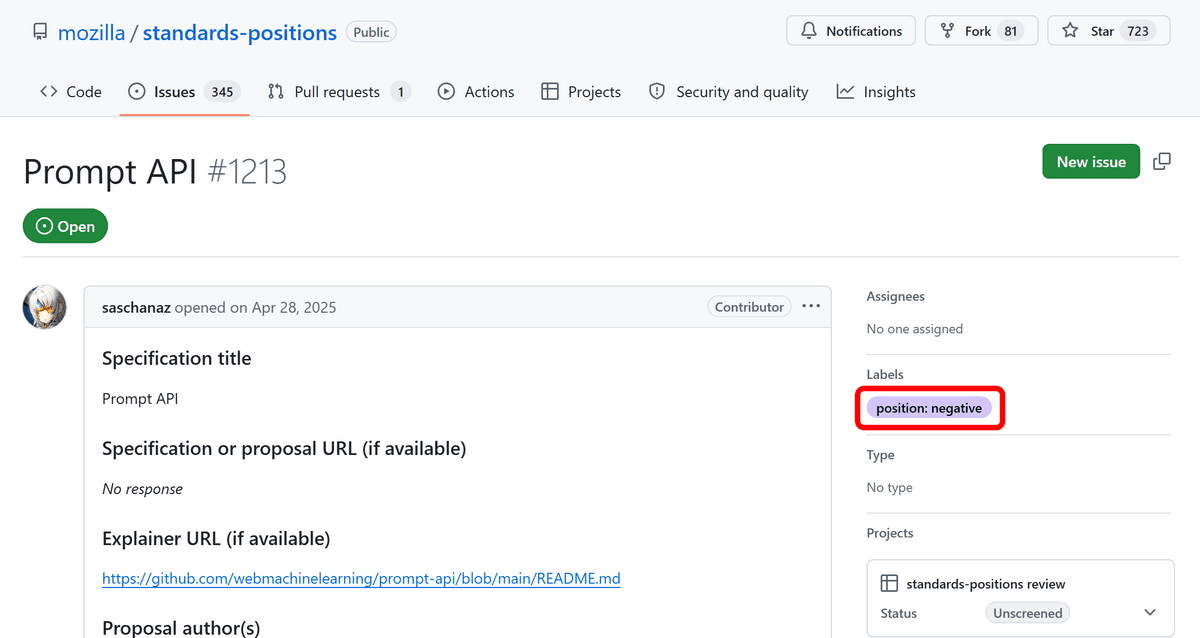
Prompt API · Issue #1213 · mozilla/standards-positions
https://github.com/mozilla/standards-positions/issues/1213#issuecomment-4347988313
The Prompt API is an API that allows web pages to directly send prompts to the browser's built-in language model, enabling tasks such as text generation, summarization, and information extraction. The specification document lists advantages such as the ability to process sensitive data locally, offline use, and reduced API usage fees for web developers.
In the Mozilla Standards Positions repository , where Mozilla publishes its official stance on new web standards proposals, including 'for,' 'against,' and 'concerned,' Mozilla has rated the Prompt API as 'against.' Jake Archibald, who is in charge of web developer relations at Mozilla, stated that the Prompt API would have serious negative consequences for the interoperability, updatableness, and neutrality of the web platform.
Mozilla is particularly concerned about the fact that prompts are heavily optimized for each model. Even if a developer creates a prompt that works as expected on Gemini Nano, there is no guarantee that the same prompt will produce the same quality output when another browser uses a different language model. The Prompt API README also explicitly states that model quality, stability, and interoperability between browsers are not guaranteed.
Making adjustments for Gemini Nano used in Chrome, such as 'specifying the output format in detail' or 'writing in a roundabout way to avoid rejection,' can result in excessive or counterproductive adjustments when used with a different model embedded in a different browser. With traditional Web APIs, the goal is to ensure that the same JavaScript works the same way across multiple browsers according to the specifications, but with the Prompt API, the same code does not necessarily produce the same results because the output of an AI model depends on the model's training data, system prompts, safety policies, and version updates.
Google explains that the Prompt API is an API for directly accessing 'browser-provided on-device AI language models,' and that it makes it easier to process generated text through output constraints using JSON schemas and regular expressions. An '
From Mozilla's perspective, the fact that it's 'enabled for regular web pages' is also a problem. If the number of sites supporting the Prompt API increases as it's implemented in Chrome, other browsers will be pressured to replicate Chrome's similar behavior to maintain compatibility. Furthermore, if the first AI model used by the Prompt API is Google's Gemini Nano, there's a risk that the entire web will be drawn to behave like Gemini Nano.

Furthermore, Archibald also criticizes the fact that using the Prompt API in Chrome involves agreeing to Google's usage policy regarding generated AI. The fact that the availability of web standard APIs depends on the unique policies of each browser vendor and model provider could set a precedent that undermines the neutrality of web platforms.
Mozilla itself has also incorporated an AI execution platform into Firefox. However, Firefox's AI Runtime is a mechanism for Firefox's internal functions and extensions, and is not a standard API for regular web pages. Furthermore, Firefox's mechanism is designed to explicitly use task names and model IDs, which is different from the Prompt API, which hides 'which model is being used.'
The Prompt API has attractive advantages such as local AI, privacy, offline operation, and low cost. On the other hand, publishing it as a web standard presents challenges such as model dependencies, terms of use, breaking changes during updates, and cross-browser compatibility. Mozilla is not arguing that they want to 'eliminate AI from the web,' but rather that 'if it is to be included as a web standard API, it must be designed in a way that does not tie the web to a specific model or the interests of a specific company.'
Related Posts: