The EU has announced a new proposal to open up Android to competing AI services, which Google has protested, calling it unfair interference.

It has been revealed that the EU is pressuring Google to increase the openness of Android, demanding that it open up key Android features to other companies, including voice recognition technology that can activate AI. Google has pushed back, saying that this is 'unfair intervention' and could result in unnecessary costs.
The Commission seeks feedback on measures to ensure interoperability with Google's Android
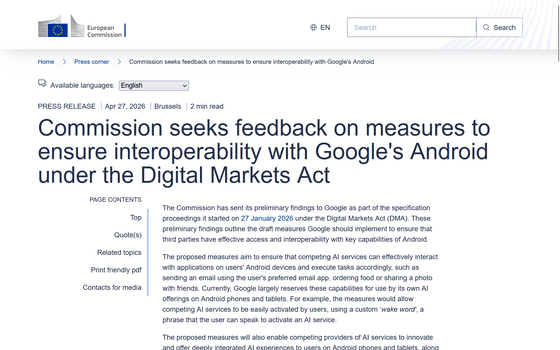
Google Faces EU Push to Open Android Ecosystem to Rival AI Services - Bloomberg
EU tells Google to open up AI on Android; Google says that's 'unwarranted intervention' - Ars Technica
https://arstechnica.com/ai/2026/04/europe-could-force-google-to-open-android-to-other-ai-assistants/
As part of the specification development process initiated under the Digital Markets Act (DMA) on January 27, 2026, the EU sent Google a preliminary opinion. This preliminary opinion proposes measures that Google should take to allow third parties to access key Android features.
This includes opening up functionality to other companies' AI. For example, it could allow users to customize the 'wake word' to activate an AI other than Google's 'Gemini,' or enable AI to control the standard email app.
While Android allows you to easily install and use AI apps like ChatGPT and Grok, they don't have access to as much data as Gemini, which is installed by default.

The EU argues that 'opening up access to these features will provide Android users across the EU with a wide range of AI services to choose from.' To assess the validity of the proposal, it has asked relevant parties to submit their opinions through a public consultation by May 13, 2026. The EU has stated that it will 'carefully evaluate the feedback provided by stakeholders and Google,' and that adjustments may be made based on the feedback received.
Henna Wilkunen, Vice-President for Technical Sovereignty at the European Commission, said, 'As we respond to the rapidly evolving landscape of AI, it is clear that interoperability is key to unlocking the full potential of these technologies. These measures will make a wide range of AI services available on Android, allowing users to freely choose the AI services that best suit their needs and values without sacrificing functionality.'
In response to the proposal, Google's senior competition counsel, Claire Kelly, issued a statement saying, 'Unfair intervention could undermine the privacy and security of European users while unnecessarily increasing costs.'
The Digital Markets Act, which the EU is using as the basis for this measure, designates seven major technology companies as 'gatekeepers' and imposes strict regulations to ensure fair competition. In addition to Google, companies like Apple are also being forced to respond in various ways.
Apple strongly argues that the Digital Markets Act poses a risk of malware and privacy breaches, but the European Commission ignores this, stating it has 'no plans to amend the law' - GIGAZINE

Related Posts:







in Note, Posted by log1p_kr