In response to the opinion that 'books are too expensive,' a former executive of a long-established publishing company countered that 'they are actually inexpensive compared to other products.'
Many people probably look at the prices of books in bookstores and think, 'Wow, they used to be so much cheaper!' Joel J. Miller, who was formerly vice president of the long-established publishing house
No, Books Are Not Remotely Too Expensive - by Joel J Miller
https://www.millersbookreview.com/p/no-books-are-not-remotely-too-expensive
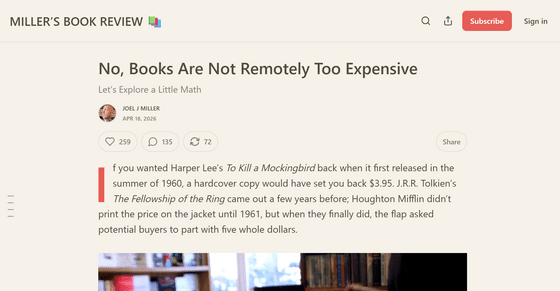
When the first volume of J.R.R. Tolkien's Lord of the Rings was published in the 1950s, there was no price listed on the book. It wasn't until 1961 that books began to include a price tag, and Lord of the Rings was priced at $5 (approximately 800 yen).
If you were to try to buy the same book in 2026, more than 60 years later, it might cost between $20 (approximately 3,200 yen) and $30 (approximately 4,800 yen), or even more. Seeing this situation, some people are surprised and say, 'The price of the book is too high!'
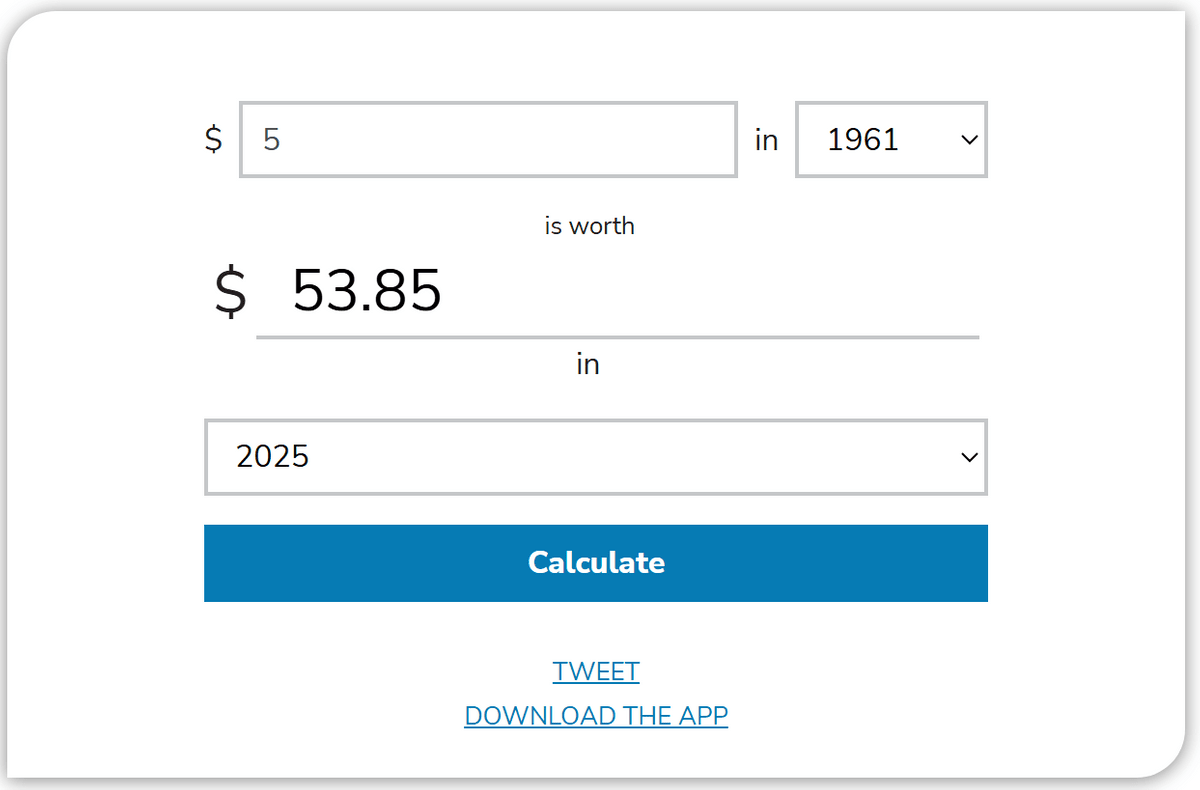
While the nominal price has certainly jumped several times over from $5, Miller says that 'inflation must be taken into account' when comparing prices. In fact, tools for calculating the effects of inflation estimate that $5 in 1961 would be equivalent to $53.85 (approximately 8,600 yen) in 2025, but the actual price of the book in 2025 is about half that.
Miller argued that while books are certainly affected by inflation, they are surprisingly resilient to it, and that books have actually become cheaper.
In Japan, the Publishing Science Research Institute of the Japan Publishers Association publishes
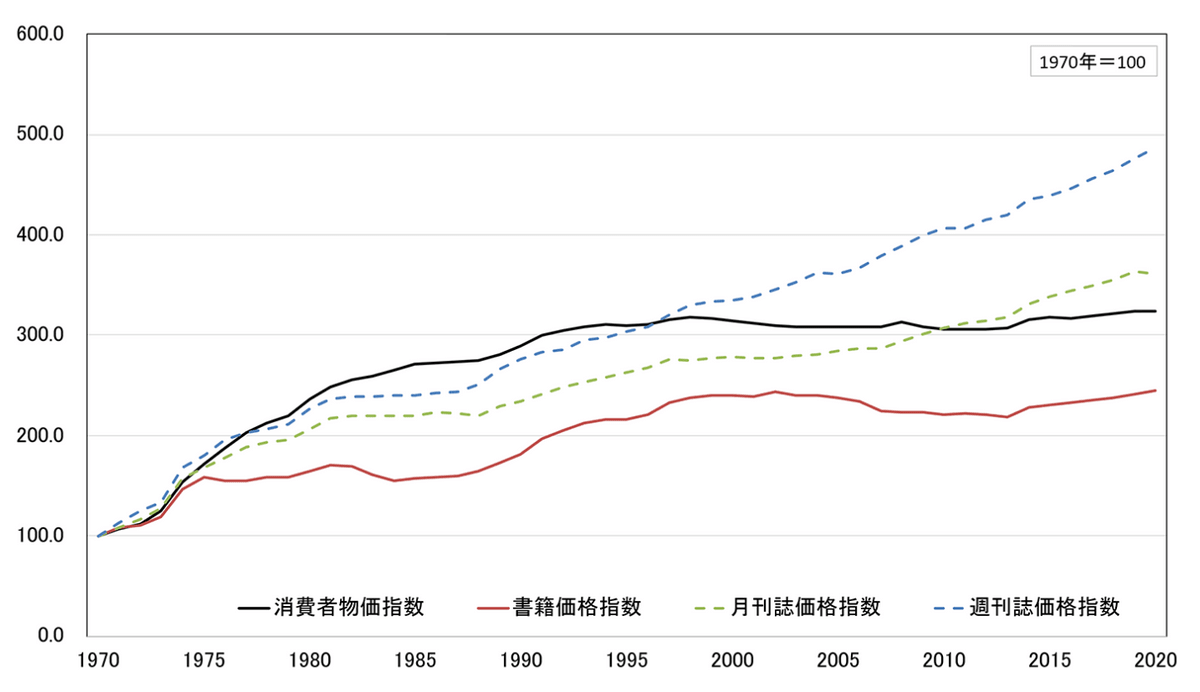
On the other hand, there is no doubt that book prices are rising, though not as much as the consumer price index. Miller lists the costs as follows: 'advance payments to authors,' 'price of paper,' 'printing and binding costs,' 'shipping and warehousing fees,' 'development, editing, copy editing, and proofreading,' 'cover design,' 'layout and typesetting,' 'index,' 'rights and permissions for cited materials,' 'sales commissions,' 'marketing costs,' and 'handling returns,' explaining that 'the cost of producing a book is enormous' and that this is the reason for the rising prices.
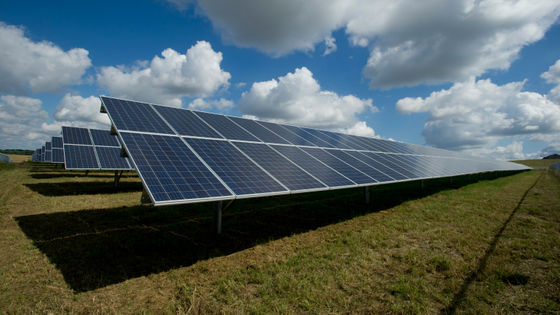
The article also mentions that the publishing industry is not making any profit despite rising book prices. For example, the renewable energy industry has an EBITDA ratio of 58.45% to sales, indicating that it is a very profitable industry. Other industries with favorable figures include the oil and gas industry at 43.21% and the semiconductor industry at 36.77%, but the publishing industry has an EBITDA ratio of only 13.18% to sales.
Miller stated that 'publishers have no more room to lower prices,' and emphasized the merits of books, saying they 'provide 10 to 20 hours of the most immersive entertainment humankind has ever created.' He reiterated that books are inexpensive, saying, 'While book prices have risen, they haven't risen as much as other prices. People have just become so accustomed to the low prices that they've forgotten how good a deal they used to be.'
Related Posts:






in Note, Posted by log1d_ts