Token Counter is a tool that allows you to compare how much token consumption has changed between Claude Opus 4.7 and Claude Opus 4.6.
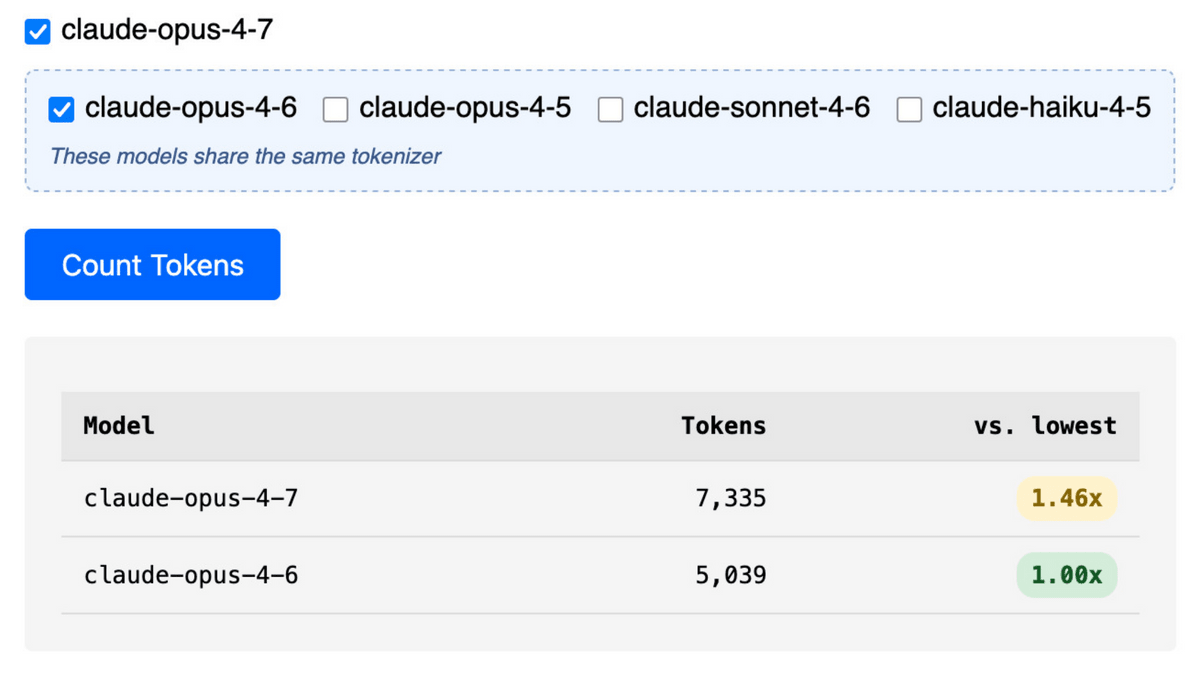
Simon Willison, a software engineer known for developing the Python web framework 'Django,' has released 'Token Counter,' a tool that displays how many tokens a Claude series AI model consumes.
Token Counter
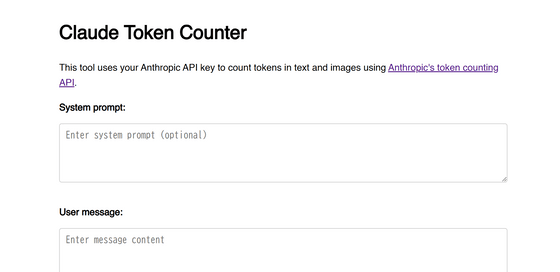
Claude Token Counter, now with model comparisons
https://simonwillison.net/2026/Apr/20/claude-token-counts/
Input to the AI model is done by breaking down human-written prompts into units called 'tokens.' A 'tokenizer' is a program that converts text and image data into tokens, and Claude Opus 4.7 uses a different tokenizer than Claude Opus 4.6 and earlier versions.
It has been revealed that the tokenizer in Claude Opus 4.7 produces a larger number of tokens after conversion compared to previous tokenizers. Since API usage-based billing is per token, the cost will increase even for the same prompt. Furthermore, usage limits and context window limits are also per token, so the increase in token size poses a significant disadvantage to users.
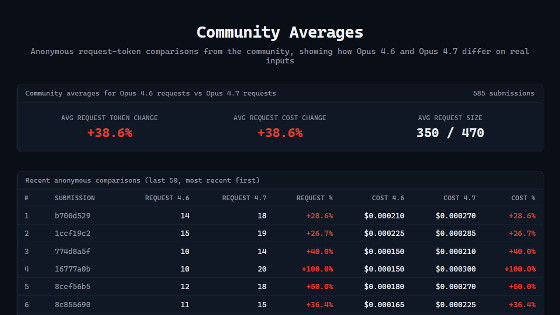
Websites already exist that analyze the differences in token consumption, and it has been revealed that token consumption in Claude Opus 4.7 increases by an average of approximately 40% compared to Claude Opus 4.6.
A website has emerged that visualizes how much token consumption has increased with Claude Opus 4.7, showing examples where the same input consumes twice as much as in 4.6 - GIGAZINE
Mr. Wilson has been developing tools to check the token consumption of AI models in the Claude series, and now Claude Opus 4.7 has been added as an option. To use Mr. Wilson's tool, you will need to prepare your own Claude API key, but Mr. Wilson has reported the results of his own testing on his blog .
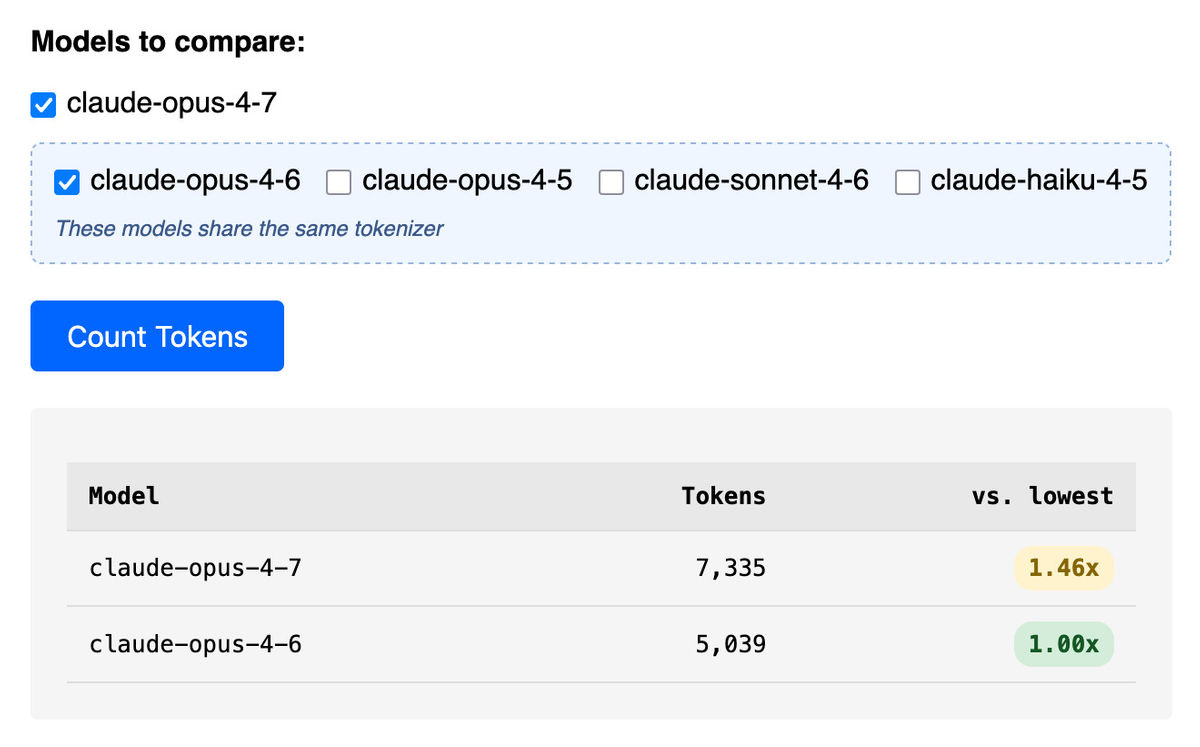
The following is the result of entering what Mr. Wilson believes to be the system prompt for Claude Opus 4.7 . Compared to Claude Opus 4.6, Claude Opus 4.7 increased the token amount by 46%.
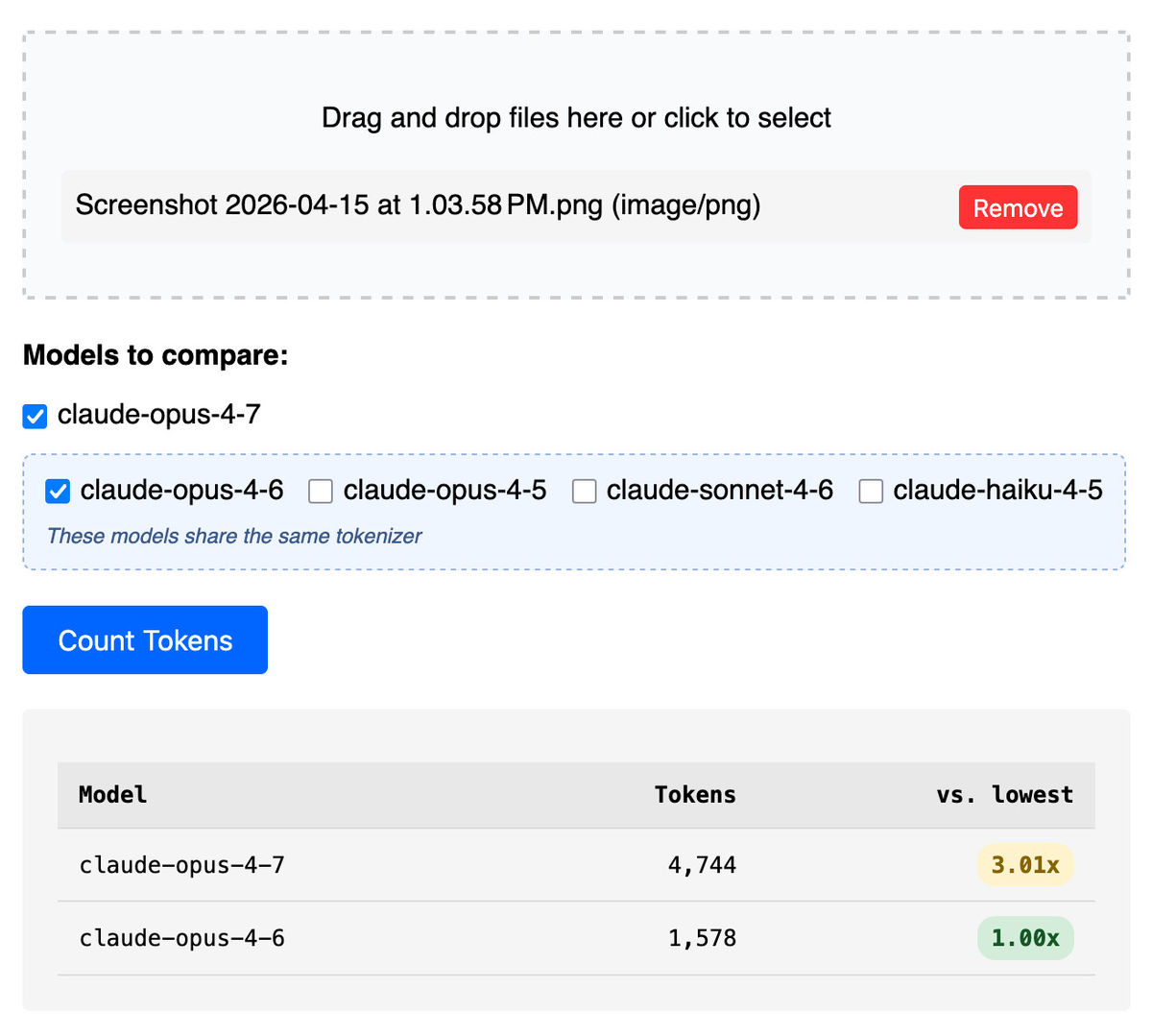
Mr. Wilson's tool also allows you to input images. Below is a screenshot of Mr. Wilson tokenizing a large image of 3456x2234 pixels. The number of tokens produced by Claude Opus 4.7 is more than three times that of Claude Opus 4.6. However, this is 'due to Claude Opus 4.7's support for high-resolution images.' For a smaller image of 682x318 pixels, Claude Opus 4.6 produced 310 tokens, and Claude Opus 4.7 produced 314 tokens, resulting in almost the same number of tokens.
On Hacker News, a news-sharing site for engineers, solutions such as 'only assigning difficult problems that justify the high usage fee to Claude, and using inexpensive, locally running AI for everyday tasks' are being discussed.
Related Posts:




in AI, Posted by log1d_ts