Does closing your eyes make it easier to hear sounds?

Many people close their eyes to block out visual information and concentrate on hearing when they want to hear a faint sound. A research team at Shanghai Jiao Tong University in China conducted an experiment to see if closing your eyes improves your ability to hear sounds in noisy environments, and the results were surprising.
Visual engagement modulates cortical criticality and auditory target detection thresholds in noisy soundscapes | The Journal of the Acoustical Society of America | AIP Publishing
Closing Your Eyes Might Not Help You Hear Better After All - AIP Publishing LLC
https://publishing.aip.org/publications/latest-content/closing-your-eyes-might-not-help-you-hear-better-after-all/
Does Closing Your Eyes Help You Hear? A Surprising Study Has The Answer : ScienceAlert
https://www.sciencealert.com/does-closing-your-eyes-help-you-hear-a-surprising-study-has-the-answer
Since the brain can only process a limited amount of information at once, the idea that 'closing your eyes and blocking out visual information increases the brain's resources allocated to processing auditory information, thereby improving your ability to hear sounds' seems logical. However, it was unclear whether closing your eyes is actually beneficial when trying to hear sounds in a noisy environment.
The research team then had 25 subjects sit in chairs and conduct an experiment in which they were asked to identify one of five sounds— 'the splash of water from a canoe paddle,' 'the sound of drums,' 'the chirping of a skylark ,' 'the sound of a train running,' and 'the sound of keyboard keys being typed'—while a 70 dB (decibels) background noise was played.
The experiment was conducted under four conditions: 'eyes closed,' 'eyes open and staring at a blank screen,' 'eyes open and staring at an image related to the target sound,' and 'eyes open and staring at a video related to the target sound.' In the latter two conditions, for example, if the target sound was 'the splash of water from a canoe paddle,' the subjects tried to listen to the sound while staring at related images or videos as follows:
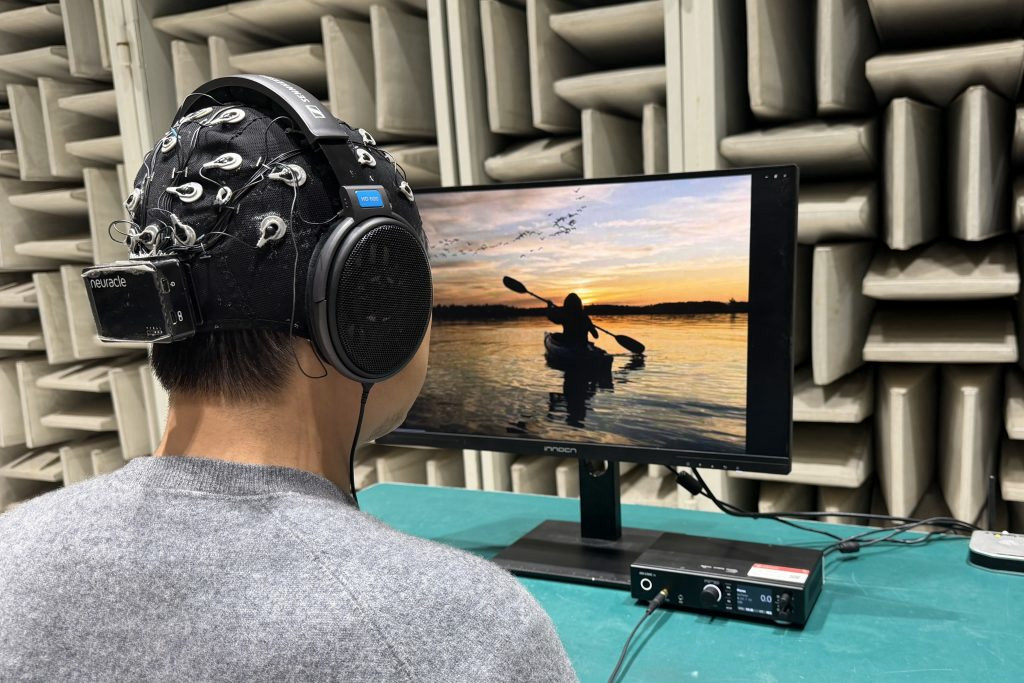
The background noise was fixed at 70 dB, but participants were able to increase or decrease the volume of the target sound and reported the 'volume of the target sound that was barely audible amidst the background noise.' The research team used 'looking at a blank screen with eyes open' as a baseline to determine how loudly participants could distinguish the target sound.
The experiment revealed that, on average, subjects needed a sound 1.32 dB louder than the baseline level when staring at a blank screen to detect the target sound with their eyes closed. On the other hand, when looking at an image related to the sound, the required volume was 1.6 dB lower than the baseline level, and when looking at a video related to the sound, the required volume was as much as 2.98 dB lower.
Yu Huang, a researcher at Shanghai Jiao Tong University, stated, 'Contrary to popular belief, we found that closing your eyes actually reduces your ability to perceive these sounds. Conversely, viewing dynamic images that correspond to sounds significantly improves auditory sensitivity.'
Next, the research team had the subjects wear electroencephalographs and repeated the same experiment while monitoring their brain activity. They found that when the subjects closed their eyes, background noise and soft sounds were filtered out more actively, resulting in them being unable to hear not only background noise but also the target sound.
Huang explains, 'In noisy environments, the brain needs to actively separate signals from background noise. We found that the internal focus induced by closing your eyes is actually counterproductive in this situation, leading to excessive filtering. Visual stimuli, on the other hand, help connect the auditory system to the outside world.'
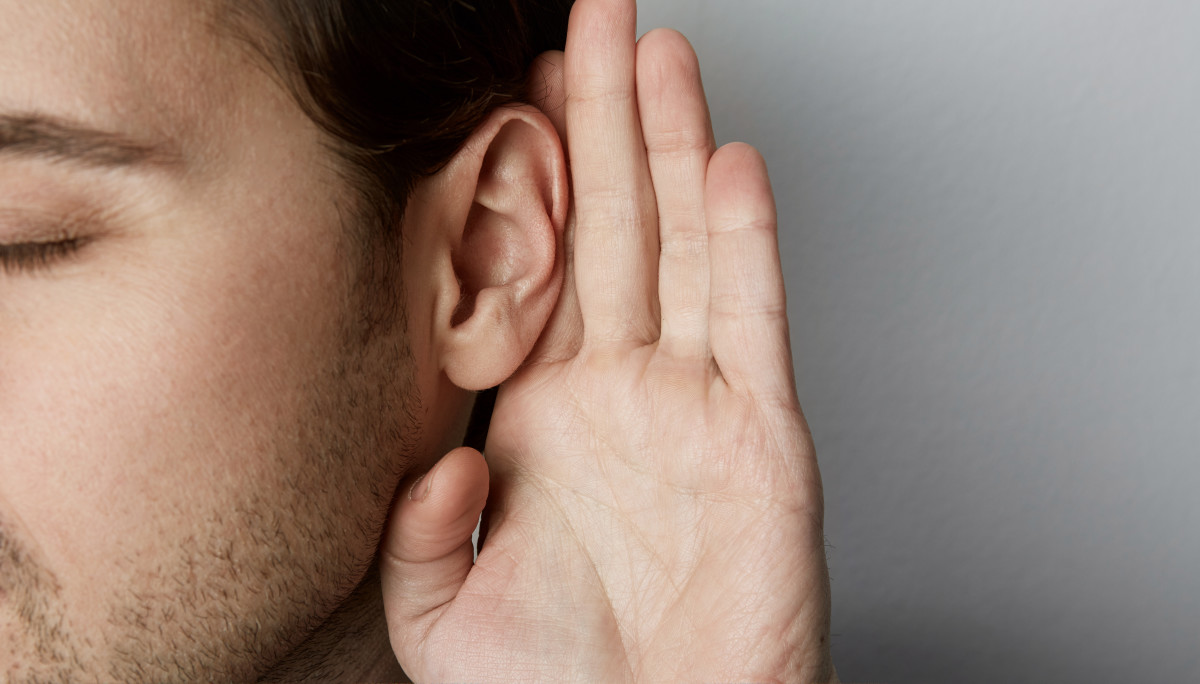
This study specifically investigated the ability to hear sounds in noisy environments. Previous research has shown that in quiet environments, closing your eyes improves hearing. However, since noisy environments are common in modern society, it may be more common to hear sounds with your eyes open.
The research team plans to study further questions such as, 'What happens if you show images or videos of birds when you want to hear the sound of drums?' Huang stated, 'Does the boost in auditory ability simply occur by keeping your eyes open? Or does the brain seek a perfect match between visual and auditory information? Understanding this difference will allow us to distinguish between the specific benefits of integrating multiple senses and the general effects of attention.'
Related Posts:






in Science, Posted by log1h_ik