Your brain may be working more actively when you blink less

Blinking is an involuntary action, like breathing, and is generally thought to be related to vision. However, an experiment examining the number of blinks while listening to voices in a noisy environment found that blinking decreased as the noise increased, even though the visual environment remained unchanged.
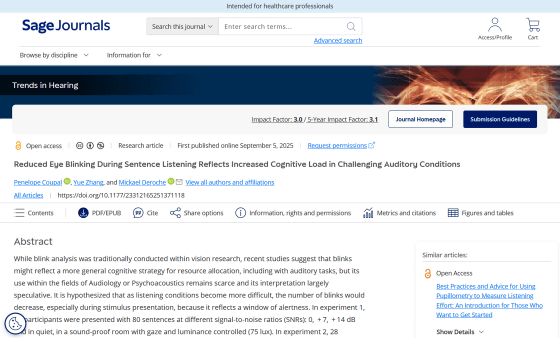
Reduced Eye Blinking During Sentence Listening Reflects Increased Cognitive Load in Challenging Auditory Conditions - Penelope Coupal, Yue Zhang, Mickael Deroche, 2025
Blinking less may mean brain is working harder, study shows
https://medicalxpress.com/news/2025-12-brain-harder.html
Research on blinking has long been conducted as part of visual research, but in recent years it has been suggested that blinking may also be related to cognitive functions such as hearing. Therefore, a research team from Concordia University in Canada conducted an experiment to examine the relationship between auditory tasks and the number of blinks.
'We wanted to know whether blinking is influenced by environmental factors and how it relates to executive functions,' said lead author Penelope Coupal. 'For example, is it possible to strategically time your blinks to avoid missing what's being said?'

The research team recruited approximately 50 native English or French speakers and had them sit in a soundproof room listening to audio. They were asked to focus on a cross displayed on a screen and listen to audio played through headphones while the background noise level was varied. All audio was spoken in the subjects' native language.
The results of the experiment showed that the subjects blinked less frequently while listening to audio compared to before and after. The number of blinks also decreased as the noise became louder, suggesting that the more difficult the auditory task, the more suppressed blinking becomes.
The researchers also performed the same experiment with different lighting conditions in the room, but found no change in blinking patterns, suggesting that it is the level of cognitive demand, rather than the amount of light reaching the eyes, that determines blink rate.

The rate at which participants blinked during the task varied widely, with some blinking just 10 times per minute and others blinking as many as 70 times per minute, but the pattern of increase and decrease in blinking rate remained consistent across all participants.
'We don't just blink randomly,' Coupal said. 'In fact, when important information is presented, we systematically blink less frequently.'
Related Posts:








in Science, Posted by log1h_ik