The SynthID watermark embedded in content generated by Gemini can be removed.

The 'reverse-SynthID' project, which conducts research on watermarks, has demonstrated that it is possible to neutralize (remove) the digital watermarks embedded in images and text generated by Google's AI, Gemini, that indicate that they are AI-generated.
reverse-SynthID - Analyze and remove Google's AI watermark with precision.
GitHub - aloshdenny/reverse-SynthID: reverse engineering Gemini's SynthID detection · GitHub
https://github.com/aloshdenny/reverse-SynthID
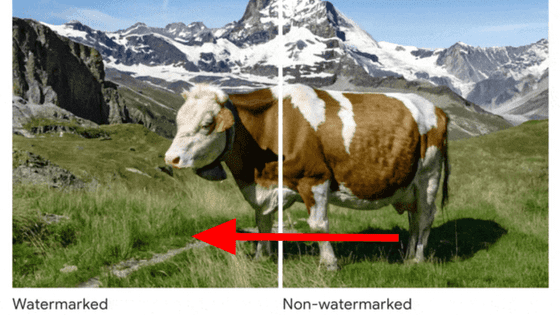
SynthID is a mechanism that embeds a digital watermark, which is unidentifiable to humans, into content generated by Gemini, making it difficult to use for malicious purposes.
Google announces 'SynthID,' a tool that adds digital watermarks to images generated by its image generation AI to prevent the spread of fakes - GIGAZINE
Initially, it only supported images, but in May 2024, it also added support for text and video.

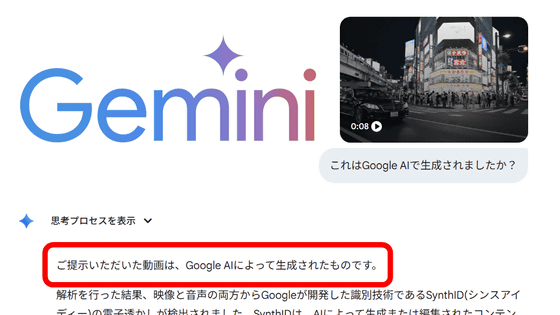
A verification portal for identification, SynthID Detector, has also been created.
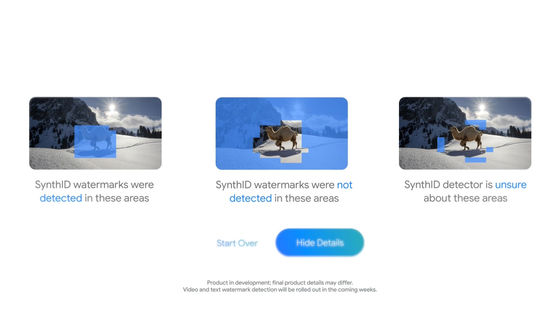
In their 'reverse-SynthID' project, Arrosh Denny and his colleagues, who are researching AI-based digital watermarking, identified through signal processing and spectral analysis that SynthID watermarks have a unique carrier frequency structure based on the image resolution, without accessing Google's encoders or decoders. They also found that the frequency patterns of the watermarks maintain consistency across images generated by the same Gemini model.
As deliverables, they have developed a detector that can detect watermarks with 90% accuracy, and a method called 'multi-resolution spectral bypass' that neutralizes SynthID watermarks at any image resolution. Using multi-resolution spectral bypass, the phase regularity of the information embedded as SynthID watermarks can be reduced by 91%, making it less likely for images to be identified as 'AI-generated images with watermarks.'
Regarding this method, which effectively 'removes watermarks,' Denny cautions, 'The project is limited to research and educational purposes. The tools are intended for three purposes: research on the robustness of watermarks, security analysis regarding the identification of AI-generated content, and understanding spread spectrum coding techniques. Please do not use them to falsely represent AI-generated content as human-generated.'
Related Posts: