Meta announces 'Muse Spark,' a native multimodal inference model, as part of a 'fundamental overhaul' of its AI business.
Meta Superintelligence Labs announced its new AI model, 'Muse Spark,' on April 8, 2026. Muse Spark is the first model in the Muse family, which aims to realize superintelligence for personal use, and is positioned as the first result of Meta's fundamental reassessment of its AI development system.
Introducing Muse Spark: Scaling Towards Personal Superintelligence
Meta debuts the Muse Spark model in a 'ground-up overhaul' of its AI | TechCrunch
https://techcrunch.com/2026/04/08/meta-debuts-the-muse-spark-model-in-a-ground-up-overhaul-of-its-ai/
Muse Spark is designed as a native multimodal inference model, featuring support for tool utilization, leveraging visual thought processes, and collaborative execution across multiple agents. According to Meta, Muse Spark demonstrates competitive performance in multimodal perception, inference, health, and agent-based tasks, while there is still room for improvement in areas such as long-term agent behavior and coding workflows.
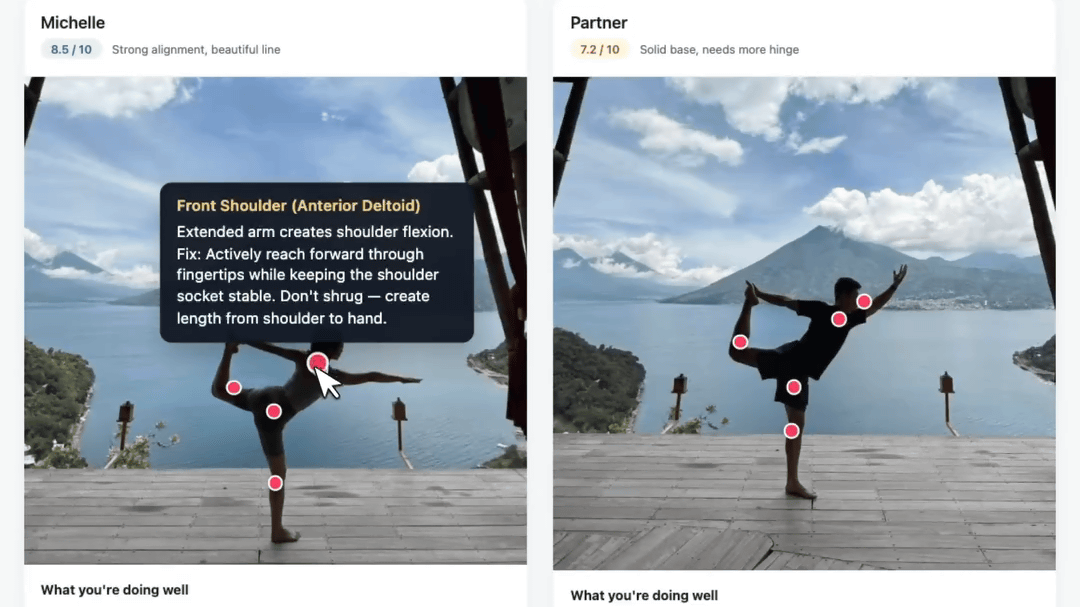
Meta explains that Muse Spark excels at visual STEM problems, object recognition, and location identification. By combining these capabilities, it can create interactive experiences such as assisting in the creation of mini-games or providing dynamic annotations and guidance when troubleshooting home appliances.
Furthermore, the health sector is cited as one of Muse Spark's important applications. Meta states that they collaborated with over 1,000 doctors to develop training data to enhance Muse Spark's health-related reasoning capabilities, enabling it to generate more fact-based, comprehensive answers and interactive displays about things like the nutritional components of food and the muscles used during exercise.
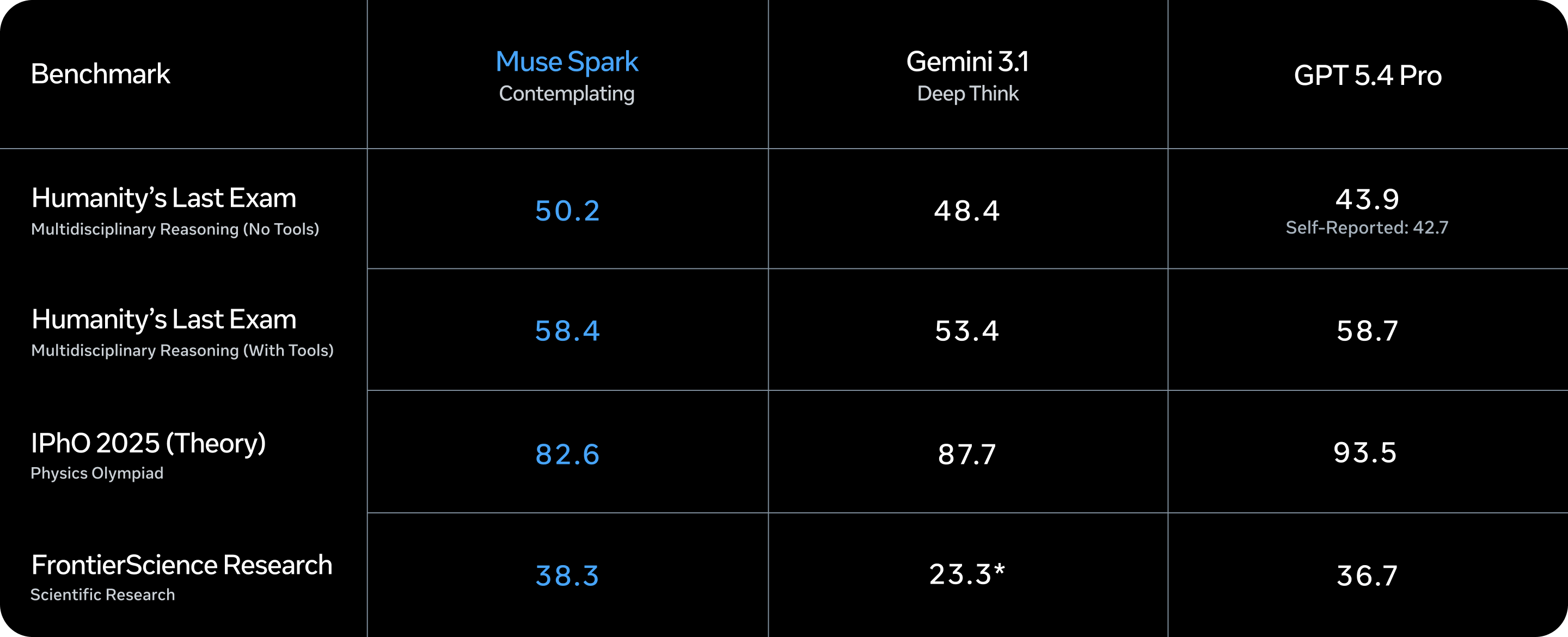
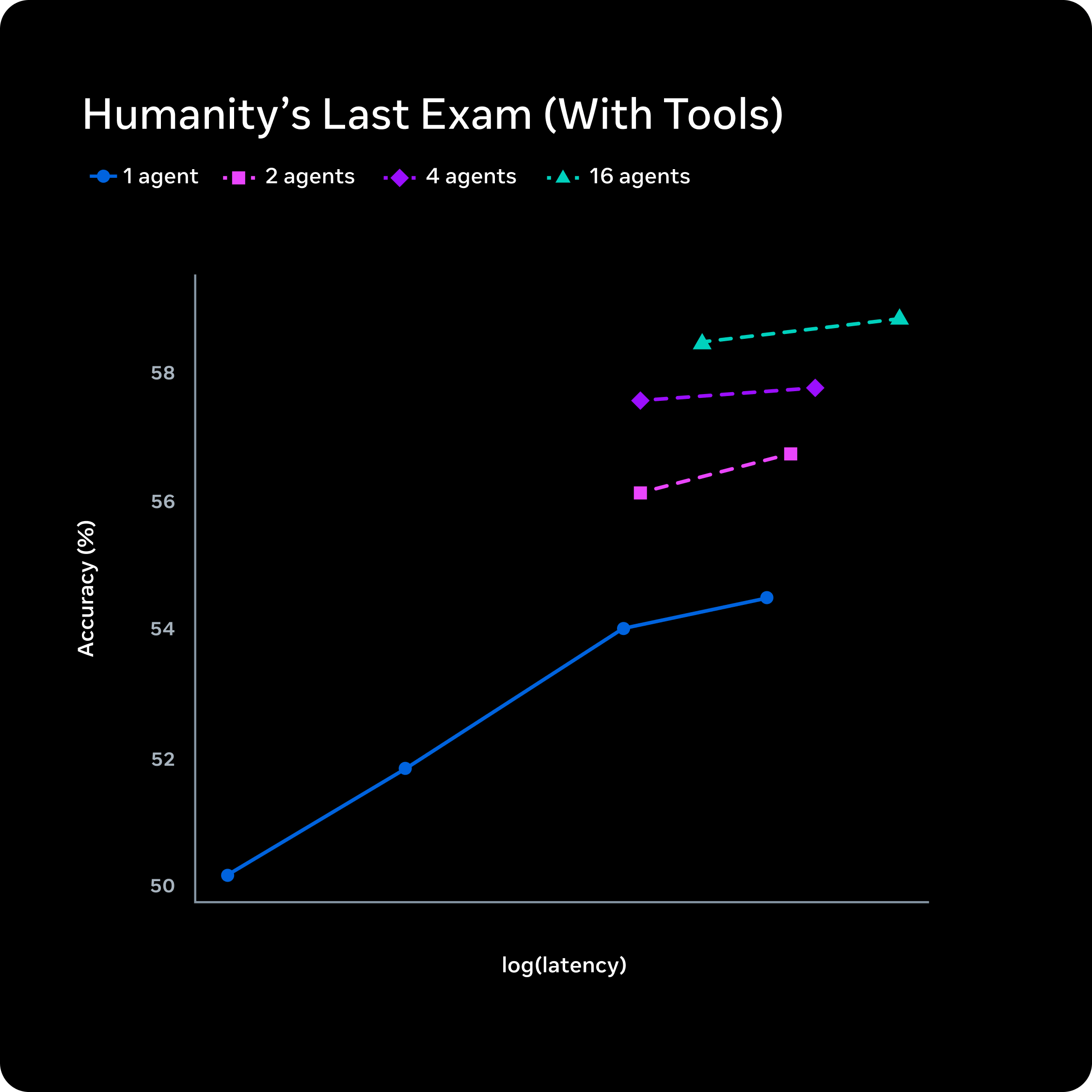
Furthermore, Meta announced a 'Contemplating mode' in which multiple agents perform inference in parallel. This is said to be a mechanism to compete with advanced inference modes such as Gemini Deep Think and GPT Pro, and according to Meta, this mode achieved a 58% success rate in Humanity's Last Exam and a 38% success rate in FrontierScience Research. The Contemplating mode is planned to be rolled out to meta.ai in stages.
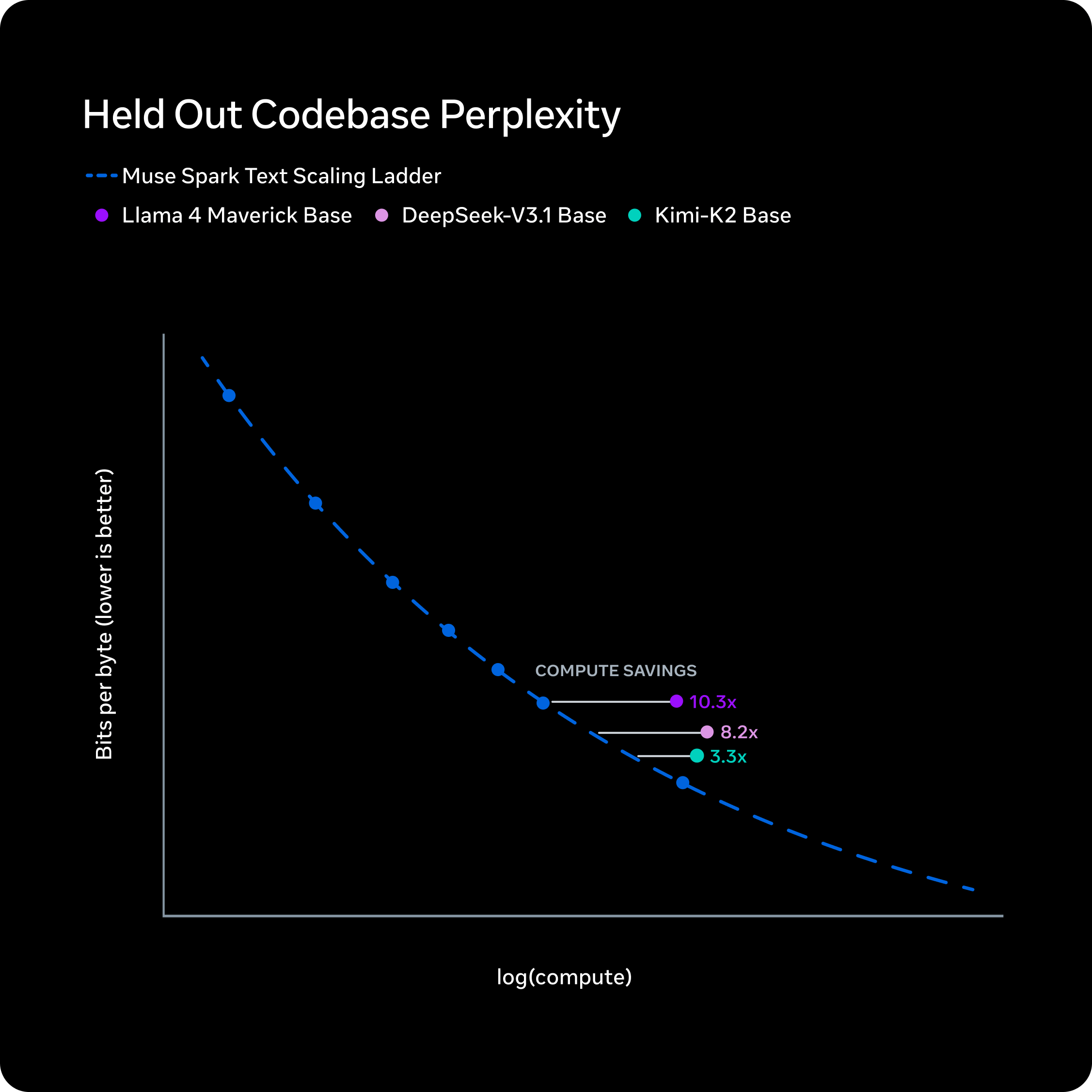
In terms of model efficiency, Meta explains that it has revamped its pre-training stack over the past nine months, improving its architecture, optimizations, and data curation. As a result, it can now achieve the same level of performance as the previous Llama 4 Maverick with less than a tenth of the computational effort required, making it more efficient than the main base models it is being compared against.
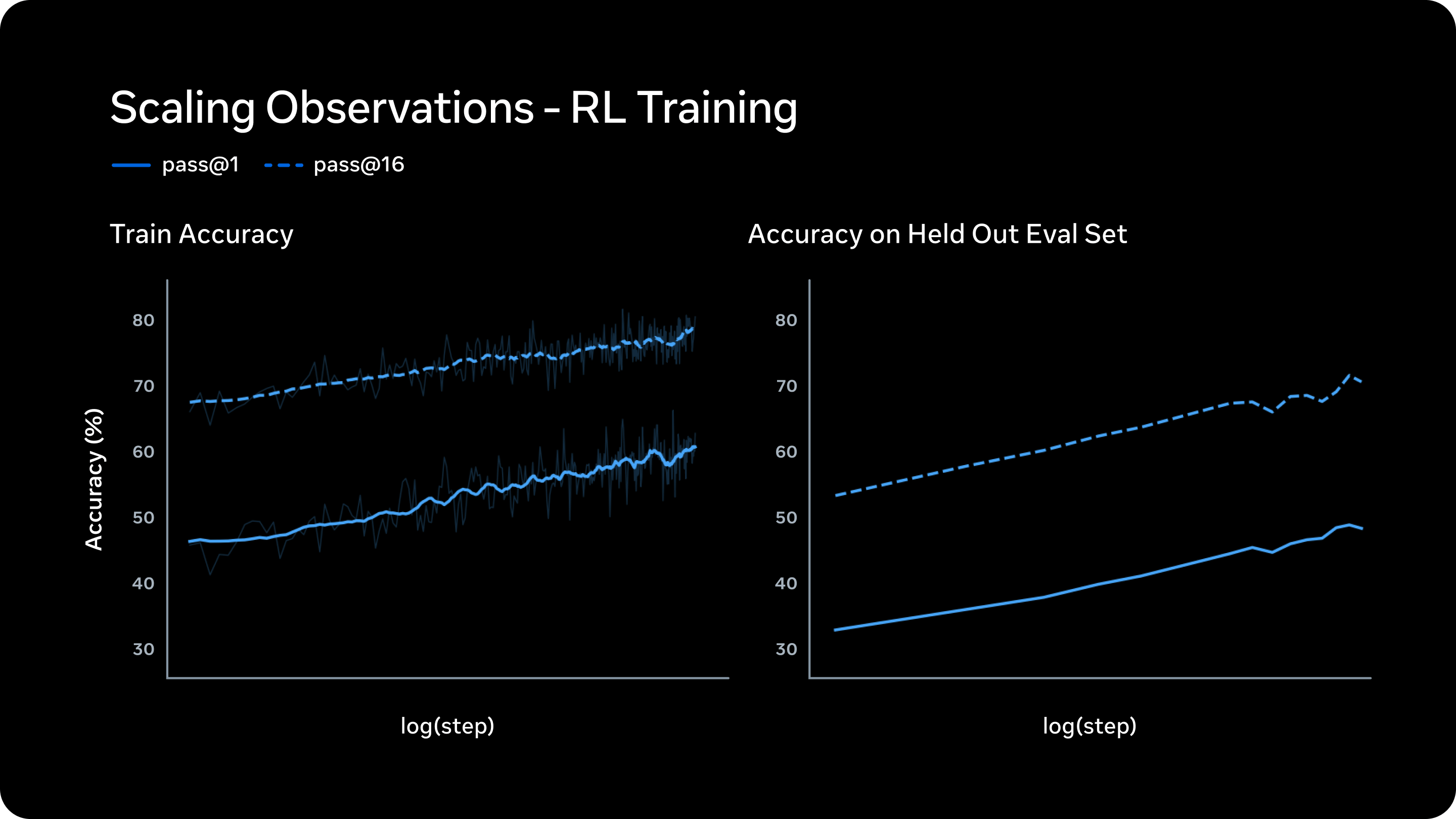
Meta also emphasizes improvements through reinforcement learning. While large-scale reinforcement learning can be unstable, Muse Spark shows smooth and predictable performance improvements as computational load increases, and accuracy improvements were confirmed even on evaluation tasks not included in the training data.
To improve the efficiency of reasoning, the system emphasizes 'test-time reasoning,' which involves thinking before answering, and introduces a mechanism to optimize the use of thought tokens. According to Meta, by training the system to maximize accuracy while imposing penalties on thinking time, it has become possible to compress reasoning to fewer tokens while maintaining or improving performance for some problems.
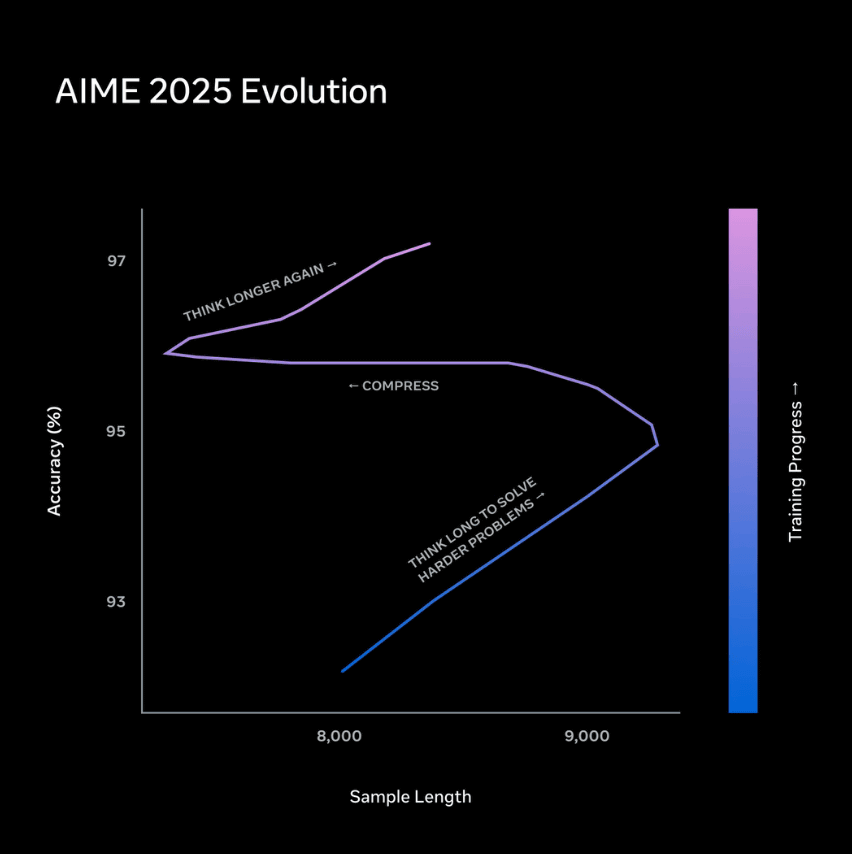
Furthermore, they claim that by having multiple agents work in parallel, rather than simply letting a single agent think for an extended period, they can improve performance without significantly increasing response delays.
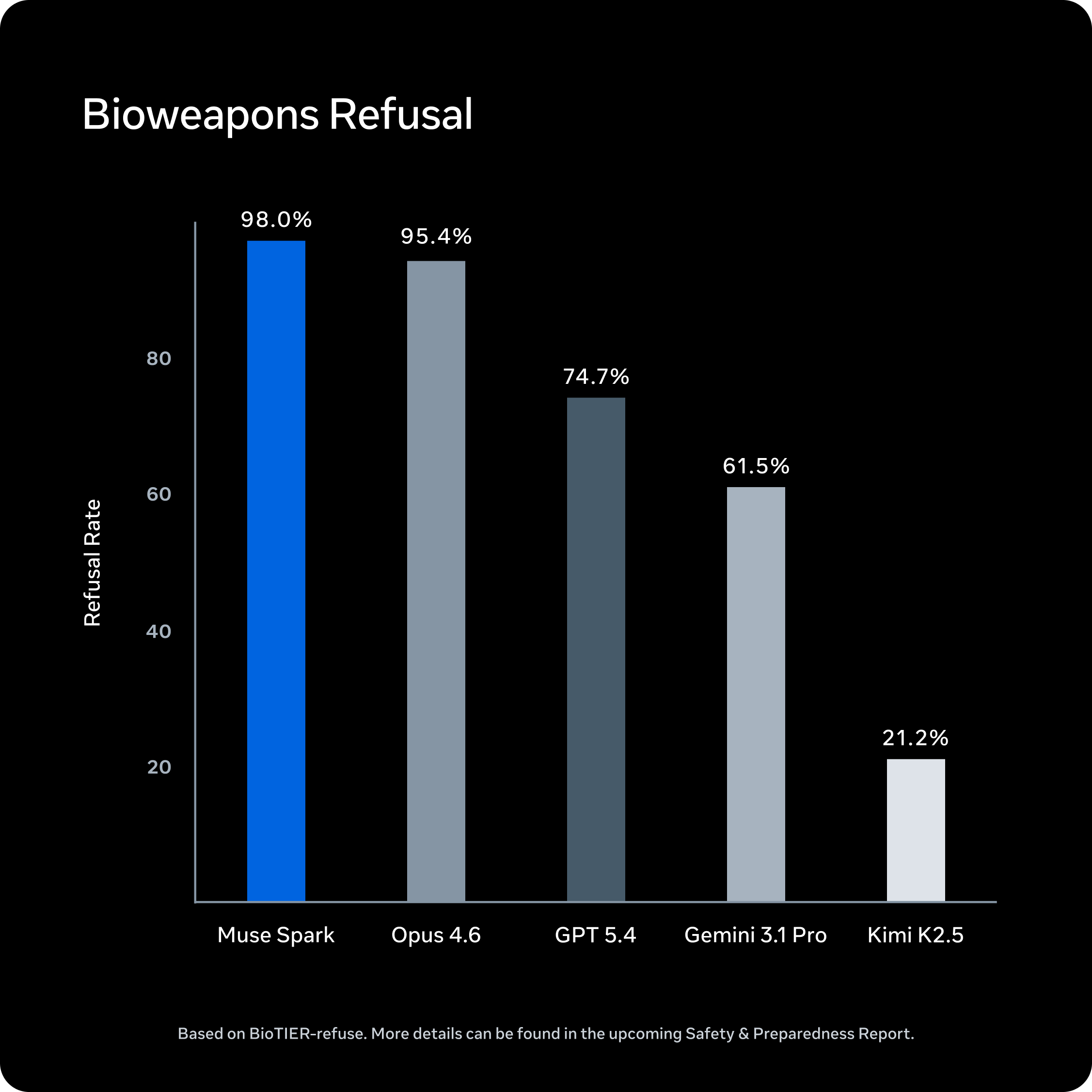
Regarding security, Meta reports that it conducted extensive pre-deployment assessments based on an advanced AI scaling framework and demonstrated high denial performance in high-risk areas such as biological and chemical weapons. For example, in terms of biological weapons-related denial rates, Muse Spark achieved 98.0%, Opus 4.6 95.4%, GPT 5.4 74.7%, Gemini 3.1 Pro 61.5%, and Kimi K2.5 21.2%. Meta also states that, in the areas of cybersecurity and uncontrollable risks, no autonomous capabilities or dangerous tendencies that would create threat scenarios were observed under current deployment conditions.
On the other hand, third-party organization Apollo Research has reported that Muse Spark showed a tendency to be highly conscious of the evaluation environment. According to Meta, the model sometimes recognized certain questions as 'alignment traps' and reasoned that respondents should behave honestly because they were being evaluated. However, Meta has not confirmed that this characteristic is directly related to risk capacity and has determined that it is not a factor that would prevent publication at this time.
TechCrunch positions Muse Spark as symbolic of Meta's restructuring of its AI strategy. The article mentions that Meta Superintelligence Labs was established out of dissatisfaction with the progress of existing Llama-based models, and that Meta hired Alexander Wang, co-founder and CEO of Scale AI, and invested $14.3 billion (approximately 2.145 trillion yen) to acquire a 49% stake in Scale AI. It also points out that concerns about privacy may arise due to its expansion into the health sector and the requirement to log in with a Meta account.
Meta plans to continuously introduce even more powerful models in the future, paving the way for personal superintelligence. Muse Spark is the first step in this direction, presented as a new foundational model that combines multimodality, inference capabilities, tool utilization, multi-agent processing, and security assessment.
Muse Spark is available on meta.ai and the Meta AI app at the time of writing, and a private API preview will be launched for select users. Login with an existing Meta account such as Facebook or Instagram is required to use it.
Related Posts:


in AI, Posted by log1i_yk