Intellectual hobbies like reading, writing, and language learning may significantly reduce dementia risk

Dementia, which causes declines in memory and judgment, significantly reduces quality of life and places a great burden on families and caregivers, making dementia prevention increasingly important as society ages. New research suggests that activities such as reading, writing, and language learning may help delay or prevent dementia.
Associations of Lifetime Cognitive Enrichment With Incident Alzheimer Disease Dementia, Cognitive Aging, and Cognitive Resilience | Neurology
American Academy of Neurology: Neurology Resources | AAN
https://www.aan.com/PressRoom/Home/PressRelease/5311
Simple Lifelong Habits Can Cut Your Alzheimer's Risk by 38%, Study Finds : ScienceAlert
https://www.sciencealert.com/simple-lifelong-habits-can-cut-your-alzheimers-risk-by-38-study-finds
While it's said that continuing to engage in intellectual activities even in old age can help prevent dementia, there hasn't been much comprehensive research into the impact of lifelong intellectual activity on later cognitive ability. Therefore, a research team at Rush University Medical Center in Illinois, USA, investigated the relationship between lifelong 'cognitive enrichment' and dementia in subjects.
The study's subjects were 1,939 elderly people who were free of dementia at the time of the study's start, with an average age of approximately 80. The subjects answered questionnaires about activities such as reading, writing, learning foreign languages, visiting museums and libraries, and using dictionaries at each stage: up to age 18, at age 40, and at the start of the study. From these, a cognitive enrichment score was calculated.
Over an average of eight years of follow-up, 551 participants developed Alzheimer's disease and 719 developed mild cognitive impairment. The researchers used this data to examine the relationship between cognitive enrichment scores and dementia.

The analysis revealed that 21% of participants with the highest cognitive richness scores developed Alzheimer's disease, while 34% of participants with the lowest cognitive richness scores developed Alzheimer's disease.
The average age of those with the highest cognitive richness scores was 94, while the average age of those with the lowest scores was only 88. Additionally, the results also showed that those with the highest cognitive richness scores were about 5 years later on average at developing dementia and about 7 years later on average at developing mild cognitive impairment compared to those with the lowest scores.
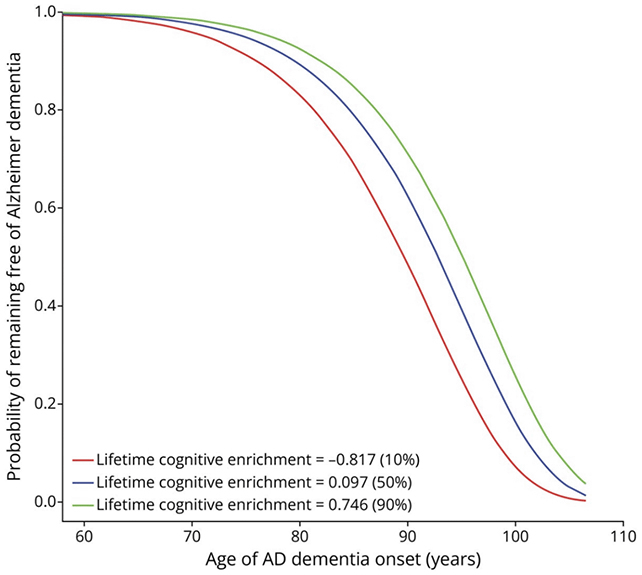
The graph below shows the percentage of people who will not develop Alzheimer's disease, with age shown on the horizontal axis. Comparing the top 10% of subjects with the highest cognitive richness scores (green), those in the middle (blue), and those in the bottom 10% (red), we can see that the higher the cognitive richness score, the less likely they are to develop dementia.
When the research team analyzed brain tissue from participants who died during the study, they found that the brains of people who scored higher on cognitive enrichment in childhood had a certain level of protection against the buildup of proteins associated with Alzheimer's disease.
Furthermore, when they examined whether factors related to socioeconomic status (SES) influenced the rate of cognitive decline, they found that cognitive affluence scores acted independently of SES. 'Our findings suggest that cognitive affluence is not simply a proxy for SES,' the research team wrote in their paper.
While this study only shows the association between cognitive enrichment and dementia, it does not prove a causal relationship, such as 'reading for many years reduces the likelihood of developing dementia.' Nevertheless, it provides new evidence that there is a strong relationship between staying mentally active and reducing the risk of dementia.
'Our findings are promising and suggest that continued engagement in diverse, intellectually stimulating activities throughout life may make a difference in cognitive function,' said lead author Andrea Zammit , assistant professor of neuroscience at Rush University. 'Public investments in expanding access to enriched environments, such as libraries and early education programs that encourage lifelong learning, may contribute to reducing dementia rates.'
Related Posts:








in Science, Posted by log1h_ik