What are the characteristics of the brains of 'superagers' who have excellent memory even when they are older?
'
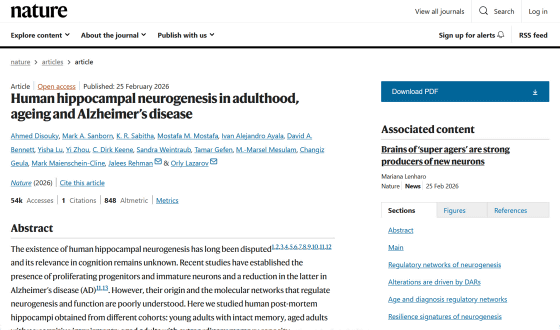
Human hippocampal neurogenesis in adulthood, aging and Alzheimer's disease | Nature
https://www.nature.com/articles/s41586-026-10169-4
As SuperAgers age, they make at least twice as many new neurons as their peers - Northwestern Now
https://news.northwestern.edu/stories/2026/02/as-superagers-age-they-make-at-least-twice-as-many-new-neurons-as-their-peers
Superagers' brains have a 'resilience signature,' and it's all about neuron growth | UIC today
https://today.uic.edu/superagers-brains-have-a-resilience-signature-and-its-all-about-neuron-growth/
Superagers' 'Secret Ingredient' May Be The Growth of New Brain Cells : ScienceAlert
https://www.sciencealert.com/superagers-secret-ingredient-may-be-the-growth-of-new-brain-cells
It has long been a topic of debate whether neurogenesis , the birth of new neurons in the hippocampus , the human memory center, continues after adulthood.
A 1998 paper suggested that neurogenesis may occur in the adult hippocampus, but a 2018 paper reported that neurogenesis gradually ceases after puberty, and hippocampal neurogenesis remains a hot topic .
Now, a team of researchers from the University of Illinois at Chicago, Northwestern University, and the University of Washington analyzed postmortem hippocampal tissue samples collected from various groups to see if they could identify biological markers of neurogenesis in the hippocampus and whether there were differences in the degree of neurogenesis between groups.
Brain samples were collected from five groups: eight healthy young adults aged 20-40, eight healthy older adults aged 60-93, six Super Agers aged 86-100, six individuals aged 80-94 who showed signs of preclinical Alzheimer's disease, and ten older adults aged 70-93 who had been diagnosed with Alzheimer's disease.
To clarify the neurogenesis pathway in the hippocampus of the adult brain, the research team first examined brain tissue from young adults. They then analyzed 355,997
The results not only showed that neurogenesis was occurring in the adult hippocampus, but also that the SuperAger brains had 2 to 2.5 times more neurogenesis than healthy peers and Alzheimer's disease patients. Neurogenesis was reported to be minimal in patients in the preclinical stage of Alzheimer's disease and nearly halted in patients with Alzheimer's disease.
'SuperAgers had twice the neurogenesis of other healthy older adults,' said co-author Professor Orly Lazaroff of the University of Illinois at Chicago School of Medicine. 'Something in the brains of SuperAgers allows them to maintain their superior memory. I believe hippocampal neurogenesis is the secret, and the data backs it up.'
Genetic analysis of the cell nuclei also showed that the neurons of SuperAgers showed increased gene activity related to strengthening synaptic connections, improving plasticity, and expressing brain-derived neurotrophic factor, which is essential for the survival, growth, and maintenance of neurons.
'We've been saying for a while that the aging brains of Super Agers are biologically active, showing signs of adaptability and flexibility, but we didn't know why,' said co-author Tamar Geffen , a neuropsychologist at Northwestern University. 'Our findings provide biological evidence that the brains of Super Agers are more plastic, and this is a real discovery that suggests that neurogenesis of young neurons in the hippocampus is one factor.'
'This study also revealed that changes in two types of neurons, astrocytes and CA1 , are important factors that determine whether cognition and memory can be maintained during aging. Further research may lead to treatments that enhance neurogenesis and hippocampal resilience, as well as the identification of environmental and lifestyle factors that affect brain aging.'
'What's interesting about this study for the general public is that it shows that age-related brain decline is not fixed or inevitable,' said Ahmed Disowski , lead author of the paper and a doctoral student at the University of Illinois at Chicago. 'Understanding how some people naturally maintain neurogenesis may pave the way for strategies to preserve memory and cognitive function as more adults age.'
Related Posts:




in Free Member, Science, Posted by log1h_ik