What will 2025 be like for the open standard communication protocol 'Matrix'?
'Matrix,' one of the open standard communication protocols also used in
Matrix.org - The 2025 Matrix Holiday Special
https://matrix.org/blog/2025/12/24/matrix-holiday-special/
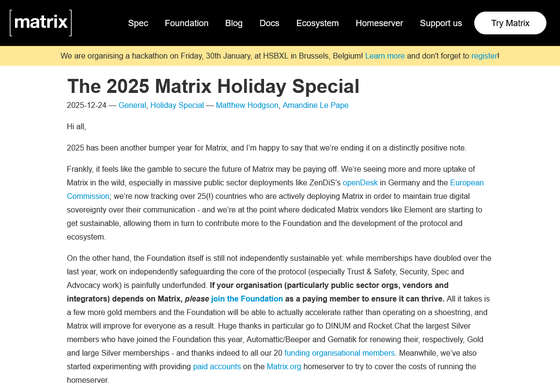
Matrix's Matthew Hodgson and Amandine Le Pape described 2025 as a 'year of maturity' for Matrix.
During the process of compiling the keynote speech for
GitHub - element-hq/synapse: Synapse: Matrix homeserver written in Python/Twisted + Rust
https://github.com/element-hq/synapse
Element , a Matrix-compatible chat app, has released the official AGPL Synapse distribution, ESS Community, which includes the Element Admin management interface. Based on the philosophy of ' FOSS provides features that empower end users, while Pro provides features that empower businesses,' Synapse Pro continues to add scalability and paid support for large-scale deployments.
Element Server Suite Community
https://element.io/server-suite/community

At the same time, the Conduit family of native Rust home servers continues to grow and accelerate, evolving into Continuwuity , Grapevine , and Tuwunel .
Matrix's core achievements include the successful large-scale migration to next-generation authentication via OpenID connect, as well as the implementation of the first and most important phase of Project Hydra in Room Version 12 , which improved state resolution and reduced state resets.
MatrixRTC has received significant improvements in the form of Sticky Events, which allows for simpler and more reliable signaling, and slots, which strengthen permission management. These improvements are expected to be officially adopted as a specification soon. There has also been significant progress in improving the metadata footprint that Matrix stores on its servers.
There were various operational issues with Matrix.org's home server, and there were many complaints about the speed of the migration to Matrix 2.0. However, the reason is that the Maintenance Management Case (MSC) is still being finalized, and some users are continuing to use the old version of the app without knowing about Element X.
Matrix.org - Element X
https://matrix.org/ecosystem/clients/element-x/
However, in reality, the Matrix experience has improved dramatically compared to a few years ago, with the number of cases where messages fail to be decrypted has decreased significantly unless the user loses their recovery key or deletes all devices.
However, there are certainly challenges remaining, starting with reducing Synapse resources. The Element team demonstrated a 100x reduction in Synapse database usage, but they are busy with Project Hydra and other robustness improvements and have not yet been able to achieve this.
Another concern is that the sliding synchronization performance of matrix-rust-sdk and Synapse has deteriorated since the initial implementation. This is likely due to simplifications to improve client-side maintainability and server-side changes. While synchronization performance is good, it has not yet reached the 'instant synchronization' that was achieved in the first beta.
Furthermore, there are still many issues with encryption, such as users still complaining that they are unable to decrypt their records because they have lost their recovery keys. As a solution, methods are being considered for storing the recovery key in a WebAuthn passkey or hardware token, or for deriving it from the ID provider side of OpenID connect to the client side.
Progress has been made on Phases 2 and 3 of Project Hydra, which will see Matrix move to MSC4243 -compliant public keys to remove directly identifiable personal information from its Matrix ID. This will address the final hurdle in Matrix's GDPR compliance and pave the way for the long-awaited account portability feature.
On the client side, we've finally reached a point where some of the supporting APIs are becoming bottlenecks, and there's a lot of work left to do to improve how external apps integrate with Matrix, whether that's via widgets or looking at developments in WebXDC and other initiatives.
While it's unclear which projects will be realized in 2026, much 'depends on how much funding is available,' Hodgson and Le Pape say. 'The implication is that if the foundation operates on a shoestring, more attractive projects will go unfunded, to everyone's detriment.'
Related Posts:







in Note, Web Service, Posted by logc_nt