Research shows that women's sexual desire is strongly affected by stress
Stress has various effects on human health and mental health, but the interaction between stress and sexual experience is not well understood. Research examining stress in daily life and sexual desire has shown that women's sexual desire may be particularly affected by stress.
Too stressed for sex? Associations between stress and sex in daily life - ScienceDirect
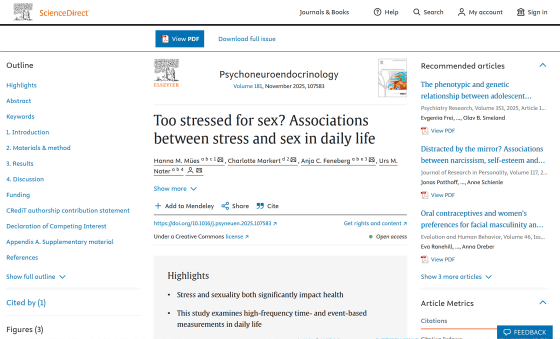
Women's sexual desire is more strongly affected by stress, new study suggests
https://www.psypost.org/womens-sexual-desire-is-more-strongly-affected-by-stress-new-study-suggests/
At first glance, stress and sexuality may seem unrelated, but the two are related areas that overlap with hormones, emotions, and cognition. Chronic stress increases cortisol levels in the body, which can inhibit the secretion of sex hormones such as testosterone and estrogen . This hormonal imbalance may lead to decreased libido and sexual function.
Stress can also decrease attention to one's surroundings and increase self-consciousness, making it difficult to relax and feeling less emotionally connected to one's partner. Psychological tension, particularly in interpersonal relationships, can lead to avoiding intimacy. On the other hand, some people may seek sexual activity as a way to cope with stress, seeking emotional release and a sense of security.
The study's lead author, Hannah Muhs, a postdoctoral researcher at the University of Vienna's Center for Public Health, conducted an experiment to examine the relationship between stress and sexual desire, sexual arousal, and sexual activity.
The research team recruited 63 healthy heterosexual men aged 19 to 32 in Vienna. Over a 14-day period, participants were asked to complete six daily assessments of subjective stress, sexual desire, and sexual arousal, as well as to provide saliva samples. They also completed an additional report within 15 minutes of engaging in sexual activity, including sex, masturbation, and petting.

Analysis of the data revealed that when participants reported high subjective stress, their levels of sexual desire and arousal also tended to decrease. This was true for both men and women, but the reverse correlation - increased sexual desire and arousal was associated with lower stress - was only significant in women.
The study also revealed gender differences in the biological stress response based on salivary cortisol levels: In women, elevated cortisol levels were significantly associated with decreased sexual desire, but no significant differences were observed in men.
Furthermore, no significant associations were found across time lags, so it was not possible to confirm that stress at a certain point during the day predicts sexual desire several hours later. However, sexual activity was significantly associated with a subsequent decrease in cortisol levels, suggesting that sexual activity has a biological stress-reducing effect in both men and women.
The research team concluded, 'The results of this study suggest that stress suppresses momentary sexual desire and sexual arousal. In light of the dual control model, stress may play a role in suppressing sexual activity.'
However, because this study only included young, healthy, heterosexual men in stable relationships, it cannot be directly generalized to other populations, and the results may differ if a more diverse demographic group were included.
Related Posts:







in Science, Posted by log1h_ik