What were the results of the 'one laptop per student' program after 10 years in 531 elementary schools?

In developing countries, efforts have been made to improve children's access to technology in order to provide them with a fulfilling education. One such initiative is the One Laptop per Child (OLPC) program, which provides one laptop to every child. Santiago Cueto and his colleagues at the Catholic University of Peru examined 10 years of data from the OLPC program in Peru and reported on it.
Laptops in the Long Run: Evidence from the One Laptop per Child Program in Rural Peru | NBER
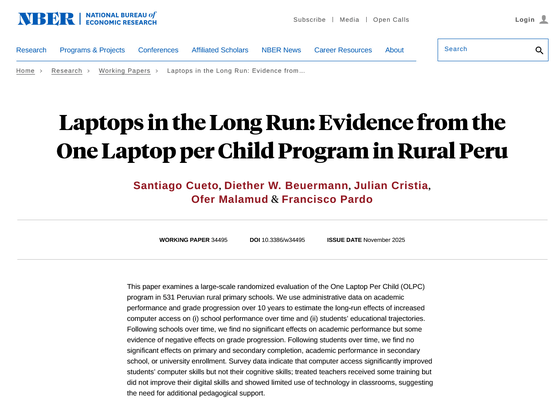
Laptops in the Long-Run: Evidence from the One Laptop per Child Program in Rural Peru
https://publications.iadb.org/en/laptops-long-run-evidence-one-laptop-child-program-rural-peru
As its name suggests, OLPC is a program aimed at providing one PC per student. In Peru, 531 elementary schools were randomly assigned to an intervention group and a control group. Teachers in the intervention group were expected to receive 40 hours of training on how to use computers and how to use them for educational purposes, and they were assigned laptops starting in 2009.
Since 2011, the number of PCs per student in the control group has increased to 0.4. However, due to the loss or breakdown of the PCs, the number of PCs per student in the intervention group has fallen to less than 1. However, there remains a significant difference in the degree of access to PCs between the two groups.
Cueto and a research team led by Ofer Malamud of the Inter-American Development Bank and Northwestern University examined the results of national achievement tests administered to second-graders between 2009 and 2016.
The study found that there was little evidence to suggest that the OLPC program improved children's academic performance , and in fact, data on progression rates even showed a negative impact . This suggests that providing PCs alone to children without sufficient support may have had a negative impact on their academic performance rather than contributing to it.

In addition, the impact on career paths was assessed using nationally standardized tests administered to second-, fourth-, and eighth-graders, tests administered by Cueto et al. to fifth- and sixth-graders, and longitudinal administrative data. The results showed that while there was a slight increase in the primary school completion rate (2.1%) and the university application rate (2.2%), no significant impact was observed.
The research team investigated why there was no effect despite the program being in place for 10 years. For example, the percentage of teachers in the intervention group who had received training was 35% higher than teachers in the control group, but no significant effect was observed in either group on digital skills using computers or the internet. Furthermore, while it was confirmed that children in the intervention group did indeed acquire digital skills using laptops, the effect on skills using desktop PCs was only 'marginally significant,' and there was no effect on internet-related skills. The research team speculates that the limited opportunities to use laptops for educational purposes at school and the small effects on intermediate outcomes other than digital skills may have contributed to the lack of a positive impact on academic performance.
The research team suggests the need for additional educational support.
In Japan, the GIGA School Initiative is being promoted to provide each student with a device and a high-speed communication network, and all elementary and junior high school students across the country already have at least one device. Details of the GIGA School Initiative and its achievements are summarized on the Ministry of Education, Culture, Sports, Science and Technology's website.
Promotion of the Informationization of Education and the GIGA School Initiative: Ministry of Education, Culture, Sports, Science and Technology
https://www.mext.go.jp/a_menu/shotou/zyouhou/index.htm
Related Posts:








in Education, Posted by logc_nt