Nationwide test to test elementary and junior high school students' internet skills to be implemented from 2013

by
The Ministry of Education, Culture, Sports, Science and Technology is preparing to conduct a test to measure the ability of elementary and junior high school students to use information and communication devices such as computers. The ministry has included the cost in its budget request for next year, and the test is scheduled to be conducted in fiscal 2013.
Internet literacy test for elementary and junior high school students...starting in 2013: Society: YOMIURI ONLINE (Yomiuri Shimbun)
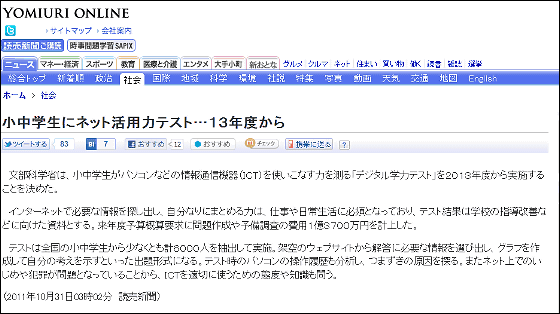
According to an article in the Yomiuri Shimbun, the Ministry of Education, Culture, Sports, Science and Technology has decided to implement a ' Digital Academic Proficiency Test ' to measure elementary and junior high school students' ability to use information and communication technology ( ICT ) such as computers, starting in fiscal 2013. The Ministry has earmarked 137 million yen in its budget request for next fiscal year for the cost of creating questions and conducting preliminary research.
The test will be administered to a minimum of 6,000 elementary and junior high school students nationwide. Questions will involve selecting the information needed to answer questions from a 'fictitious website,' creating graphs to demonstrate one's thinking, and analyzing the student's computer activity history during the test to identify the cause of any difficulties. In addition, given the growing problem of online bullying and crime, the test will also test students' attitudes and knowledge regarding the appropriate use of ICT.
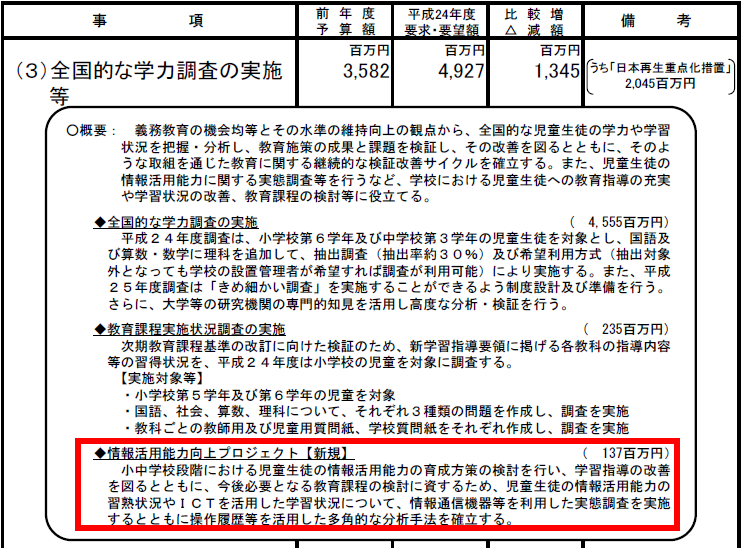
This 'Digital Academic Ability Test' is mentioned in the PDF file ' Major Items of the FY2012 Budget Request ' published in the list of presentation materials for the Ministry of Education, Culture, Sports, Science and Technology's FY2012 Budget Request . The content of this academic ability test is clearly stated as the ' Information Literacy Ability Improvement Project .'
'We will consider policies for developing students' information literacy skills at the elementary and junior high school levels, improve learning instruction, and, in order to contribute to the consideration of future educational curricula, conduct a survey of students' information literacy skills and their learning status using information and communication devices, and establish a multifaceted analytical method using operation history, etc.' In other words, the main purpose seems to be to collect data for improving information education classes.
I called the Ministry of Education, Culture, Sports, Science and Technology to inquire about this 'digital academic achievement test.'
GIGAZINE (hereinafter referred to as G)
Will there be an official announcement soon regarding the contents of the 'digital academic achievement test' that has been reported?
Ministry of Education, Culture, Sports, Science and Technology (hereinafter referred to as “Mun”):
As reported in the media, the budget request for this measure is currently in the preliminary stage, and details will be decided in the future.
G:
Please tell us the current status of how your classes on the use of ICT are progressing.
Sentence:
All elementary and junior high schools have internet access and offer information utilization classes. However, the content of the classes seems to vary depending on the school.
G:
It is said that at least 6,000 elementary and junior high school students from across the country will be selected to take the survey, but are there any plans to include all elementary and junior high school students in Japan in the future?
Sentence:
Given that teaching content differs from school to school, we plan to select 3,000 students from elementary schools and 3,000 students from junior high schools, and gather them in specific grades.
G:
Although the test is aimed at elementary and junior high school students, it is likely that the age range will vary depending on the grade level selected. Are the questions asked the same for everyone?
Sentence:
It will be tailored to the content of the study.
G:
It has been reported that the answers will be derived from a 'fictitious website' rather than an actual internet environment.
Sentence:
The content of the test is still under consideration and nothing has been decided yet. It is likely that the content in the article was written based on the assumption that the test will be similar to the 'digital reading comprehension' survey conducted by the Organization for Economic Cooperation and Development (OECD) in 2009, which used a 'fictitious website.' The content is currently being determined with the cooperation of university professors, so it is not yet decided whether the questions will be in the format described in the article.
G:
I see. Thank you for your answer.
The promotion of education regarding internet use is a very big step, but it is desirable that this goes beyond simply eradicating underground websites at school, which are seen as breeding grounds for bullying, and instead promotes independent internet use by each and every student.
Related Posts: