GitHub now allows users to set a limit on the number of pull requests that can be opened simultaneously, a measure to combat mass posting in the age of AI-generated content.
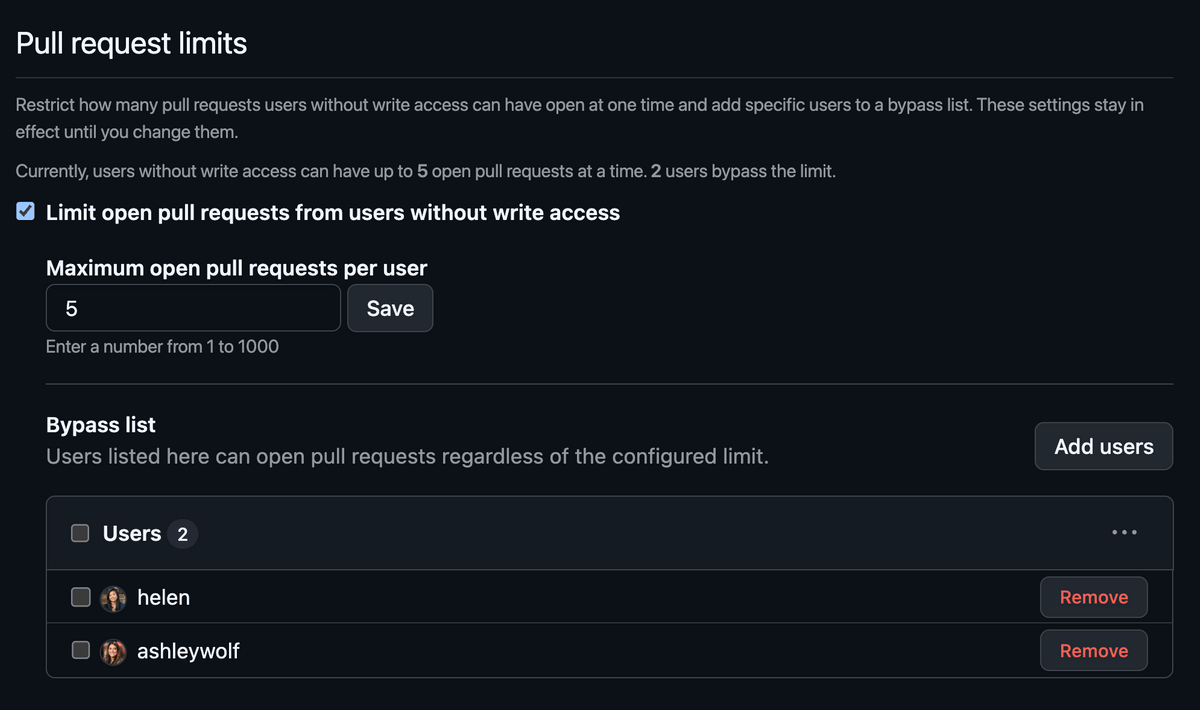
On June 17, 2026, GitHub added a new feature that limits the number of pull requests that a user without write permissions can open simultaneously in a single repository.
Limit open pull requests for users without write access - GitHub Changelog
Maintainer Month Update: Tackling Contribution Noise and Giving Maintainers More Control · community · Discussion #197319 · GitHub
https://github.com/orgs/community/discussions/197319
When a single user submits multiple revision proposals in a short period, maintainers need to verify whether each proposal is relevant to the project, adheres to submission rules, and whether the submitter is willing to accept the revision request. While the ease of creating pull requests using generation AI has accelerated the increase in the number of submissions, including low-quality proposals, it has also increased the burden on maintainers who have to review the content.
To address the problem of a large influx of low-quality pull requests, GitHub added features in February 2026 that allow users to completely disable pull requests or to restrict submissions to collaborators only . Open-source projects have also been taking steps to prohibit or restrict pull requests.
Open-source browser 'Ladybird' stops accepting external code, shifting to a development system for the AI era - GIGAZINE

However, stopping submissions altogether would prevent valuable suggestions from external sources from reaching us, and limiting participation to co-developers would restrict entry for first-time users.
The newly added limit feature is an option to prevent mass submissions while keeping the pull request window open. Repository administrators can set the maximum number of pull requests that can be open simultaneously for users without write permissions.
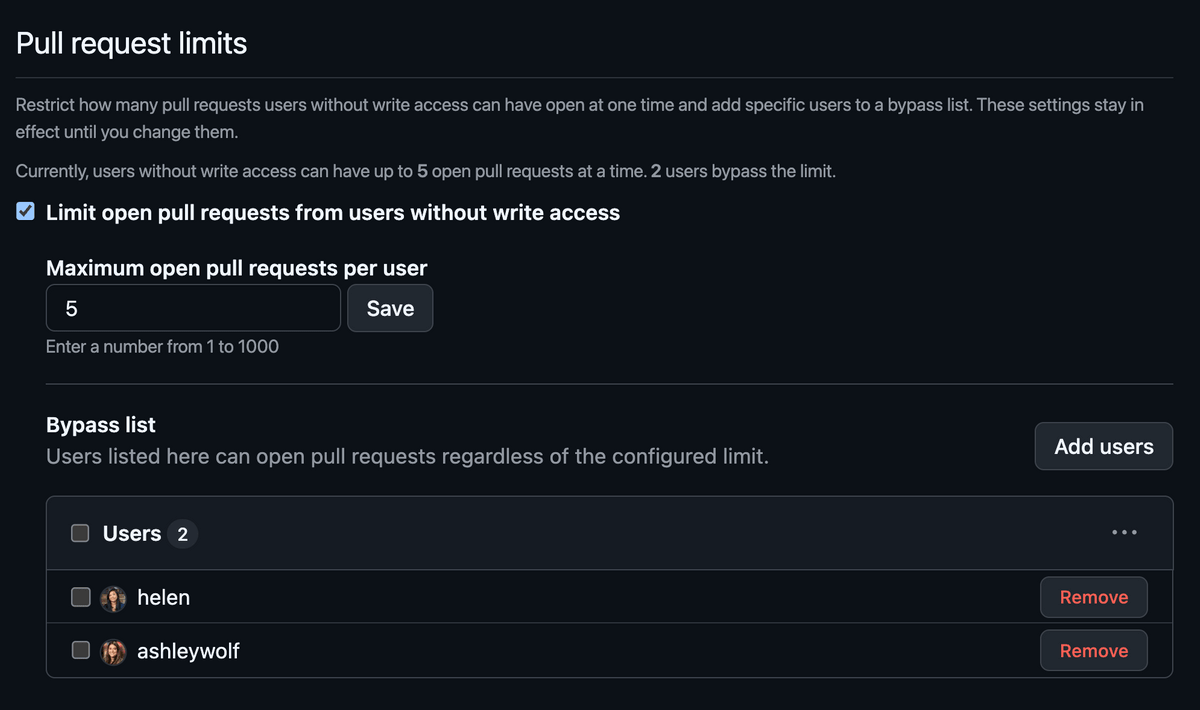
To create a new pull request after reaching the limit, users must either close their existing pull requests or have them incorporated into the project. This prevents a small number of users from flooding the list of pending pull requests with a large number of requests.
To avoid restricting users who consistently submit valuable suggestions, a bypass list is available to exempt trusted contributors from the limits. You can also allow specific users to submit many pull requests without granting them write access to the repository as co-developers.
As the number of pull requests increases, so does the workload for continuous integration (CI), which runs automated code tests and other processes, in addition to human review. GitHub explains that the cap feature reduces the burden of unnecessary reviews and CI, making it easier for maintainers to prioritize useful suggestions.
GitHub sees this addition as the first step in its efforts to protect maintainers' time. In the future, they are considering mechanisms to automatically exempt users from restrictions based on factors such as account creation date, the number of pull requests previously accepted, and organizational affiliation, as well as similar limits on issues and measures to address large-scale submissions across multiple repositories.
Related Posts:








in Web Service, Posted by log1d_ts