Open-source browser Ladybird stops accepting external code, shifting to a development model for the AI era.

The development team behind the independent browser 'Ladybird' has announced that they will no longer accept public pull requests from outside, and that code changes will only be implemented by project maintainers.
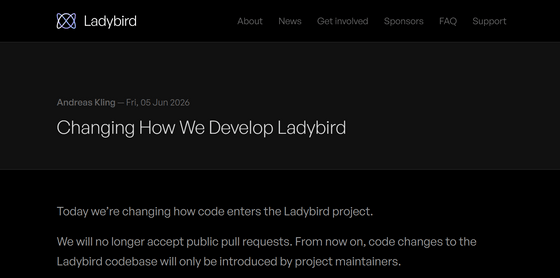
Changing How We Develop Ladybird - Ladybird
Ladybird is an open-source project that aims to create a new browser engine from scratch, rather than being a derivative of an existing browser. It aims to create an independent engine based on web standards, without using the code of existing engines such as Blink (used in Google Chrome), WebKit (used in Safari), or Gecko (used in Firefox). As of the time of writing, the initial alpha version for Linux and macOS is planned to be released by the end of 2026.
In open-source software, it's common practice for external developers to find bugs, submit fixes as pull requests, and for maintainers to review and incorporate them. For example, external contributors can submit small fixes to correct screen display misalignments or implement some previously unsupported web standards, gradually improving the project. Ladybird has also received contributions from external sources for many years.
However, with the proliferation of AI coding tools, the mere fact that someone has 'sent a big patch' is no longer as reliable as it once was in judging the effort and goodwill of the contributor, explains Ladybird founder Andreas Kling. Writing thousands of lines of code manually required considerable time and knowledge, but AI can create seemingly substantial changes in a short amount of time. The Ladybird team has stated that they use AI tools every day, and their concern is not with AI itself, but with 'who is responsible when it becomes harder to tell how the code was made.'
In the comments section of Hacker News, a news sharing site for engineers, there are also posts describing an increase in AI-generated pull requests in another large-scale open-source project called Godot. Pull requests are being sent that appear to be AI-generated not only in the code body but also in the description, and when maintainers warn them because it goes against the project's policy, some contributors rebel, saying, 'We contributed, but we're not being thanked.'
Ladybird is not the only company restricting external pull requests for AI-generated code. In January 2026, the web-based drawing tool 'tldraw' also announced a policy to temporarily close pull requests from external contributors, citing an increase in pull requests containing code generated solely by AI tools, which was leading to incomplete explanations, a lack of understanding of the codebase, and insufficient follow-up after submission.
AI causes open-source 'tldraw' to close pull requests from external contributors - GIGAZINE
Development doesn't end with incorporating working code. You need to ensure that the new code fits the existing design, can withstand future refactoring, works correctly with other functions, and can be read and understood by other developers years from now. Ladybird, in particular, is software that receives untrusted input from the entire internet as a browser, and even a single cleverly hidden vulnerability could be exploited by an attacker.

Kling explains that in the open-source world, trust has long been built through the work itself. The idea is that trust is built between maintainers and external contributors by submitting small fixes, accepting reviews, responsibly maintaining changes, and staying involved in the project over time. However, with AI making it possible to create 'work that looks like a serious contribution' cheaply and quickly, the amount of work is no longer a substitute for a measure of trust.
Therefore, Ladybird will no longer accept public pull requests, and changes to the codebase will only be introduced by project maintainers. All public pull requests that were open at the time of this policy change will also be closed. Furthermore, there will be no alternative channels for submitting patches using email, issues, comments, forks, etc. This is a fairly drastic change, effectively closing off the entire mechanism for external code submission and upstream contribution.
On the other hand, Ladybird will not cease to be open source. The source code will continue to be released under an open-source license, and external collaboration will remain important. Acceptable forms of collaboration include 'clear bug reports,' 'reductions that make the bug reproducible in the fewest steps possible,' 'website functionality testing,' 'discussions on web standards,' 'discussions on design,' 'security reports,' and 'technical feedback.' Rather than sending the code itself, external parties are expected to provide materials that the maintainers can responsibly code.

Hacker News has pointed out that 'if a bug is found and the fix is known, but a specific patch cannot be communicated, the maintainer will have to redo the same fix work,' and that 'closing the option of receiving suggested fixes is inefficient.' There are also voices saying that 'it is a shame that AI will cause open source projects to lose opportunities to find and cultivate new maintainers.'
A user claiming to be a former Chrome developer stated that Chromium, Gecko, and WebKit appear more open than Ladybird, at least in terms of accepting external code, and commented that the resources that large browser vendors invest to support external contributions should also be appreciated.
Furthermore, some have pointed out that the open-source culture appears to be shifting from a 'bazaar' type of development, where anyone can freely contribute modification ideas , to a 'cathedral' type of development, where a limited number of people internally carry out the design and implementation.
On the other hand, some comments suggest that if many pull requests are written by AI, then maintainers themselves should use AI tools like Claude Code, and that the meaning of 'blocks of code' has completely changed compared to two years ago.
Some users who support Ladybird expressed concern that 'closing pull requests might mean losing not only the code, but also less visible contributions such as ideas and reviews by many people.'
Ladybird's maintainers will continue to use AI. In other words, the new policy is not about avoiding the use of AI, but rather about shifting to a system where maintainers, who are responsible for incorporating the code, implement changes, rather than having to review a large amount of externally received code in a limited time.
Ladybird states that 'we are getting ready to deliver the browser to real users, and the development process needs to be more accountable.' The decision to narrow the code entry point for the first alpha version indicates that they have entered a stage where accountability takes precedence over development speed.
Related Posts: