One point raised is that in the age of AI, what will truly be valuable is not programming skills, but 'industry knowledge.'

As AI rapidly develops and demonstrates advanced coding capabilities, a blog post arguing that the most important skill that AI cannot replace is 'the expertise to judge whether code is correct' is gaining attention.
Domain Expertise Has Always Been the Real Moat | Aaron Brethorst
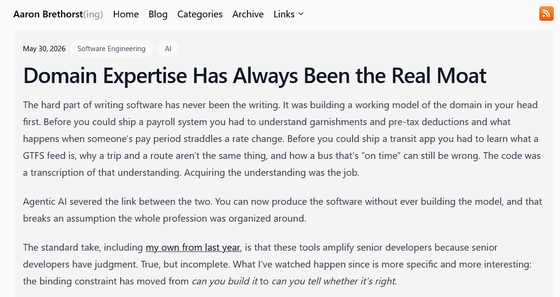
According to software developer Aaron Brethorst, the hardest part of software development isn't writing the code itself, but correctly understanding the workings of the industry and business processes being targeted. For example, when developing a payroll system, writing the code to perform the calculations is easy, but unless you have a precise understanding of what happens depending on the situation, such as tax rates, deduction conditions, and adjustments based on the pay period, you won't be able to determine whether the system is working correctly.
Bretthorst cites the example of a dispatcher with 15 years of experience in the logistics industry and a highly skilled software engineer using the same AI coding tool. The dispatcher cannot write any programs, but can determine whether the logistics system created by the AI agent is working correctly. On the other hand, even the most skilled engineer may be able to evaluate the quality of the code, but may not be able to determine whether the system meets the operational requirements of the field.
Bretthorst points out, 'Code is merely a written representation of industry knowledge, and what's truly important is understanding that knowledge. However, agent-based AI has broken the connection between expertise and code that the entire field has taken for granted, by enabling software development without building behavioral models.'

Traditionally, engineers built systems by repeatedly failing in production environments while working in sessions with experts. On the other hand, experts rarely built systems themselves because it took them many years to learn how to build reliable software. Therefore, the ability to 'build software oneself' was considered an engineer's strength. However, Bretthorst points out that while the cost of 'the ability to translate ideas into working software' has decreased significantly with the development of AI, access to the specific knowledge of experts has not been opened up. As a result, the value of engineers' abilities has relatively decreased, while the value of experts' knowledge has relatively increased.
As an example supporting Bretthorst's claims, Anthropic held a hackathon where participants competed to see how they could best utilize the latest AI models. Despite most of the 500 participants being developers, three out of the five winners had no prior experience releasing software. Systems researcher Dexter Hadley said, 'The lesson we learned from this hackathon is that expertise trumps coding ability. Highly advanced coding AI is enabling experts, rather than developers, to build software by directly contributing their expertise. This is not a passing fad, but an irreversible change.'
How did someone with no prior software release experience win the Anthropic-sponsored Opus 4.6 hackathon? What are the requirements for AI products? - GIGAZINE

Bretthorst says, 'For experienced engineers thinking about where to invest their time in the coming years, this is where the bet is. The value of the technical skills you've painstakingly acquired—translating clear ideas into clean code—has decreased significantly. What remains rare, however, is a deep understanding of real-world industries and operations, backed by practical experience. Choose an industry, specialized equipment, regulatory framework, or real-world business process, and study it thoroughly, just as you did when you learned programming languages and frameworks. That's the part that AI agents can't acquire for you, and that's where the greatest value lies now.'
Brethorst's blog post became a hot topic on the social news site Hacker News, drawing attention to the importance of human knowledge supporting AI coding. Developers shared their experiences , highlighting how having their apps tested by people performing real-world professional tasks was a crucial learning experience. One example cited was the observation that 'while AI can leverage all kinds of software knowledge to solve problems, it couldn't even realize the possibility that the headphones were plugged into the wrong jack,' leading to a problem of no sound coming from a PC. On the other hand, some argue that experts might not be able to effectively utilize coding AI, stating, 'There's a big difference between being able to verify that a system's output is correct and being able to instruct the system on how to generate the correct output in the first place. I believe that people with high levels of expertise in specific fields would fail as software developers, even if agent AI could code perfectly, because they struggle to clearly articulate the rules they've learned over the years. They may have deep knowledge of their field, but it would be extremely difficult to instruct an AI system to test that knowledge .'
Related Posts:





in AI, Posted by log1e_dh