An article titled 'Why do Japanese companies engage in such diverse businesses?' has become a hot topic, along with questions like 'Why are Japanese companies not globally competitive in AI and EVs?'
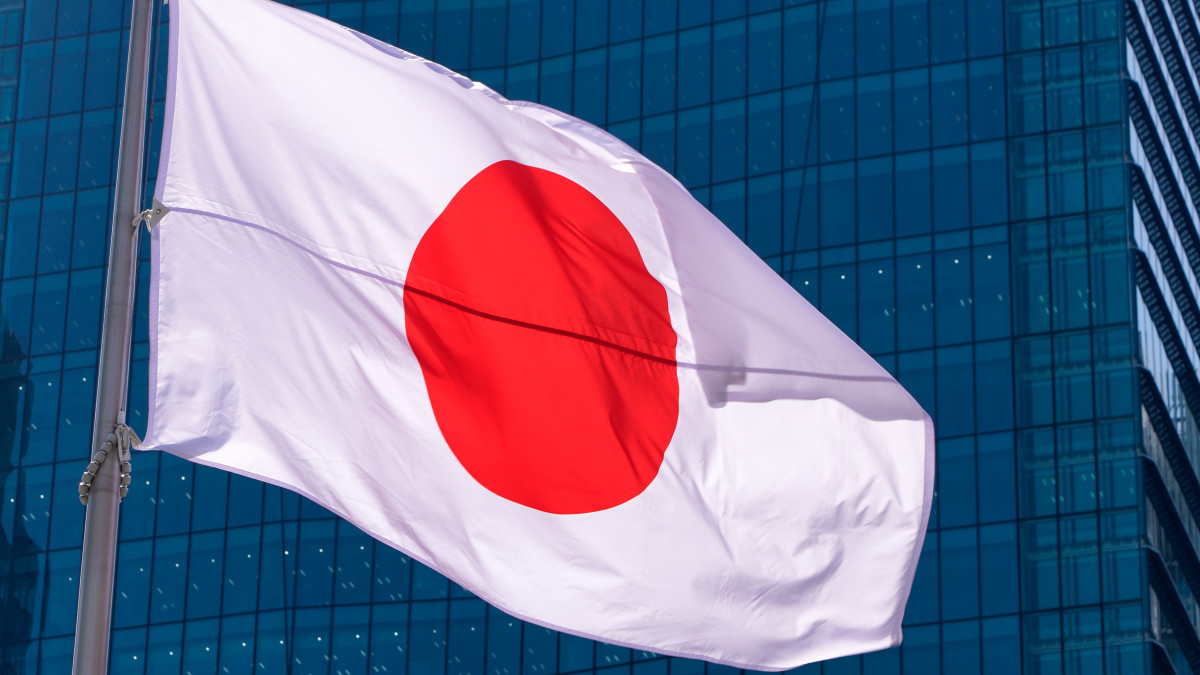
TOTO is famous as a global toilet manufacturer, but it actually also manufactures photocatalytic coatings for buildings, assistive devices for the elderly, and even
Why Japanese companies do so many different things
https://davidoks.blog/p/why-japanese-companies-do-so-many
Naturally, companies that handle a wide variety of businesses exist outside of Japan as well; for example, much of the Indian economy is dominated by a few large corporate groups such as the Adani Group. However, India is a relatively poor country with a low level of economic specialization, and its giant conglomerates specialize in relatively simple businesses such as cement and steel. On the other hand, Japan is already a wealthy and developed country, and despite being one of the most economically complex countries in the world, its companies are said to be diversifying their businesses at a very high level.
Japanese companies' diversification strategies differ from those of many companies in other developed countries. In the United States, there is a tendency to prioritize selection and concentration above all else, and it is not common for paper mills to engage in various businesses, such as Oji Paper's involvement in concert halls and in-flight catering at airports. Even in Germany, which rivals Japan in the number of technologically advanced companies, only giant conglomerates like Siemens engage in the broad range of business operations seen in Japan. In South Korea, conglomerates like Samsung and SK engage in diversified businesses, but these are companies that have been closely linked to and supported by the state, and the situation is different from Japan, where general companies are diversifying.
Ox argues that the reason Japanese companies are diversifying their businesses to such a high degree is due to 'characteristics inherent in their organizational structure.' While typical American companies are specialized, market-oriented, and prioritize shareholder profits, Japanese companies adjust their capital and labor in a completely different way.
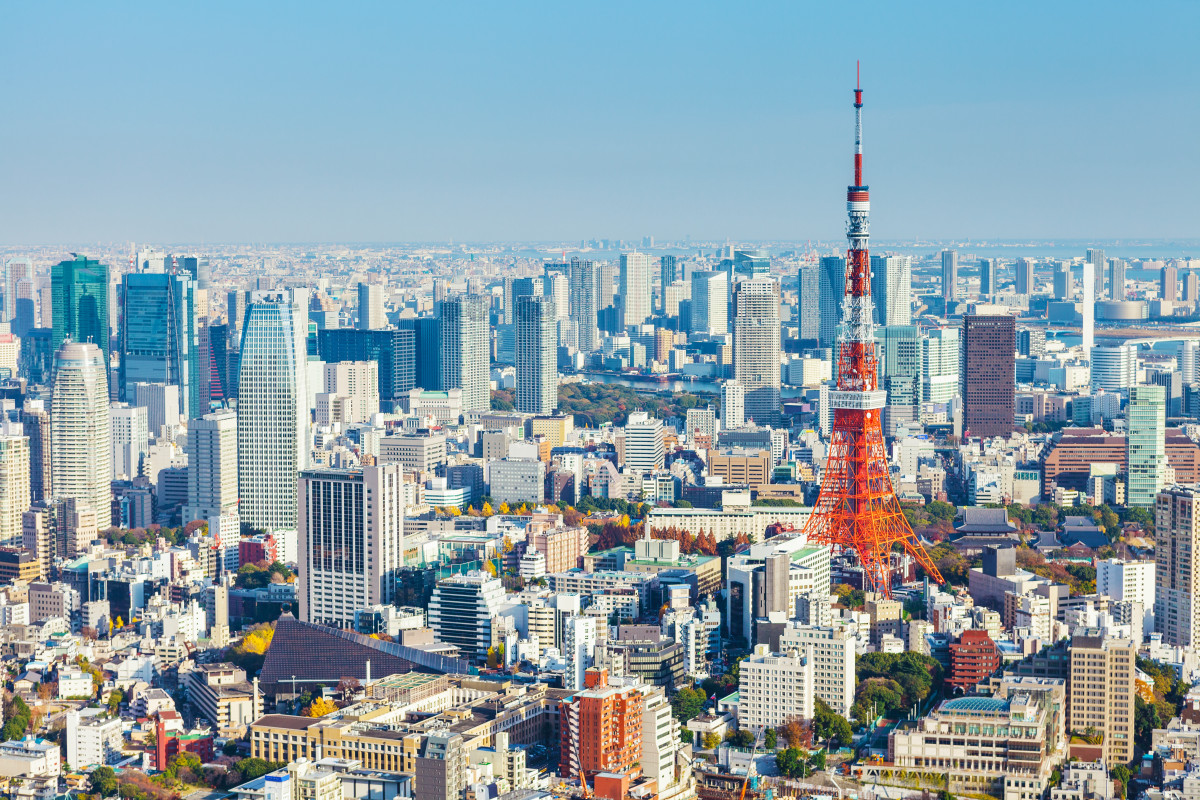
One of the first points that Mr. Ochs highlights is that, unlike Western companies, Japanese companies employ a lifetime employment system. In Japan, the general policy is to hire young people all at once after they graduate from high school or university and continue to employ them until retirement. Even if a company faces serious financial difficulties, it will take various measures such as reassigning employees or sending them to subsidiaries to avoid laying them off. Another characteristic is that individual performance is not a particularly important evaluation criterion for career advancement or salary, promotions and salary increases are mainly based on years of service, and bonuses are also linked to the company's performance.
Furthermore, in Japan, labor unions are mostly internal organizations within specific companies rather than inter-company organizations, and are therefore not subject to much pressure from external labor unions. Companies also have structures that make them less susceptible to external financial pressure, such as having strong relationships with the same suppliers over several decades, having boards of directors mostly comprised of their own executives, having a large portion of their shares mutually owned with other Japanese companies, and having a single main bank handling fundraising and performance monitoring.
As a result, Japanese companies don't feel the need to focus much on returning profits to shareholders, and most of the profits are reinvested in the business.
The fundamental difference between J-type and H-type companies lies in the fact that H-type companies have a vertically organized production system, while J-type companies have a horizontally organized system. For example, in an H-type company, if a defect occurs on the production line, the line manager reports it to upper management, who then take action to resolve the problem. In contrast, in a J-type company, the workers on the production line gather together and work to resolve the problem on the spot.
To achieve this kind of horizontal collaboration in J-type companies, workers must recognize each other's roles and be proficient not only in their own tasks but also in the diverse operations of the production line. This requires broad training and job rotation, but in H-type companies, where there is no lifetime employment system and employees are constantly changing, there is no point in conducting such broad training. Furthermore, if a J-type company, where employees are expected to be proficient in various tasks, were to introduce performance-based compensation, being rotated to a new, unfamiliar job would mean a decrease in salary, leading to resistance from employees to rotation and training.

In other words, a typical J-type company has a large number of employees with lifetime employment who cannot be fired, and whose skills are not specialized in a specific job but are tailored to the company's needs. While this system is irrational and unproductive from the perspective of external investors, Ochs explains that it is convenient for employees of J-type companies who are isolated from external pressures.
As a result, H-type companies, which aim to profit from shareholders, exist 'to generate profits and return them to shareholders,' while J-type companies, which hardly need to consider shareholders, exist 'simply to survive.' Ox believes that this survival instinct unique to J-type companies is the reason why Japanese companies diversify their businesses.
Ox said, 'If you promise to employ your employees for life, you need to create new jobs for them even if their current jobs become meaningless. In fact, you may have to keep them employed even if you can't find work to assign them. If you don't place a high value on profitability and have a large number of well-trained, versatile employees, it makes sense to reinvest the company's profits into new ventures. This diversifies the investment portfolio, reduces risk and extends the company's lifespan, and also allows you to keep surplus personnel working in some capacity.'
At first glance, J-type companies may seem like an ideal environment for employees, but they only function well in sectors requiring incremental improvement, such as automobiles, machine tools, industrial robots, optics, and precision materials. These sectors are not so fluid as to necessitate top-down strategic intervention and have relatively stable and predictable demand. However, in highly volatile sectors where top-down strategic intervention is essential, such as software, internet platforms, AI, and EVs, H-type companies, which excel at top-down selection and concentration, have an advantage.
Ox concluded that the fundamental weakness of J-type companies is the reason why Japanese companies have an overwhelming presence in some fields but no presence at all in others.
This article is also trending on the social news site Hacker News.
Why Japanese companies do so many different things | Hacker News
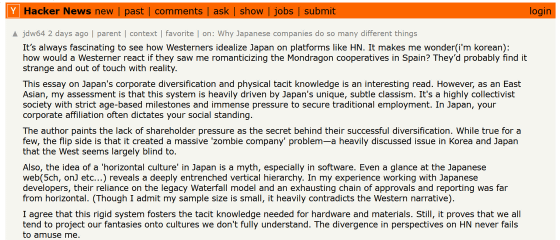
One user, who identified himself as Korean, pointed out that Westerners tend to idealize Japan on platforms like Hacker News. He explained that while the article portrays Japanese companies as having 'horizontal organizations,' in reality, age-based distinctions exist in Japan, and a clearly vertical structure is present, especially in the software industry, where Japanese developers are constantly bogged down in processes of approval and reporting to upper management.
Related Posts:






in Note, Posted by log1h_ik