Firefox now supports 'Web Serial,' which allows direct control of electronic devices from the browser.
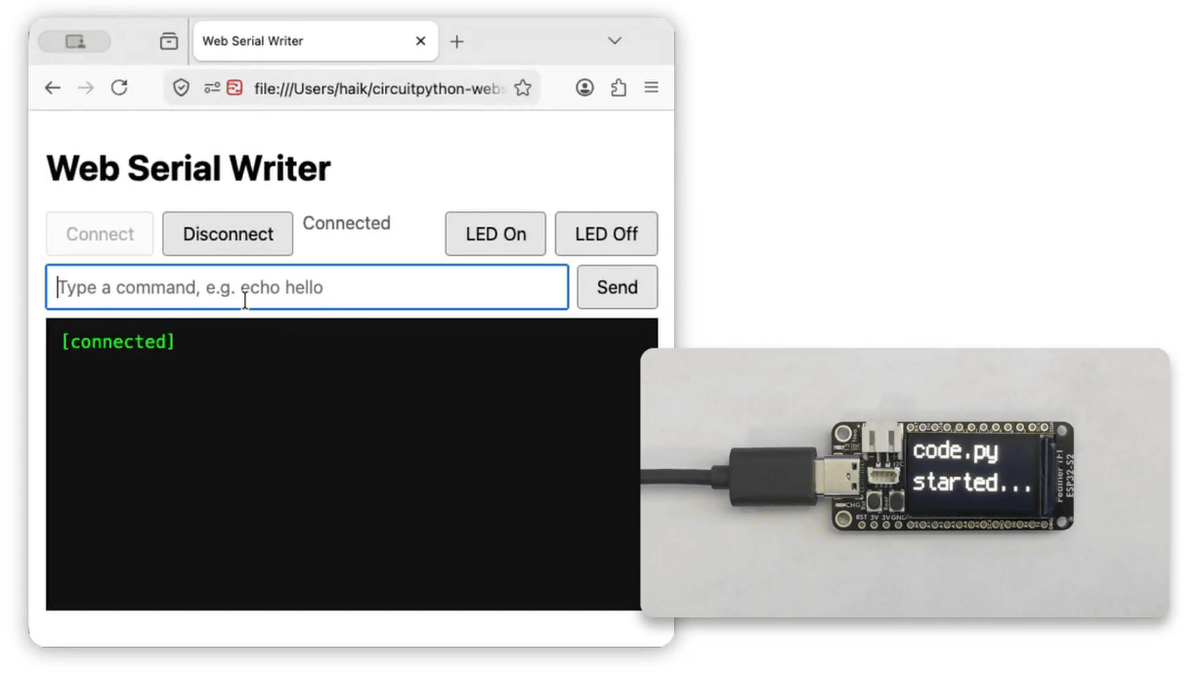
Mozilla has announced that it has added support for ' Web Serial ' to its Firefox web browser, which allows web applications to communicate directly with external devices connected via USB. This will enable direct control of various electronic devices such as microcontrollers, development boards, and 3D printers from the browser.
Announcing Web Serial Support in Firefox - Mozilla Hacks - the Web developer blog

Mozilla and Adafruit bring Web Serial workflows to Firefox
https://blog.mozilla.org/en/firefox/firefox-web-serial-adafruit/
Mozilla released the official version of its web browser, Firefox 151, on May 19, 2026. Firefox 151 features a redesigned new tab page, added PDF viewer functionality, and, for developers, support for the Web Serial API , which allows Firefox to handle serial communication-enabled microcontrollers and development boards.
Firefox 151 officially released, featuring a redesigned new tab page and the ability to delete private browsing sessions with a single click - GIGAZINE

Web Serial is a Web API that allows websites to send and receive data with serial devices using JavaScript. 'Serial' refers to a communication method in which data is sent and received sequentially in small increments between a computer and a device. Some devices connected to a USB port are recognized by the OS as a 'serial port (COM port),' and Bluetooth devices are treated similarly by using a serial communication profile. Traditionally, operating such devices required installing dedicated software or native apps, but the Web Serial API allows direct access to the serial port from JavaScript on a web page, making it possible to perform tasks such as firmware writing, sensor control, and device configuration using only a browser.
Mozilla collaborated with Adafruit , an open-source hardware community, to test and validate what browser-based hardware development looks like with Firefox's WebSerial support. As a result, Mozilla stated, 'Firefox is a more practical browser for directly manipulating and programming hardware using web technologies.'
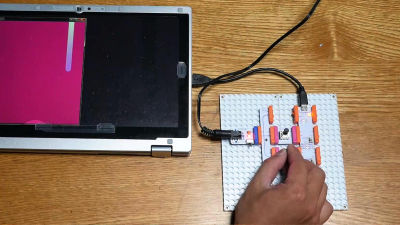
In fact, Mozilla engineer Alex Franchuk has released a video showing how he created ' Page Playground ,' a device that combines electronics and web editing. Franchuk said, 'I tried Web Serial with Firefox and it was really fun because it made the browsing experience feel like it was no longer just something to 'look at,' but something I could customize to my liking. I'm also really excited to see what cool, interesting, and useful physical devices will come out in the future. It's liberating to be able to use dedicated hardware without installing special drivers or local software.'
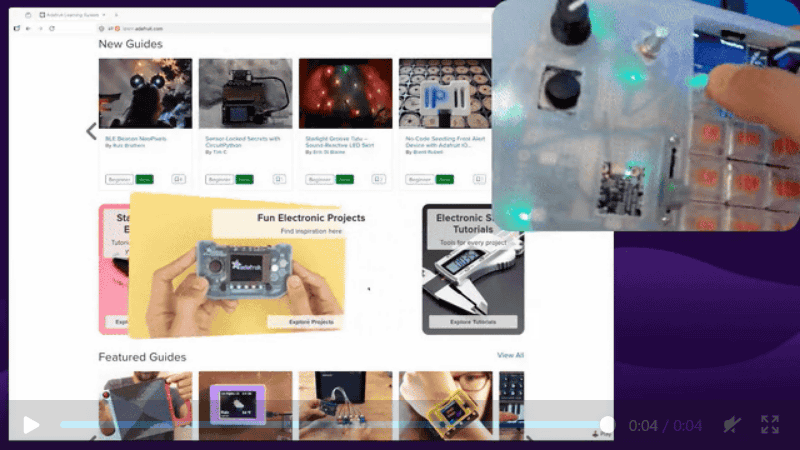
Additionally, Florian Quèze, who has been working on a project to measure power consumption at Mozilla, created ' webserial-power-profiling ,' which uses Web Serial to read power data from commercially available USB power meters and display it in Firefox. The repository for this tool is publicly available on GitHub.
GitHub - fqueze/webserial-power-profiling: Power profiling directly in the browser using WebSerial · GitHub
https://github.com/fqueze/webserial-power-profiling
Allowing web platforms to read and write to hardware devices raises clear security and privacy concerns. Web Serial prevents websites from accessing or accessing serial ports unless explicitly permitted by the user. Access permissions are managed individually for each site and each port.
Mozilla stated, 'Web Serial-enabled devices are popular among hobbyists, hardware hackers, educators, and developers, and are used in a wide range of applications. Web Serial support makes Firefox even more convenient for these projects.'
Related Posts: