We successfully induced photosynthesis in mice by administering structures derived from spinach chloroplasts to their eyes.
Plants produce the substances necessary for survival through photosynthesis, but animals are generally unable to perform photosynthesis. A research team at the National University of Singapore (NUS) has reported the results of a study in which they administered structures derived from spinach chloroplasts to the eyes of mice to induce photosynthesis.
Transplanting light-dependent reactions for mammalian eye photosynthesis - Cell
https://www.cell.com/cell/fulltext/S0092-8674(26)00469-1
Eyes that photosynthesise: NUS scientists plant a cure for dry eye disease
https://news.nus.edu.sg/eyes-that-photosynthesise/
Mouse eyes photosynthesize after plant-to-animal transplant | Nature
https://www.nature.com/articles/d41586-026-01559-9
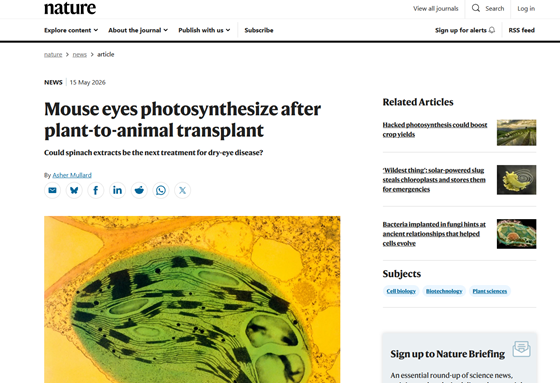
While animals are generally unable to perform photosynthesis, an exception exists in the utricles of the saccharid class, sea slugs. When they eat algae, they take in chloroplasts, and it has been reported that they can utilize nutrients produced through photosynthesis when they are in a state of starvation. Based on this example, a research team led by Xin Kuoran of NUS hypothesized that 'mammals may also be able to acquire photosynthetic capabilities in a limited form.' Their focus was then on the 'eyes,' which are the part of the body that can easily receive visible light.
The research team extracted a membrane structure called ' thylakoidgrana ' from the chloroplasts of spinach. When exposed to light, this thylakoidgrana produces ' adenosine triphosphate (ATP),' which is used for energy exchange within cells, and ' nicotinamide adenine dinucleotide phosphate (NADPH),' a coenzyme that acts as a reducing agent.
Furthermore, the research team processed these thylakoid grana into particles of approximately 400 nm in size, which are easily absorbed by cells, and named these particles 'LEAF.'
In normal photosynthesis, NADPH and ATP are produced in response to light, and NADPH is consumed in subsequent reactions to produce sugars. However, the research team removed the NADPH-consuming parts from the chloroplasts, leaving only the thylakoidgrana. As a result, LEAF only performs the reaction that produces NADPH and ATP in response to light.
The research team focused on dry eye as a target for treatment using this mechanism. In dry eye, inflammation around the cornea increases reactive oxygen species, leading to a vicious cycle where oxidative stress that damages cells further exacerbates inflammation. The research team hypothesized that if they could produce NADPH using visible light, they might be able to suppress this vicious cycle by reducing reactive oxygen species.

First, the research team transplanted LEAF into cells that had been induced into an inflamed state in the laboratory and investigated its effects. As a result, the research team reported that the amount of NADPH recovered and reactive oxygen species were suppressed within 30 minutes of exposure to light. Furthermore, when tested on tear samples taken from dry eye patients, LEAF increased the amount of NADPH by approximately 20 times and successfully reduced hydrogen peroxide, a type of reactive oxygen species that damages cells, by more than 95%.
Next, the research team conducted a preclinical trial in which they administered LEAF as an eye drop to mice. As a result, in mice administered LEAF under indoor ambient light, corneal damage recovered to a near-healthy state within 5 days, and the research team reported that it 'outperformed the effects of existing dry eye treatment drugs such as Restasys.' Furthermore, therapeutic effects were confirmed in a second preclinical trial, and no adverse effects were observed in the evaluation of skin sensitization, eye irritation, and organ toxicity over a two-month period.
Shin explained, 'We have transplanted a light-response-carrying structure extracted from a plant into mammalian tissue, demonstrating for the first time that biologically useful molecules can be created using only visible light,' adding, 'We too can possess a limited capacity for photosynthesis.'

Since oxidative stress is involved in inflammatory diseases other than dry eye, the research team suggests that LEAF may be applicable to tissues that are easily penetrated by visible light, such as the retina, skin, and skeletal muscle.
On the other hand, Corey Allard, a cell biologist at Harvard University, said, 'These kinds of attempts inevitably seem like impractical one-off gimmicks at first,' and pointed out that it is necessary to investigate how long the effects last and which cells can be targeted.
Related Posts:




in Science, Posted by log1b_ok