Why rising memory prices are actually advantageous for Apple, a memory buyer.
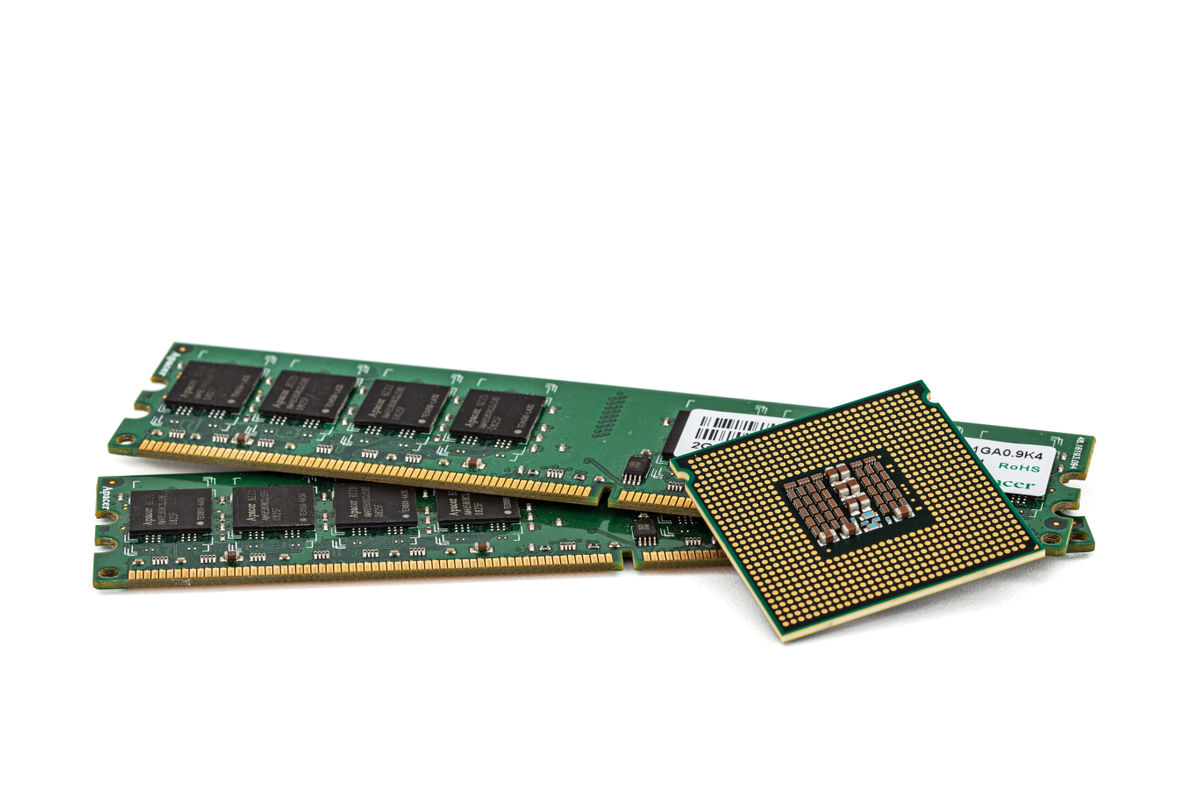
As memory accounts for a larger proportion of the manufacturing cost of smartphones and PCs, the profit margins of iPhones, Macs, and iPads tend to decrease, so the surge in memory prices seems like a major headwind for Apple. However, Horace Dediu of Asymco, an Apple-focused analytics firm, points out that the 'memory panic' of 2026 could actually work to Apple's advantage.
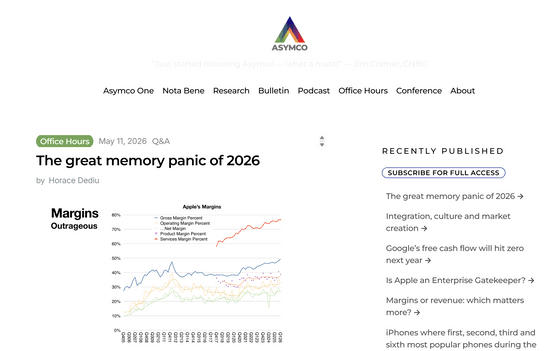
The great memory panic of 2026 – Asymco
The key point is that Apple is not simply a 'company that buys memory,' but a 'company that manufactures products on a long-term basis, producing hundreds of millions of units.' Apple products, including not only iPhones but also Macs, iPads, Apple Watches, and Vision Pros, all require memory. As a company that sells hundreds of millions of products, Apple is a very large customer for component manufacturers, allowing them to plan production and secure funding for capital investments based on supplying Apple.
The supply of semiconductors and memory is not something that can be ordered suddenly and received in large quantities the following month. It requires years of planning to adjust factory production capacity, raw materials, equipment, funding, and personnel. Therefore, customers like Apple, who make large, long-term purchases, are 'difficult to negotiate prices with' for memory manufacturers.
According to Mr. Dediu, the current surge in memory prices is mainly due to the price of 'additional memory that is suddenly needed.' In other words, it's not the price of the basic supply that has been under contract for a long time, but rather the price that has surged for short-term demand, such as 'we need more memory next month.'
The key difference here is between 'basic supply' and 'supply.' Basic supply refers to the amount secured by large customers like Apple based on long-term contracts and plans. On the other hand, supply is closer to what companies that experience a sudden surge in demand scramble to acquire from the market. It is the latter, supply, that tends to see sharp price increases during periods of memory shortage.
Apple is primarily a company that negotiates for basic supply. In other words, it's not in a position to simply accept the short-term inflated market prices and buy memory on the spot every month. Of course, if memory prices continue to rise for a long time, it will eventually affect the price of basic supply. This is because memory manufacturers also think, 'Even if it's a contract for two years from now, if we can expect high demand from other companies, we'd like to raise prices.'
However, Apple has another bargaining chip. Apple can suggest to memory manufacturers that 'if you only charge high prices now, we don't know what will happen to our business relationship once the memory market stabilizes.' The semiconductor market is a highly cyclical market with periods of boom and bust, and it's highly likely that memory manufacturers don't believe the current price surge will last forever.

In other words, memory manufacturers need to weigh the short-term profits from selling at high prices against the long-term benefits of maintaining a relationship with a giant customer like Apple. Looking only at the short-term price surge, memory manufacturers appear strong, but over several years, Apple's purchasing power and ability to place consistent orders become a major weapon.
Furthermore, memory shortages can be an even more serious problem for smartphone manufacturers other than Apple. Manufacturers that do not have the purchasing scale or financial resources of Apple may not be able to secure enough memory or may be forced to buy it at inflated prices. As a result, the manufacturing cost of their products may rise, and profit margins may deteriorate rapidly.
Apple has greater financial resources than other manufacturers to secure memory supplies. Even if Apple's profit margins temporarily decline, if competing manufacturers suffer even greater setbacks, it will work to Apple's advantage in terms of market share. Dediou also mentioned the possibility that Apple's large-scale memory stockpiling could prevent competitors from obtaining the memory they need.
In this scenario, Apple can ensure a stable supply of products, even at the expense of slightly lower profit margins. Meanwhile, competing manufacturers are forced to choose between raising product prices, cutting profits, or reducing shipment volumes due to memory shortages and rising costs. For Apple, soaring component prices are not just an increase in costs, but also create an environment that weakens its competitors.
Dediou believes that even if Apple's gross profit margin drops from 49% to 45%, it is still within Apple's tolerable range. 45% is not an extremely low figure for Apple in the past; rather, the important question is whether its competitors can withstand the same situation.
Furthermore, Dediou also touched upon the possibility of Apple launching an offensive with lower-priced iPhones in the future. If Apple could offer an experience comparable to current high-performance iPhones in a product priced around $499 (approximately 80,000 yen), it would pose a significant threat to competing manufacturers who are already struggling to make a profit even with devices in the $800 (approximately 130,000 yen) range. It should be noted that Dediou himself made this low-price strategy as speculation and it is not a plan officially announced by Apple.

Apple has a history of building competitive advantages through large-scale procurement and supply chain control. During the iPod era, it significantly impacted the supply chain for small hard drives, and it is said that Apple secured a large number of processing machines for the aluminum bodies of Macs. Even with soaring memory prices, Apple's ability to control supply chains in a similar manner could become a strength.
In other words, while soaring memory prices are driving up Apple's manufacturing costs, they also highlight Apple's scale, financial strength, long-term contracts, and supply chain management capabilities. What may be a problem for smaller manufacturers—'unable to afford' or 'too expensive'—can be transformed into a strategy for Apple: 'securing it before competitors' and 'accepting a temporary decline in profit margins to increase market share.'
Soaring memory prices will put pressure on Apple's profit margins in the short term. However, Dediou says that if the parts shortage and price increases persist, it will be competitors, not Apple, who will suffer more. In other words, the memory panic is not just a crisis for Apple, but could also be an opportunity to leverage the strength of its supply chain to expand its market share.
Related Posts:



in Hardware, Posted by log1d_ts