We have succeeded in destroying influenza viruses and the novel coronavirus using 'ultrasound.'
Ultrasound effectively destabilizes and disrupts the structural integrity of respiratory viruses | Scientific Reports
https://www.nature.com/articles/s41598-026-37584-x
Scientists use ultrasound to destroy influenza A and COVID-19 viruses without damaging human cells
https://agencia.fapesp.br/scientists-use-ultrasound-to-destroy-influenza-a-and-covid-19-viruses-without-damaging-human-cells/57968
Scientists Destroy COVID And Flu Viruses in The Lab With Sound Waves : ScienceAlert
https://www.sciencealert.com/scientists-destroy-covid-and-flu-viruses-in-the-lab-with-sound-waves
Viruses are structures that hijack the molecular mechanisms of host cells to replicate, and are known to cause a wide range of infections, from mild seasonal infections to deadly diseases. To address serious viral infections such as avian influenza and COVID-19, there is a need to accelerate vaccine development and develop innovative treatment strategies.
Previous antiviral strategies have primarily relied on biological and biochemical methods, as they needed to act within the human body. However, physical methods such as radiation and ultrasound have been used for disinfecting rooms and equipment. Therefore, the research team developed a method to destroy viruses without affecting surrounding cells by using minute vibrations caused by ultrasound.
The experiment used ultrasound equipment,
The experimental results revealed that the outer membrane called the envelope , which is found in viruses such as SARS-CoV-2 and influenza viruses, is physically destroyed, and the ability to infect host cells is significantly reduced.
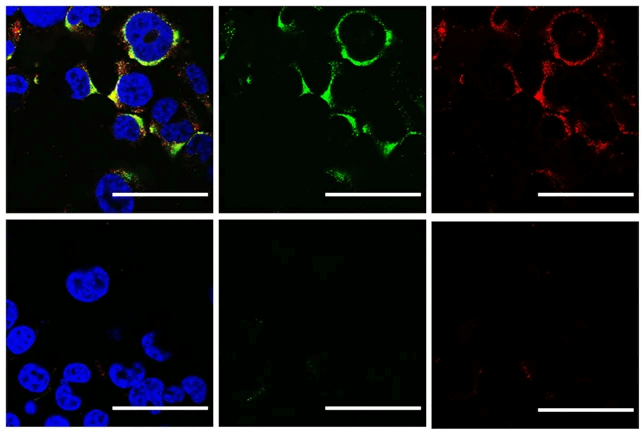
The images below show the nuclei of host cells used in the experiment in blue, the SARS-CoV-2 spike protein in green, and the SARS-CoV-2 RNA in red. The top row shows host cells infected with untreated SARS-CoV-2, and the bottom row shows host cells infected with SARS-CoV-2 after ultrasound treatment. It can be seen that ultrasound treatment destroys the SARS-CoV-2 spike protein and RNA, making infection less likely.
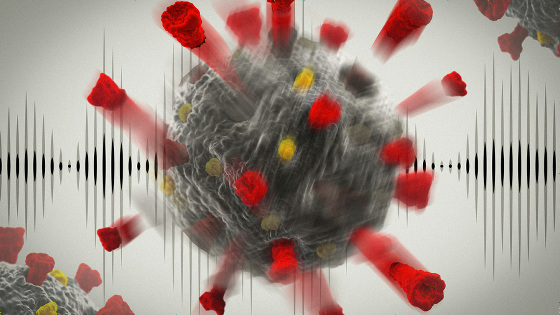
The method developed by the research team utilizes a phenomenon called acoustic resonance . When the frequency of ultrasound matches the natural frequency of the virus's envelope, the vibrations are amplified, leading to the destruction of the virus. In other words, only viruses with the corresponding natural frequency respond to the ultrasound energy, and surrounding host cells are not affected.
Odémir Bruno, a computational physicist at the University of São Paulo and co-author of the paper, commented, 'This phenomenon is entirely geometric. Spherical particles, like many enveloped viruses, absorb ultrasonic energy more efficiently. The accumulation of energy inside the particle changes the structure of the virus's envelope, eventually leading to its rupture.'
In this experiment, it was observed that the virus was far more vulnerable to ultrasound than the surrounding cells. Furthermore, the temperature and pH of the surrounding cells remained stable, ruling out thermal or chemical damage as the cause of virus destruction.
One of the advantages of using ultrasound to destroy viruses is that it does not have a destructive effect on surrounding cells or solutions. Furthermore, since the target is the physical structure of the virus itself rather than a single molecular pathway, it is also advantageous that it will function even if the virus's genes mutate, as long as the structure remains the same. This means that even if mutant strains such as the delta and omicron strains of SARS-CoV-2 appear, the virus can be destroyed in the same way.
While this discovery is groundbreaking, it does not mean that ultrasonic virus destruction has been established as a treatment method. There is still much work to be done before it can be put into practical use, such as adjusting the ultrasound and conducting experiments on humans. The research team hopes that the ultrasonic approach will also be effective against other viral infections and has already begun investigating viruses that cause diseases such as dengue fever and Zika fever .
Related Posts:





in Free Member, Science, Posted by log1h_ik