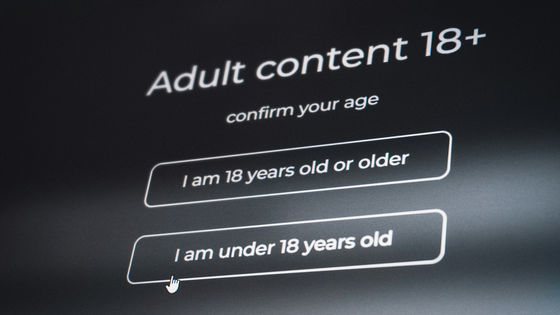
The reality of children circumventing online age verification, such as by 'drawing a mustache on their face,' has been revealed.

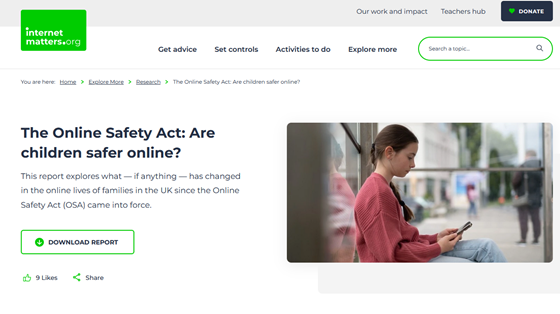
In the UK, age verification has been strengthened under the Online Safety Act to prevent children from accessing online services or harmful content that are inappropriate for their age. However, a survey by Internet Matters, an organization that works to ensure children's online safety, revealed that children are finding various ways to circumvent age verification.
The Online Safety Act: Are children safer online? | Internet Matters
https://www.internetmatters.org/hub/research/online-safety-act-report-2026/
Kids say they can beat age checks by drawing on a fake mustache • The Register
https://www.theregister.com/security/2026/05/04/kids-can-bypass-some-age-checks-with-a-drawn-on-mustache/5224601
Following the implementation of the child protection provisions of the Online Safety Act on July 25, 2025, Internet Matters conducted an online survey from September 15 to October 1, 2025, targeting 1,270 pairs of children aged 9-16 in the UK and their guardians.
The survey revealed that 68% of children and 67% of parents said they 'see more safety features' such as content reporting and filtering than before. Furthermore, 53% of children said they 'have been asked to verify their age on online platforms.'
Of the children asked to verify their age, 37% used methods to estimate their age from their facial image, 24% used third-party apps, and 22% used government-issued identification cards. On the other hand, 34% of the children asked to verify their age did not complete the verification process. Reasons given included 'the process was too complicated' and 'they realized the target age was higher than their own.'
Internet Matters points out that while age verification is becoming widespread, children still see it as 'easy to circumvent.' 46% of children said that 'age verification is easy to circumvent,' while only 17% said it was 'difficult to circumvent.'

32% of children reported that they had bypassed age verification in some way to access age-restricted features, apps, platforms, or websites in the past two months. The reasons for bypassing age verification included: 'to access social media that is unavailable due to age restrictions' (34%), 'to play online games or participate in gaming communities' (30%), and 'to use chat and messaging apps' (29%).
The most common method used to bypass age verification was 'entering a fake birthday,' used by 13% of all children. 'Using someone else's account, including a parent's or sibling's,' accounted for 9%, and 'Using someone else's device' accounted for 8%. Furthermore, 7% of children used a VPN, 6% used someone else's identification documents, and 3% used unrelated photos to pass age estimation based on facial images.
As an additional investigation, Internet Matters conducted small-group interviews with children aged 11-16 and their guardians from February 2 to February 16, 2026. More specific methods of avoidance were discussed. For example, an 11-year-old girl said she had seen instances where videos of game characters moving their heads were used for age verification. The mother of a 12-year-old boy said she had found her son drawing a mustache on his face with an eyebrow pencil, and that he was verified as 15 years old in that state.

Furthermore, even when children showed their faces, the system that estimated their age from facial images sometimes misjudged their actual age, and the children continued to use the service with the incorrectly estimated age.
A 13-year-old boy said, 'If I need identification for live streaming, I'll use my parents' ID, and if I need to upload a photo, I'll use an image I found on the internet.' Concerns were also raised during the interviews about using AI to make faces appear older.
Parents can sometimes be involved in circumventing age verification. 26% of parents said they had allowed their children to circumvent age verification. Of these, 17% actively helped, and 9% tacitly condoned it. According to Internet Matters, parents who allowed their children to circumvent age verification were not necessarily downplaying the risks. Interviews with parents and children revealed that some parents believed they understood the risks and could trust their own children to be safe.

However, even with the widespread adoption of age verification systems, the problem of children having harmful experiences online remains. 49% of children reported having had some kind of harmful experience online in the past month. Specific examples included 'violent content' (12%), 'content that portrays unrealistic body types as ideal' (11%), and 'racist, homophobic, or sexist content' (10%).
Rachel Huggins, CEO of Internet Matters, stated that 'stronger action from both governments and the industry is needed to ensure that children only use online services appropriate for their age and developmental stage.' She explained that safety measures should be incorporated from the very beginning when creating online services and new features, rather than being added after an incident occurs.
Related Posts:







in Web Service, Security, Posted by log1b_ok