An AI has been created that can detect cancer three years earlier than specialists, detecting 'invisible changes' in regular CT images.
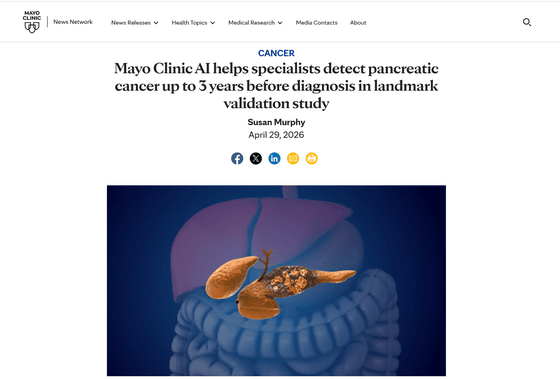
Mayo Clinic AI helps specialists detect pancreatic cancer up to 3 years before diagnosis in landmark validation study - Mayo Clinic News Network
https://newsnetwork.mayoclinic.org/discussion/mayo-clinic-ai-detects-pancreatic-cancer-up-to-3-years-before-diagnosis-in-landmark-validation-study/
Next-generation AI for visually occult pancreatic cancer detection in a low-prevalence setting with longitudinal stability and multi-institutional generalisability | Gut
https://gut.bmj.com/content/early/2026/04/22/gutjnl-2025-337266
The Mayo Clinic has been working for years to enable the early detection of pancreatic cancer, one of the deadliest cancers. In a study published in April 2026, they validated a next-generation AI model called 'REDMOD' using data and workflows reflecting more than 2,000 clinical settings, including CT scans from multiple healthcare institutions and imaging systems.
The CT scans processed by the AI included images of patients who were initially interpreted as normal but were later diagnosed with pancreatic cancer. As a result, REDMOD identified 73% of pre-diagnosed cancers approximately 16 months before diagnosis. This detection rate is nearly double that of specialists (radiologists) who reviewed the same CT scans without AI assistance.
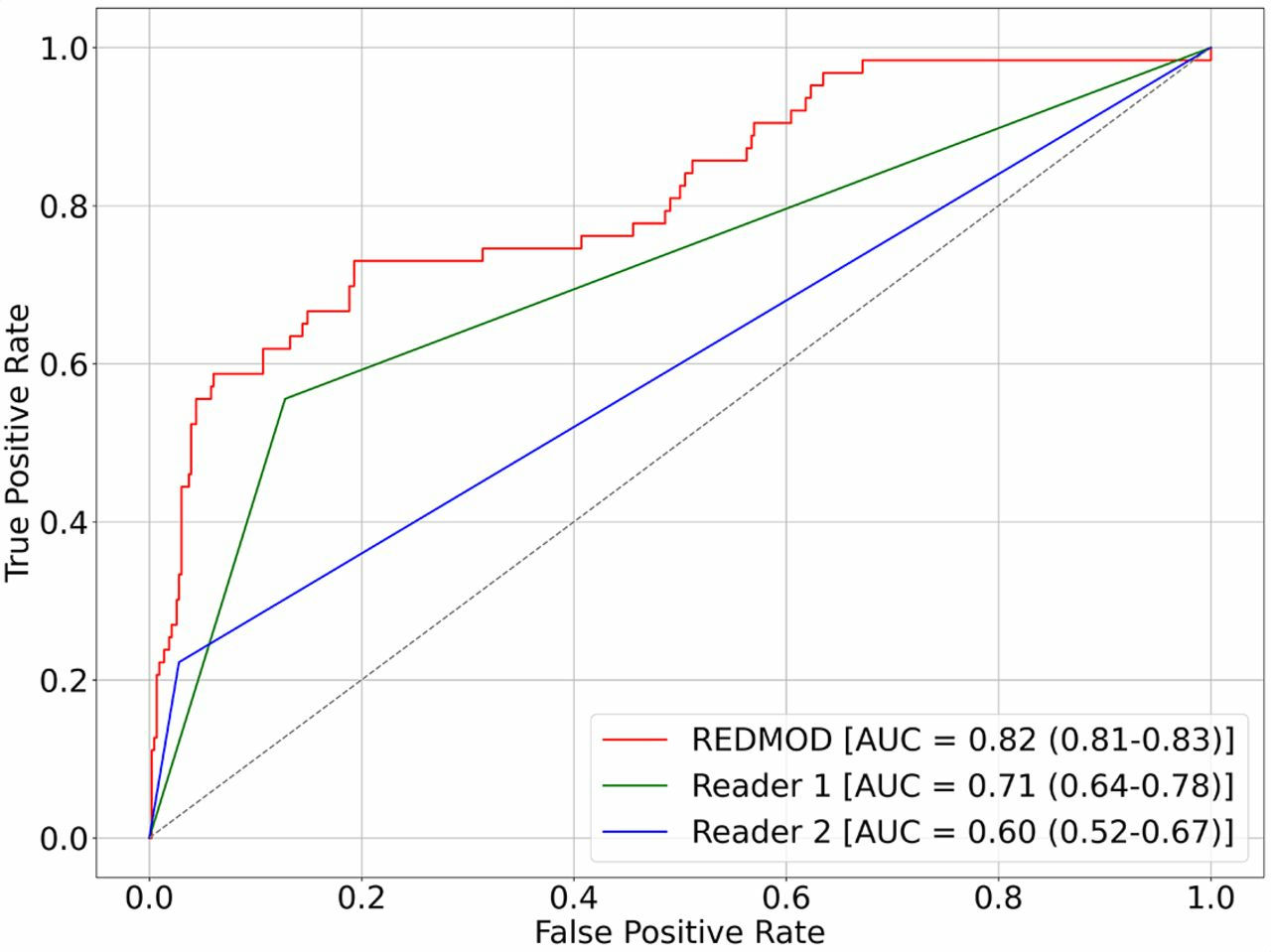
Furthermore, in scan images taken more than two years before diagnosis, the AI detected approximately three times more early-stage cancers that would normally have been missed by specialists. Therefore, researchers report that 'the earlier the diagnosis, the more pronounced the benefits of REDMOD become.' The graph below shows the true positive rate (vertical axis) and false positive rate (horizontal axis) for each threshold, with higher left corners indicating 'fewer false positives and greater accuracy.' The red line indicates that REDMOD demonstrated significantly better accuracy than specialists, shown in green and blue.
REDMOD's predictive results have also been confirmed to maintain stability over time. In patients who underwent multiple scans, REDMOD produced consistent results at intervals of several months, suggesting its potential for long-term monitoring and early detection. Furthermore, it is noteworthy that high accuracy was maintained not only within the Mayo Clinic but also with CT scanners from other manufacturers and data from external institutions acquired under different conditions, suggesting that REDMOD has the potential to be implemented not only in specific hospitals but also in clinical settings worldwide.
Dr. Ajit Goenka, one of the study's authors and a radiologist and nuclear medicine specialist at the Mayo Clinic, said, 'The biggest obstacle to saving lives from pancreatic cancer has been the inability to detect the cancer at a curable stage. REDMOD can identify cancerous features from a seemingly normal pancreas, and it can reliably identify cancer over the long term in a variety of clinical settings.'
This study investigated whether it was possible to predict the presence of cancer in people who have developed cancer based on past data using CT scans. However, to confirm its usefulness in actual clinical practice, a prospective study is essential to apply it to people who will be receiving treatment in the future and track whether the predictions match future diagnoses. Based on this, the researchers argue that the REDMOD framework represents a significant advancement that could shift the approach of diagnosing naturally occurring, common pancreatic cancer from the traditional method of diagnosing it after symptoms appear in the advanced stage to an approach of intervening before the disease develops.
Related Posts:





in AI, Posted by log1e_dh