Why should the 'online age verification system,' promoted under the guise of protecting children, absolutely not be allowed?

In recent years, there has been a growing movement to mandate the implementation of 'online age verification systems' for all internet services and apps, under the guise of protecting children's safety in online spaces. While this may seem like a child-friendly measure at first glance, privacy activist
🧵 THREAD
— Glenn Meder (@GlennMeder) April 28, 2026
1/ Online age verification is the hill to die on.
Not a fight you can sit out. Not a battle you can skip. Not a policy you can afford to ignore while you focus on something else.
This is it. This is the line. This is the infrastructure that enables every other piece…
Maeder argues that online age verification systems are 'infrastructure that enables every element of the digital control network,' and that allowing them would eliminate all online freedom. As a reason, he cites the fact that age verification requires identity verification using a digital ID. In other words, if an online age verification system is introduced for the purpose of protecting children, everyone, including adults as well as children, will need to be authenticated with a digital ID before they can speak, view, or post online.
Maeder stated, 'Age verification is a Trojan horse. Once it gets in, a surveillance state will start operating in earnest.' He added, 'If you love freedom, you should stop online age verification. If you love your family, you should stop online age verification. If you want to do what's best for your children, you should stop online age verification,' warning that they must act quickly before it's too late.
3/ If you love freedom, you must stop online age verification.
— Glenn Meder (@GlennMeder) April 28, 2026
If you love your family, you must stop online age verification.
If you want the best for your children, you must stop online age verification.
This is not optional. This is not someone else's fight. This is yours.…
Once an online age verification system is implemented, it becomes difficult to reverse it. Every time you use a website, platform, app, or web service, your identity and online behavior will be linked, and that data will be permanently stored, monitored, and tracked.
What Ms. Maeder is particularly concerned about is that the online age verification systems being introduced under the guise of protecting children are actually designed to control today's children as 'slaves' for life. Children raised in a world where online age verification systems are commonplace will be unable to pursue ideas anonymously, challenge the government or authority without damaging their reputation, or speak online without the fear that their words might be misused by someone.
Maeder stated, 'They will grow up in a digital surveillance environment. And you will have to tell your children that you had the opportunity to stop it, even though you witnessed it being created.'
6/ Your children will never know what it was like to think freely online.
— Glenn Meder (@GlennMeder) April 28, 2026
They will never explore ideas anonymously. They will never question authority without it being logged in their permanent profile. They will never speak freely without fear that every word will be used…
On the other hand, politicians, influential figures, and corporations promoting online age verification systems are said to have a clear understanding of what they are doing. Maeder points out, 'They are not trying to protect children. They are using children as weapons and building a surveillance infrastructure that can never be openly implemented. They are counting on you to prioritize 'sounding rational' over protecting your children from a system designed to control them forever.'
7/ The psychopaths pushing age verification laws know exactly what they are doing.
— Glenn Meder (@GlennMeder) April 28, 2026
They are not trying to protect children. They are using children as a weapon to build the surveillance infrastructure they could never pass openly.
They are counting on you caring more about…
When political topics such as online age verification systems are brought up, they tend to be linked to political beliefs, such as being right-wing or left-wing, or the political party one supports, with comments like, 'That person is against it because they support the opposition,' 'Only leftists and liberals oppose this claim,' or 'I want to agree with what the ruling party says.'
However, Maeder argues that this is not a matter of right or left, or Republican or Democratic support, but a matter that transcends political beliefs, such as 'freedom or slavery' or 'whether children grow up freely or under surveillance.' 'Age verification laws are being promoted in both Republican and Democratic states. They are being promoted by Republicans and Democrats alike, who smile and say, 'We care about your family,' while locking your children in cages,' Maeder said.
8/ This is not about left versus right. This is not about Republican versus Democrat.
— Glenn Meder (@GlennMeder) April 28, 2026
This is about freedom versus slavery. This is about whether your children grow up free or grow up monitored.
Age verification laws are being pushed in red states and blue states. By…
Mäder's call against online age verification systems has also become a topic of discussion on the social news site Hacker News.
Online age verification is the hill to die on | Hacker News
https://news.ycombinator.com/item?id=47950091
One user points out that if online age verification systems become mandatory, it will only lead to a massive surge in identity fraud, with half of those cases likely being committed by adults trying to protect their privacy.

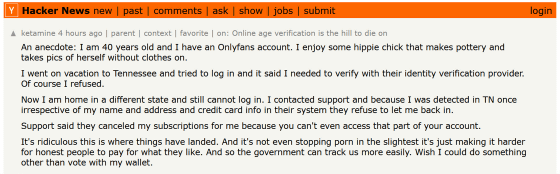
Another user shared their experience with the adult social media platform OnlyFans, where they were asked to verify their identity when trying to log in while traveling in a different state than their home address. After refusing to verify their identity just once, they were subsequently denied login again upon returning home and were forced to cancel their subscription. They expressed
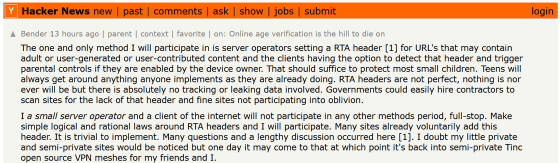
A user who runs a small server commented that they would only participate in the regulations by having the server operator add an adult label (
Related Posts:






in Web Service, Security, Posted by log1h_ik