A 23-year-old amateur solved a mathematical problem that experts had been unable to solve for 60 years; the key was how to use ChatGPT.

It has been revealed that Liam Price, who has no formal education in advanced mathematics, solved a mathematical problem that had remained unsolved for 60 years with the help of ChatGPT.
Amateur armed with ChatGPT 'vibe-maths' a 60-year-old problem | Scientific American
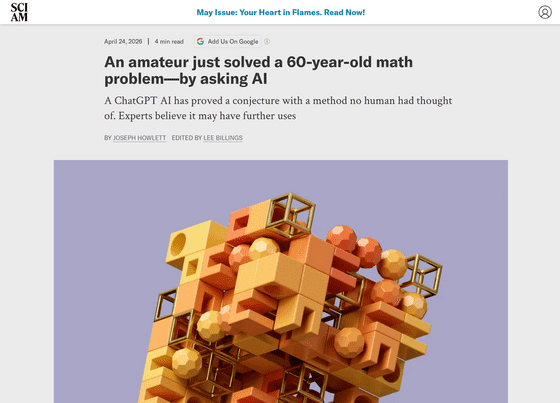
Price is a 23-year-old amateur math enthusiast who was working on one of the many unsolved problems presented by the renowned 20th-century mathematician Paul Erdős. Instead of the conventional approach of starting with rigorous formulations and proofs, Price adopted an 'intuitive' method in which he first allowed the AI to generate ideas freely, and then humans selected and filtered the output.
The AI did not directly write the proof, but rather helped Price solve the problem by suggesting approaches that humans would not have thought of. The final solution submitted was reportedly a method that even math experts had never considered before.
Mathematician Terence Tao described the situation by saying, 'Humans made a slight mistake in their initial approach to this problem.' He suggested that the reason it remained unsolved for so long wasn't because the problem was inherently difficult, but rather 'because of a habit in human thinking.'

This case demonstrates that AI can powerfully support the expansion of human thinking. It is particularly adept at presenting ideas that are not bound by existing intuition or conventions, and mathematics experts are pointing to its potential application to other unsolved problems. In fact, there have been reports of researchers using ChatGPT to search past literature and discover overlooked answers or partial solutions, and studies have emerged that have found new proof ideas with the support of AI.
As of April 2026, there are limits to AI's ability to autonomously construct rigorous proofs, meaning that AI will not simply replace mathematicians. In this case, the 'proof' produced by ChatGPT was quite poor, and it required some deciphering to understand what it was trying to say.
Nevertheless, the fact that 'a single amateur, in collaboration with AI, reached a solution that even a group of experts couldn't achieve' suggests that the style of mathematical research is changing.
Related Posts: