Anthropic has reported its findings regarding the decline in Claude's quality and will reset user restrictions.

Anthropic has investigated the issue of a decline in quality reported by users of its AI service 'Claude' and has reported its findings.
An update on recent Claude Code quality reports \ Anthropic
According to Anthropic, performance in Claude Code, Claude Agent SDK, and Claude Cowork was degraded between March 4, 2026 and April 20, 2026, due to three causes. The API was not affected.
◆Reason #1: The standard inference load of the Claude Code has been reduced.
In most cases, the longer an AI model thinks, the better its output. However, this also comes with drawbacks such as increased response times and a higher likelihood of hitting usage limits. Therefore, Claude Code allows users to set 'how long the AI should think.'
When Anthropic released Claude Opus 4.6 to Claude Code in February 2026, they set the default inference load to 'high'. However, the high setting sometimes resulted in extremely long thinking times, and users provided feedback such as 'the UI appears to freeze because the inference takes too long' and 'token usage suddenly increases when the inference takes too long.'
Internal testing showed that even when the task speed was reduced to 'medium,' delays were significantly reduced for most tasks, albeit at the cost of a slight decrease in quality.
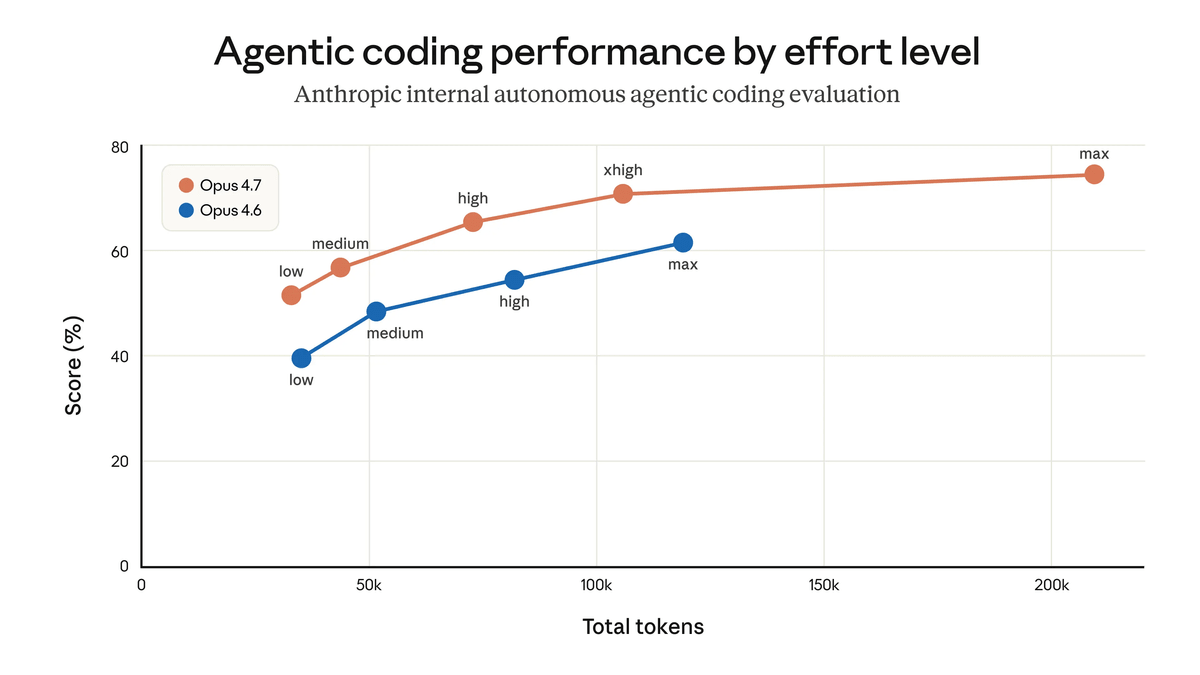
Therefore, to reduce latency, Anthropic changed its default inference load from high to medium on March 4, 2026. Claude Code's dialog also recommended the medium setting.
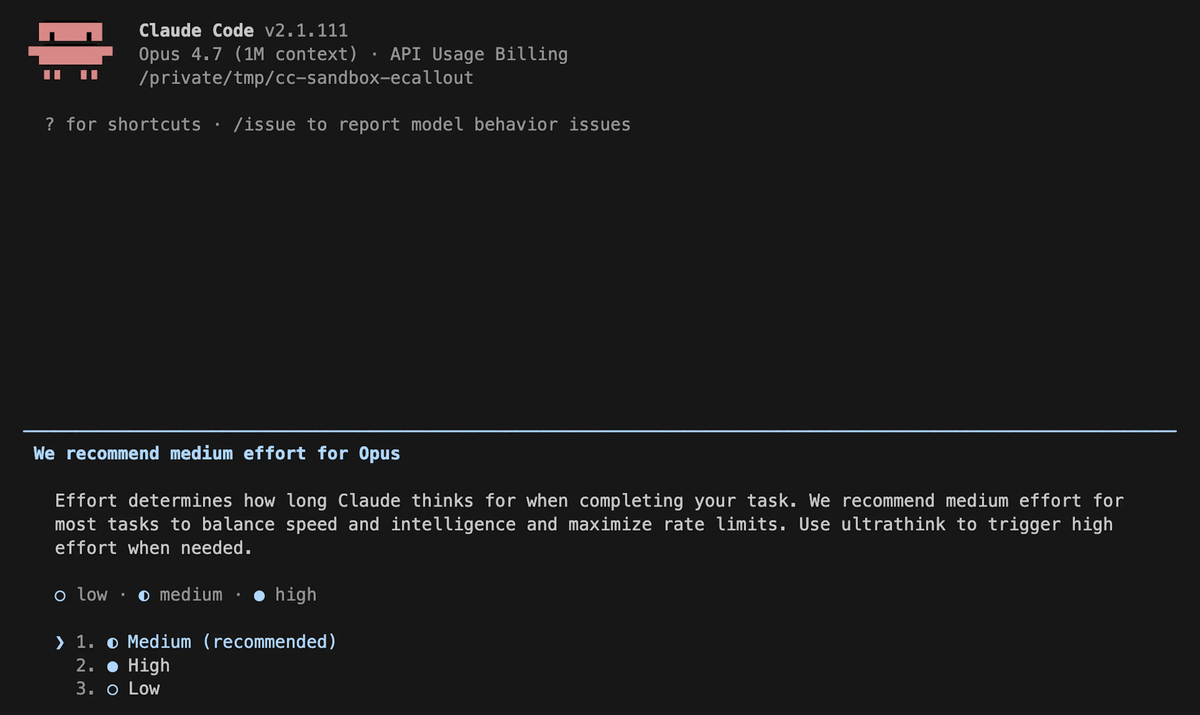
However, immediately after the changes, a flood of reports came in from users stating that 'Claude Code's intelligence has decreased.' Anthropic changed the design of things like the startup notification and the workload setting selector to let users know that 'the settings can be changed,' but most users continued to use the default settings.
Ultimately, Anthropic reversed the change on April 7, 2026, and changed the default setting for the Claude Opus 4.6 back to 'xhigh,' one level above high, and the default setting for other models back to 'high.'
◆Cause #2: Changes that remove old thinking
The reasoning Claude makes when performing a task is saved as a cache in the conversation history and can be referenced when continuing the reasoning later. However, if too much old cache accumulates, it will no longer fit in the prompts, so on March 26, 2026, Anthropic made a change to 'delete old thought history if the session has been idle for more than one hour.'
However, there was a bug in the implementation; instead of deleting past thought history if the session had been idle for more than an hour, it ended up deleting the thought history of any session that had been idle for more than an hour. As a result, Claude would forget his previous thoughts every time he started a new one, leading to reports from users that he was experiencing severe forgetfulness and repetition.
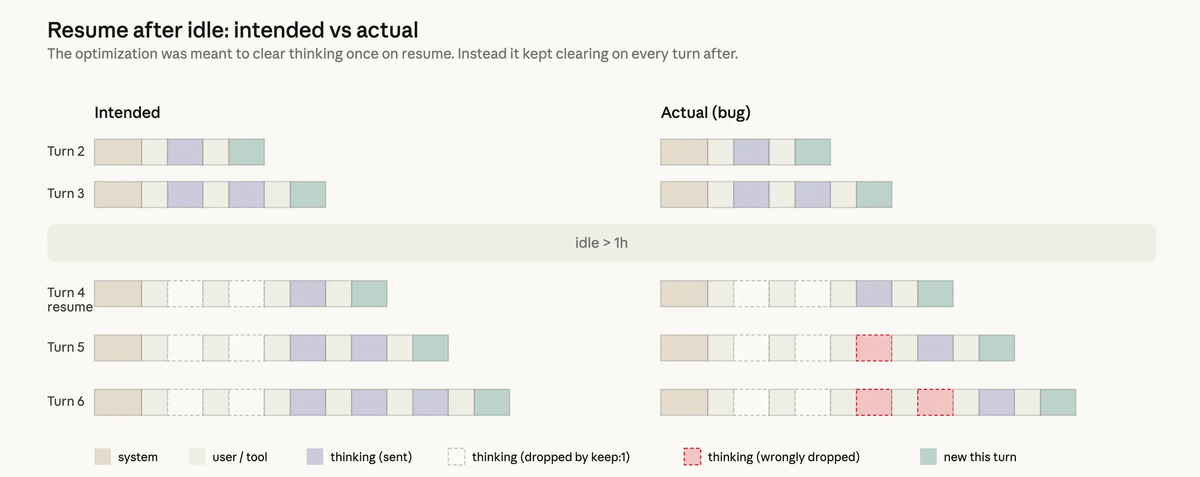
The continuous deletion of previous thought processes from subsequent requests also led to a problem of frequent cache misses. Anthropic stated, 'We believe this was the root cause of the problem of usage limits being consumed too quickly.'
Reports indicate that Anthropic's Claude quickly reaches its usage limit with typical use, rendering it unusable - GIGAZINE

The bug that caused thought history to be accidentally deleted was fixed on April 10, 2026.
◆Cause #3: Changes to system prompts to reduce redundancy
Claude Opus 4.7, released on April 16, 2026, has a 'redundancy' that results in significantly longer output compared to previous models. While this enhances its ability to handle difficult problems, it also increases the number of output tokens, so Anthropic has added a character limit to the system prompt.
Specifically, they added phrases such as, 'Keep the text between tool calls to 25 words or less. Unless the task requires more detailed explanation, keep the final answer to 100 words or less.' After several weeks of internal testing that yielded no problems, Anthropic confidently released the new system prompts alongside Claude Opus 4.7.
However, in this investigation, an expanded evaluation set was used to examine the impact of the system prompt change, and it was found that there was approximately a 3% performance decrease in both Claude Opus 4.6 and Claude Opus 4.7. Anthropic states that they reverted the system prompt to its original state on April 20, 2026.
Anthropic stated, 'We take the reports of performance degradation very seriously. We never intentionally degrade our models,' and announced that they reset usage restrictions for all users on April 23, 2026.
Related Posts:






in AI, Posted by log1d_ts