An AI called 'Mediator.ai' has emerged that takes the arguments of both sides as input and mathematically proposes a fair compromise.

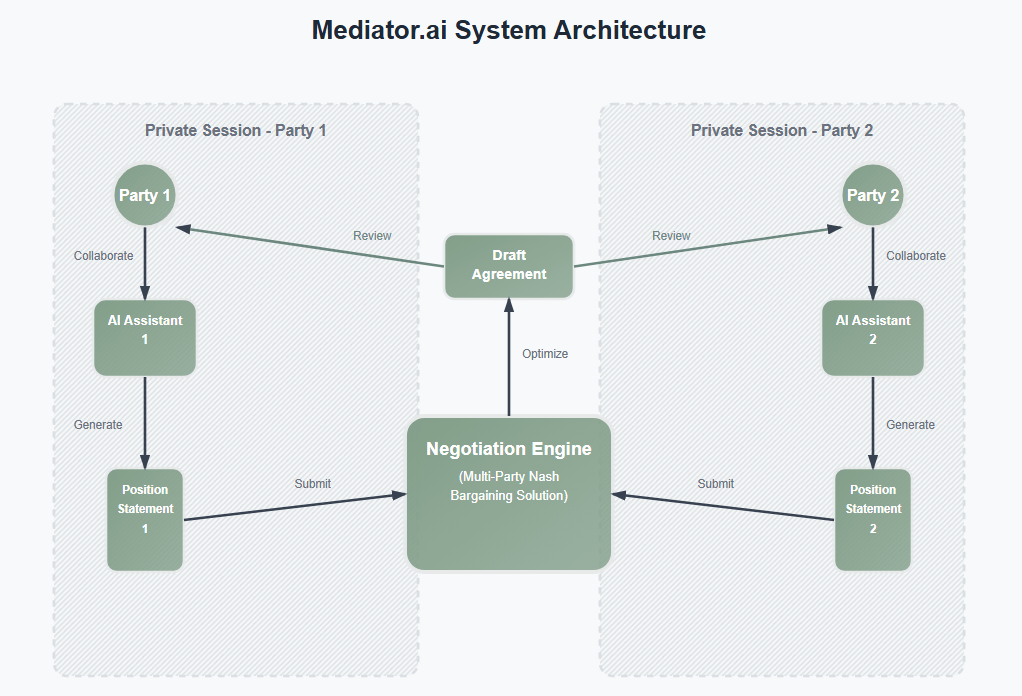
An AI platform called ' Mediator.ai ' has emerged that allows two opposing parties to input their respective arguments privately and then present a fair compromise that satisfies both sides. This system utilizes a large-scale language model (LLM) to convert individual preferences expressed in natural language into mathematical utility functions and calculates an agreement that maximizes fairness based on
Mediator.ai - Cooperative negotiation is a solvable problem
https://mediator.ai/
The underlying theory of Mediator.ai is inspired by the developers' own experience with prenuptial agreements and aims to solve the problem that traditional negotiations tend to favor the more assertive party.
Research suggests that highly cooperative individuals tend to suffer a lifetime earnings disadvantage of up to $460,000 (approximately 70.8 million yen). In contrast, Mediator.ai employs John Nash's mathematical negotiation solution, maximizing the product of utility functions representing each participant's satisfaction to arrive at a provably fair agreement that optimizes the overall benefit without compromising the interests of either party.
The Mediator.ai process centers on each party interacting with a dedicated AI assistant to clarify priorities—what is important and what is negotiable. The AI assistant generates hundreds of one-to-one comparison questions and estimates a utility function that includes emotions and context, which are difficult to quantify, by determining which of proposals A and B the user prefers. The negotiation engine then uses a genetic algorithm to iteratively refine multiple candidate proposals, deriving the optimal agreement that maximizes the Nash product.
For example, consider a case where a couple jointly purchases a $720,000 (approximately 114 million yen) house, with the man contributing $126,000 (approximately 20 million yen) as a down payment and the woman contributing her entire savings of $54,000 (approximately 8.6 million yen). Mediator.ai proposes a unique compromise that would be difficult for humans to conceive on their own: while maintaining a simple 70%/30% ownership ratio, the man pays $10,000 (approximately 1.6 million yen) in advance into the woman's personal account to alleviate her anxiety about running out of funds.

In negotiations to sell an auto repair shop, in addition to a sale price of $280,000 (approximately 45 million yen), they included a clause stating that the non-compete obligation would be waived if the buyer defaulted on payments, thus balancing mutual trust and risk management. Regarding the issue of scope creep , where requirements are added during a project in freelance web development, they proposed an additional contract of $6,500 (approximately 1 million yen) to ensure the deliverables were delivered on time, and a plan to separate subsequent functions into Phase 2.
Mediator.ai is reportedly used primarily in low-risk areas where structural fairness is needed but doesn't warrant hiring a lawyer, such as dividing household chores with roommates or planning childcare. The cost per session is inexpensive at about $2 (approximately 320 yen), but the system assumes that both parties are willing to compromise.

Mediator.ai creates multiple proposed agreements, but it only creates proposals. The parties involved must discuss which proposal to adopt, or whether to adopt any at all, and legal review by a lawyer is required to give the document legal binding force. Nevertheless, it is expected to be a new tool for facilitating smooth negotiations by clarifying mathematically fair lines.
Related Posts:








in AI, Posted by log1i_yk