Cal.com's decision to change its open-source policy 'for security reasons' is drawing criticism.

Following advancements in AI security, Cal.com , a schedule management tool that was previously open source, switched to closed source, citing concerns that 'security could not be ensured if the source code could be examined by AI.' However, this move has been met with negative reactions from the community.
Cal.diy: open-source community edition of cal.com | Hacker News
https://news.ycombinator.com/item?id=47852155
Cal.com was originally released under the title 'An open-source alternative to Calendly,' and in a 2025 blog post, it stated that 'because it's open source, the app can be installed internally, making it ideal for companies handling confidential information.' It has expanded its market share by touting its open-source nature.
However, in April 2026, they announced a transition from open source to closed source, citing security risks if AI could examine the source code.
Open-source software 'Cal.com' decides to move to closed-source mode due to security risks associated with AI - GIGAZINE
In its announcement, Cal.com emphasized that it 'has not lost its open-source spirit,' and has open-sourced the security-critical parts of Cal.com, such as authentication and data processing, as 'Cal.diy' under the MIT license.
GitHub - calcom/cal.diy: Scheduling infrastructure for absolutely everyone. · GitHub
https://github.com/calcom/cal.diy
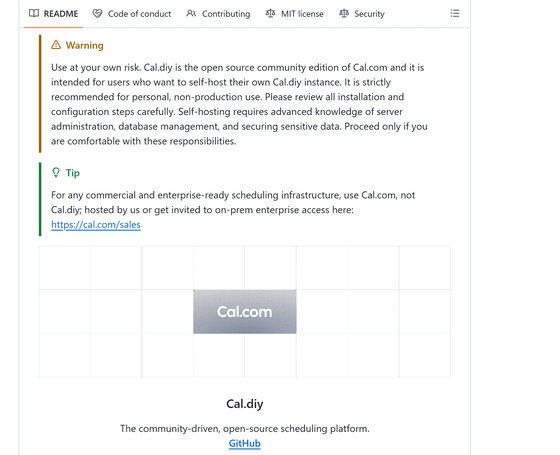
However, the description for Cal.diy states that it is 'recommended for personal, non-production use only,' which contradicts the previous description that it is 'ideal for businesses.' In addition, Cal.diy has removed features that are available in Cal.com's commercial and enterprise plans, such as 'Teams' and 'Automated Workflows,' and now includes an advertisement that says, 'For commercial use, please go to Cal.com.'
Comments from the community include, 'You can't trust a company that exchanges products just to attract customers,' and 'It's problematic to use open source as a market entry strategy and then easily back off once you've gathered the developers' contributions and support.'
On the other hand, some comments defended Cal.diy's explanation, saying, 'The Cal.diy explanation is a means to avoid legal liability, and it's possible to host it yourself,' but this was met with the counterargument that 'liability is already avoided by the open-source license terms.'
Some comments speculated that 'Cal.com simply wants to move to closed source for business reasons, and AI and security are merely justifications.'
Related Posts:







in Software, Posted by log1d_ts