Research shows that saunas lower heart rate more effectively than exercise and have a definite restorative effect.

A study analyzing data from wearable device usage has been reported to investigate whether saunas actually have positive effects on the body. The results showed that on days when people use saunas, their minimum heart rate decreases, and it may have a greater restorative effect on the body than exercise.
Saunas Lower Your Heart Rate More Than Exercise - Terra Research
Saunas have existed since the primitive age of ancient Finland and have always been thought to have therapeutic effects. In fact, various scientific studies have shown that saunas are as beneficial to health as exercise , and that people who frequently use saunas are less likely to develop dementia. On the other hand, there are also areas where understanding is lacking , such as the fact that some sauna users enter saunas expecting the wrong benefits , and that previous research has focused on the long-term health effects of sauna bathing, with little understanding of the immediate physiological responses.
Bathing and saunas, which warm the body, have been found to be as beneficial to health as exercise, and may also be effective as a treatment for diabetes patients - GIGAZINE

Therefore, Terra API , a UK-based software company that develops wearable devices, collected data from 256 wearable device users who also use saunas via their app. By aggregating approximately 59,000 heart rate data points per day, they investigated the physical condition of users on days they used saunas and on days they did not.
In this study, we used a t-test to analyze the corresponding effects in order to evaluate the immediate effects of saunas. For example, even if there is data indicating that 'people feel tired on days they use a sauna,' if many people use a sauna after exercising, this 'tiredness' data may be due to the exercise. Therefore, we conducted comparisons not only with simple observational data but also with values adjusted for activity levels.
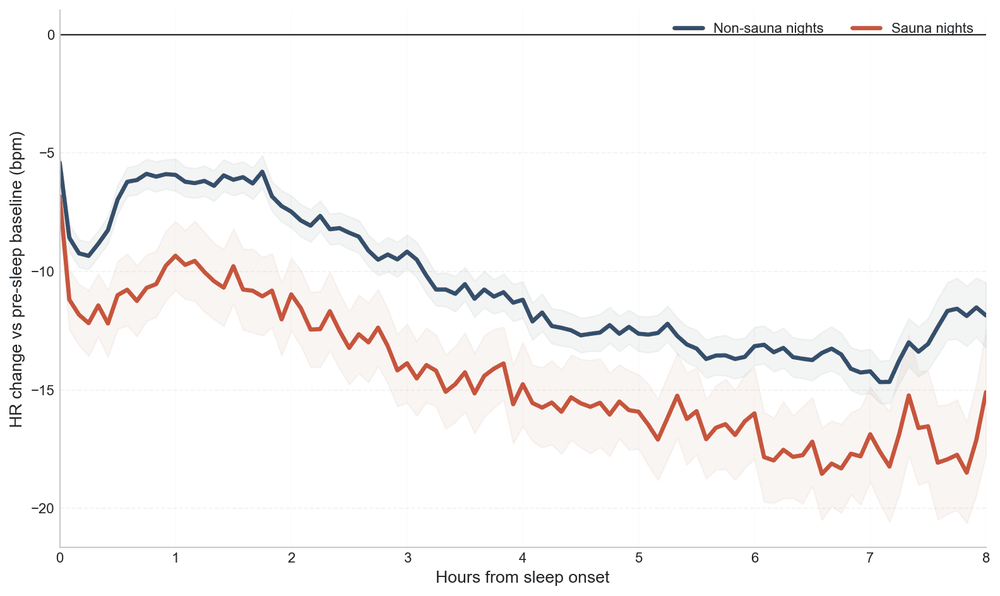
The analysis revealed that on days when participants used a sauna, their minimum heart rate tended to be lower compared to days when they did not. According to Terra API, this effect persisted even after adjusting for activity levels. The difference between sauna-using and non-sauna-using days averaged 5% (3 beats/minute), which is considered a significant physiological change. The graph below shows the decrease in heart rate over the entire sleep period, with red representing sauna-using days and blue representing non-sauna-using days.
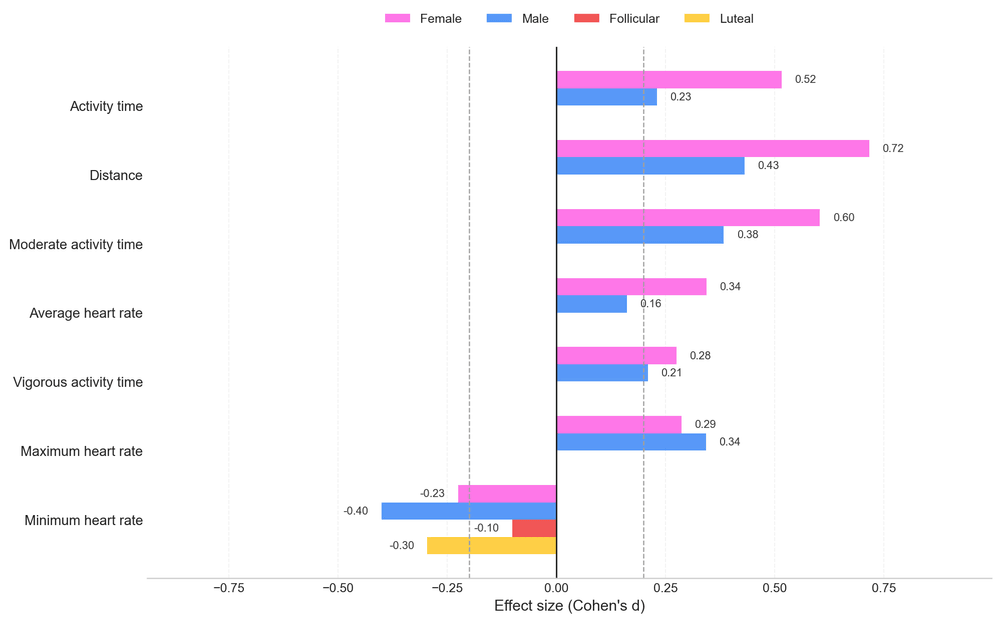
Furthermore, it was found that women showed a more pronounced increase in activity levels on sauna days. This may reflect the fact that women tend to use the sauna only on training days. On the other hand, the decrease in minimum heart rate on sauna days was smaller in women than in men. The graph below shows the changes between sauna days and non-sauna days, with activity time at the top and minimum heart rate at the bottom. Previous studies by Terra API have suggested that the menstrual cycle may affect recovery and nocturnal heart rate, and this study suggests that the effects of sauna may also be related to the menstrual cycle.
Based on these analysis results, Terra API explains: 'Sauna use is one of the activities aimed at recovery. Sauna use is associated with high levels of activity, which is consistent with how people actually use saunas, often as part of a post-exercise routine. However, even considering the level of activity, the minimum nighttime heart rate is lower on sauna use days, suggesting that saunas provide a 'physiological recovery' that cannot be explained by exercise alone. Mechanistically, this pattern is consistent with known heat stress physiology. During sauna use, heart rate increases, followed by recovery dynamics that reflect increased parasympathetic activity during cooling, leading to a decrease in heart rate and recovery during sleep.'
Kyriakos Elefteriu, who wrote the Terra API report, appeared on the social news site Hacker News to explain the experimental methodology and results. According to Elefteriu, one surprising finding from the analysis was that, if nighttime heart rate is considered a 'parasympathetic nervous system recovery signal,' saunas appear to be more effective than moderate exercise. However, it should be noted that this data analysis did not control factors such as the type of sauna and duration of use, and only included users who used wearable devices to visit saunas, meaning the data is limited to people with a relatively high level of health consciousness.
Related Posts:





in Note, Posted by log1e_dh