A play review of 'Dewan,' a game where you lead a tribe, build camps within a limited area of land, develop the story, and collect victory points.
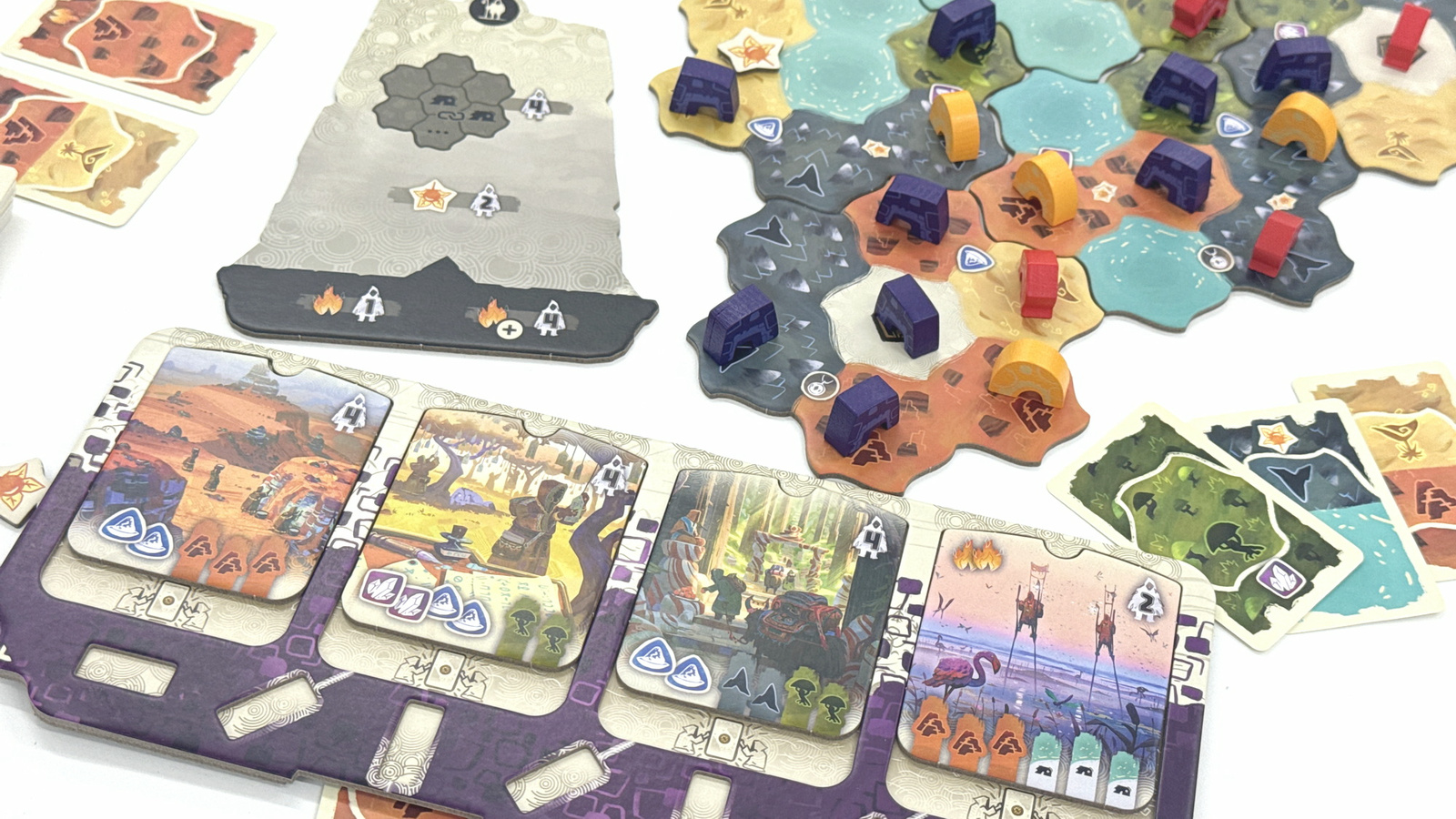
' Dewan ,' a board game where you lead a tribe, travel the world, establish bases, secure resources, and compete with other tribes for survival, has been released by Hobby Japan. It was provided as a prize in
Dewan | ANALOG GAME INDEX
https://hobbyjapan.games/dewan/
◆Open
This is what the outer box of the Dewan looks like.
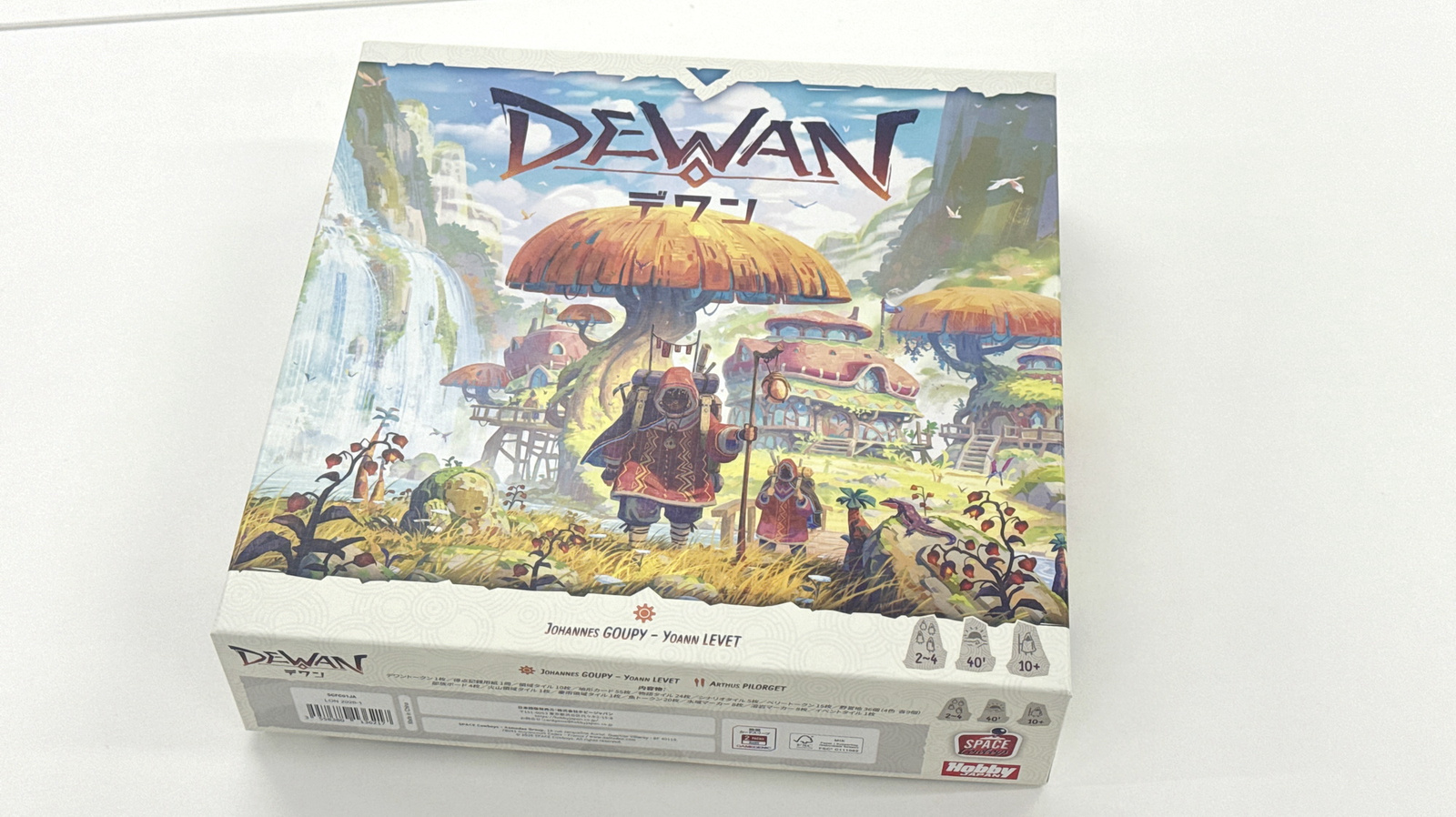
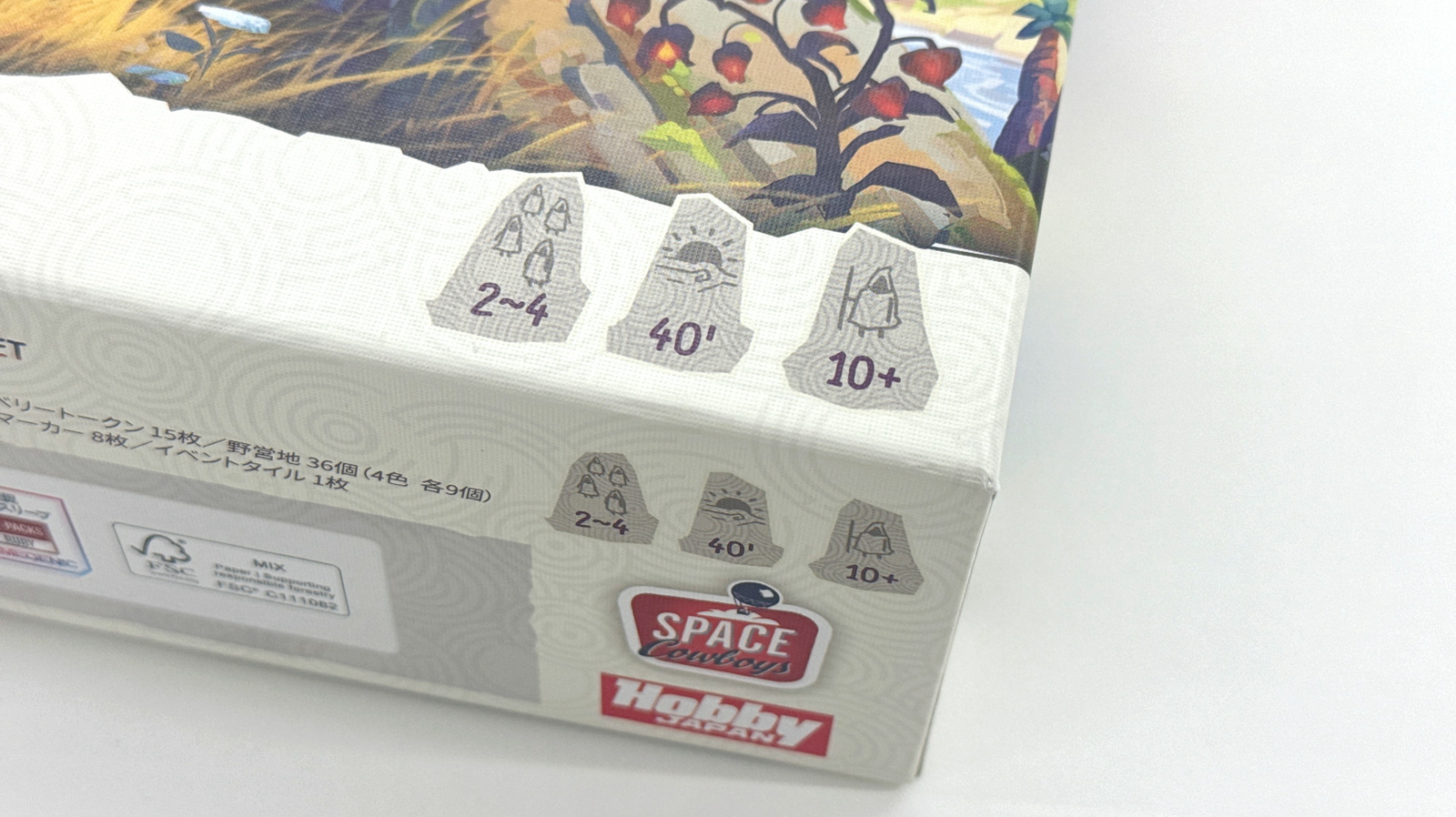
The game is designed for 2-4 players, has a play time of 40 minutes, and is intended for ages 10 and up.
I checked the contents. The storage method and the tokens/tiles.
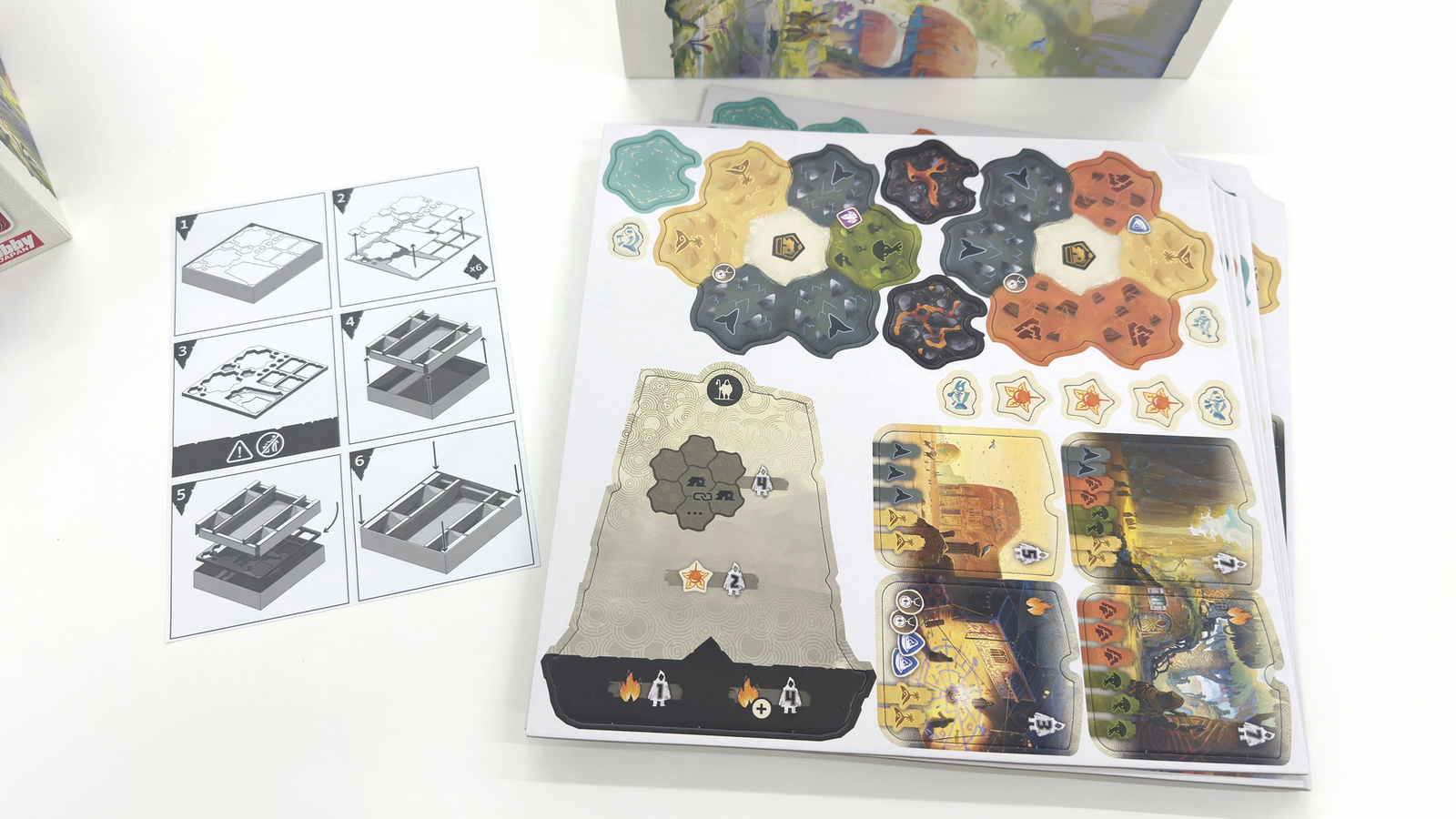
The tokens and tiles are made of cardboard and have perforations, so they can be easily separated without scissors.
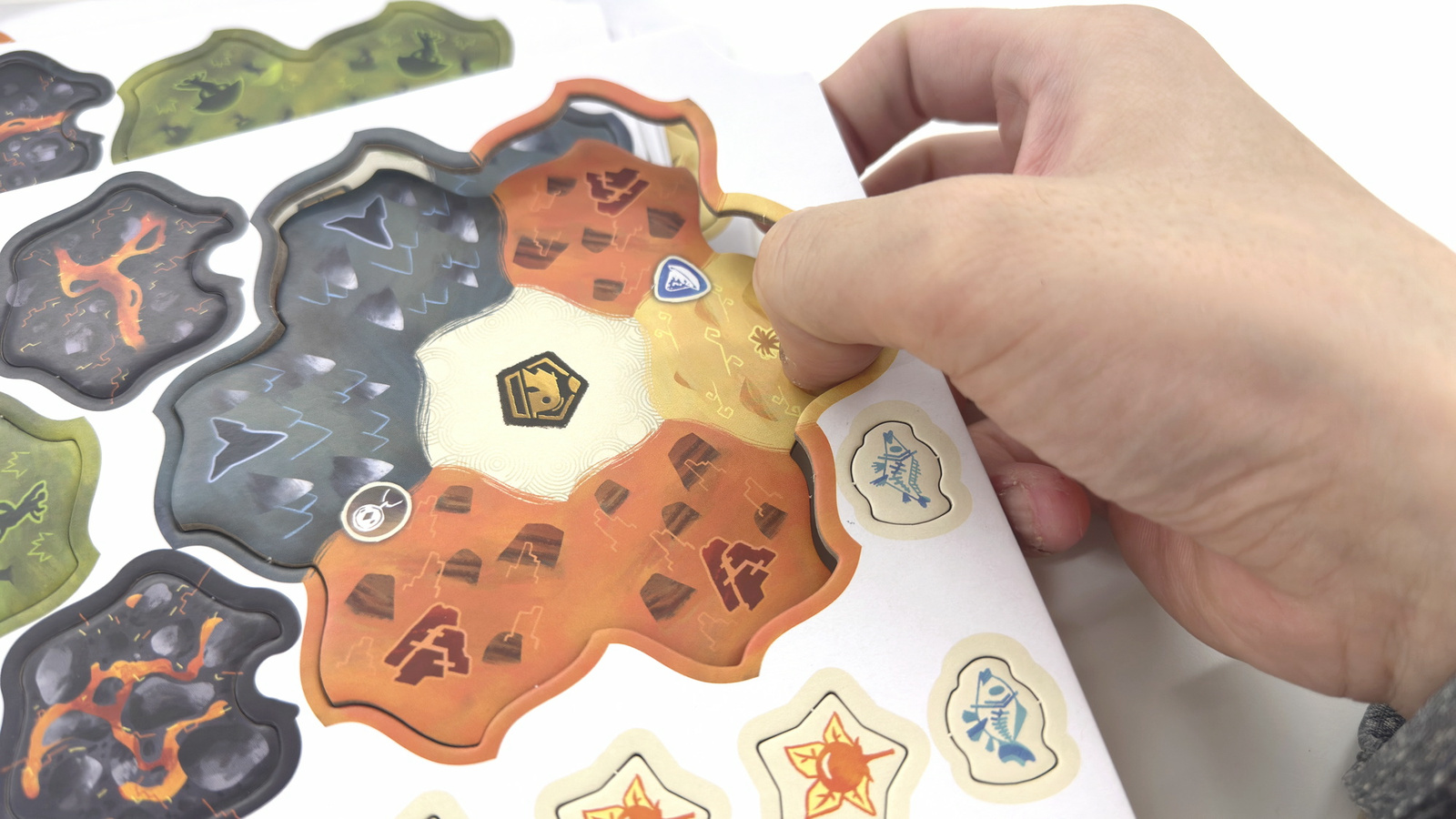
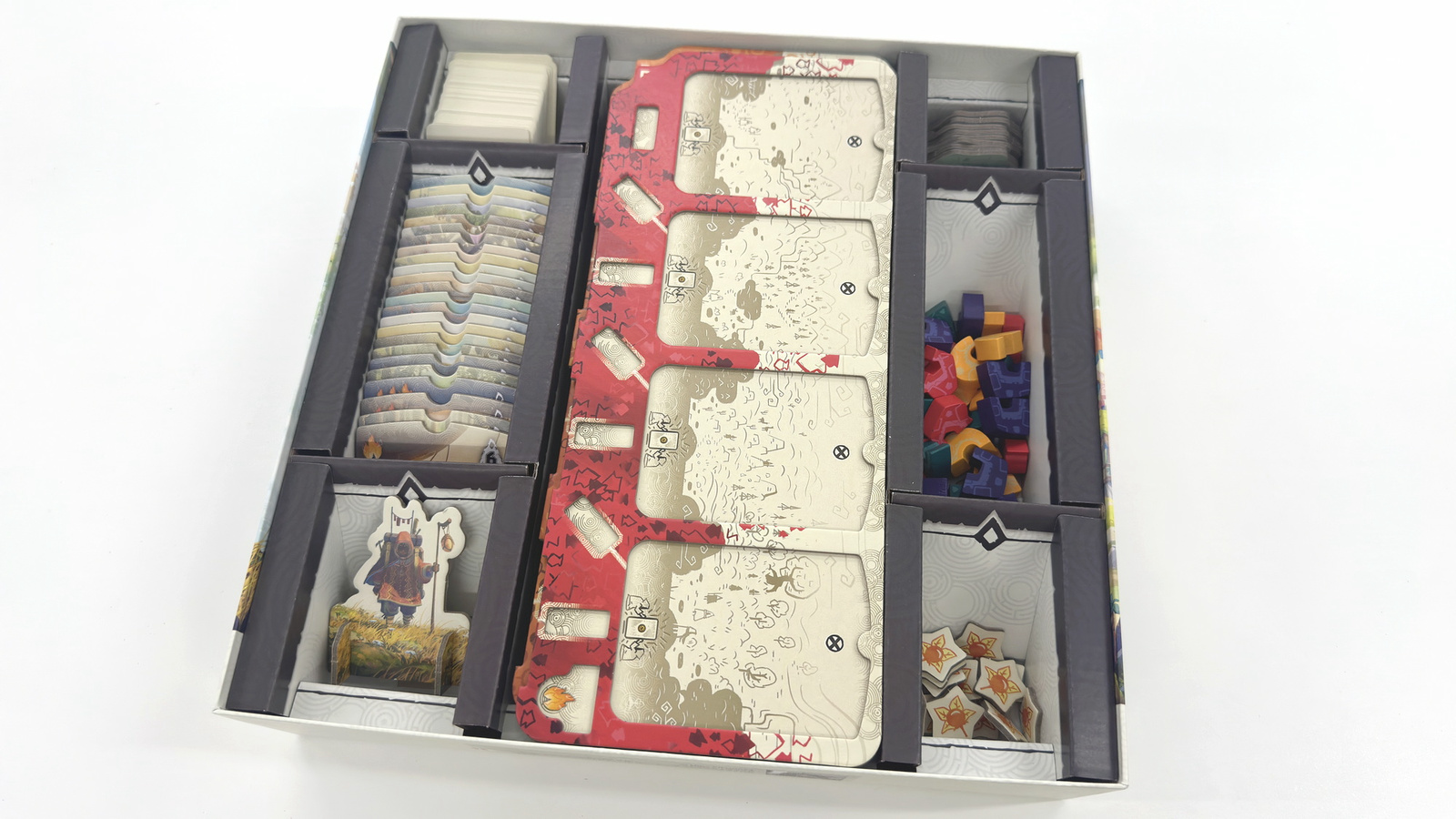
The cardboard frame, once detached, can be stored in the outer box.
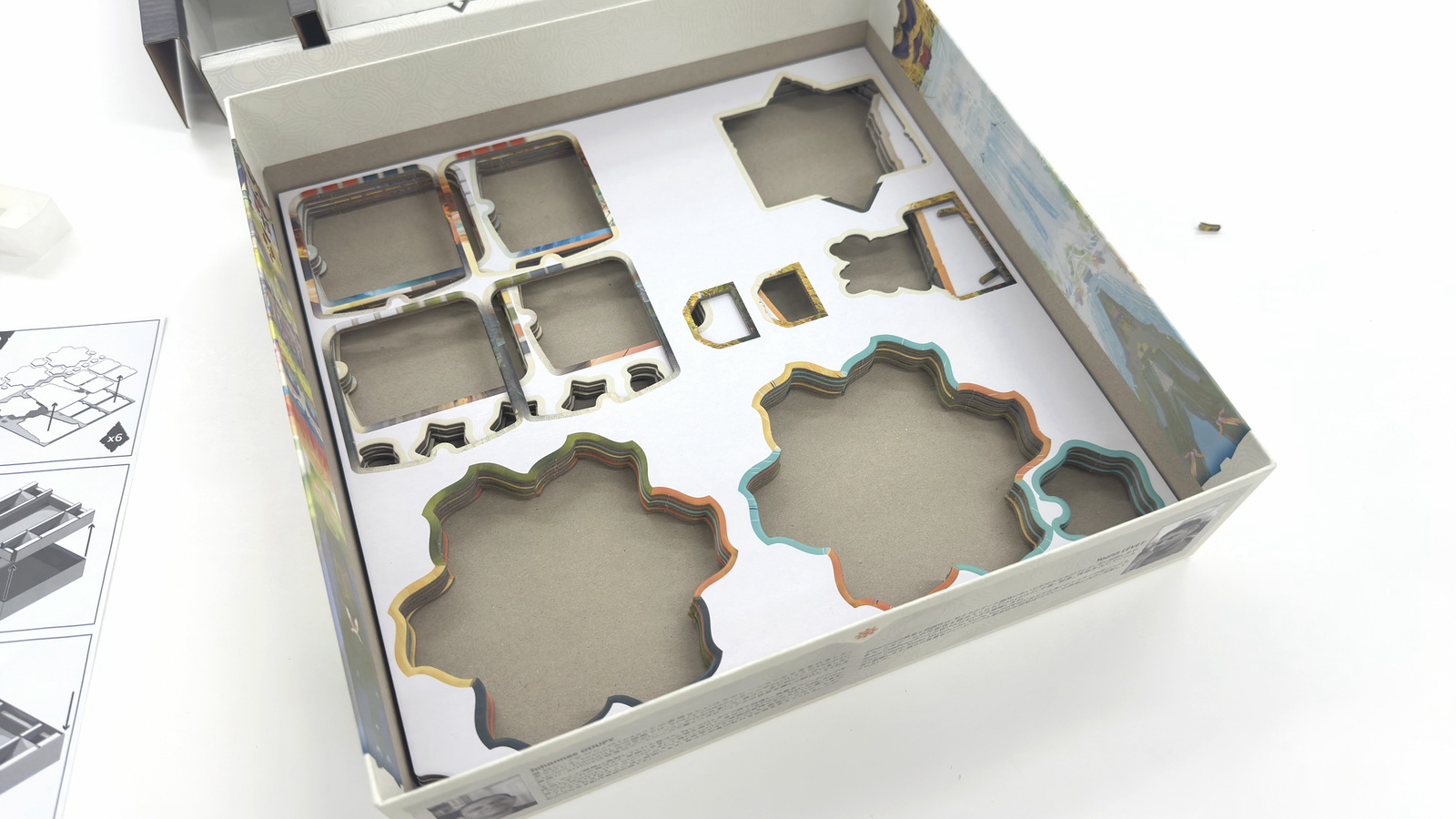
Simply place the inner box on top of the cardboard frame.
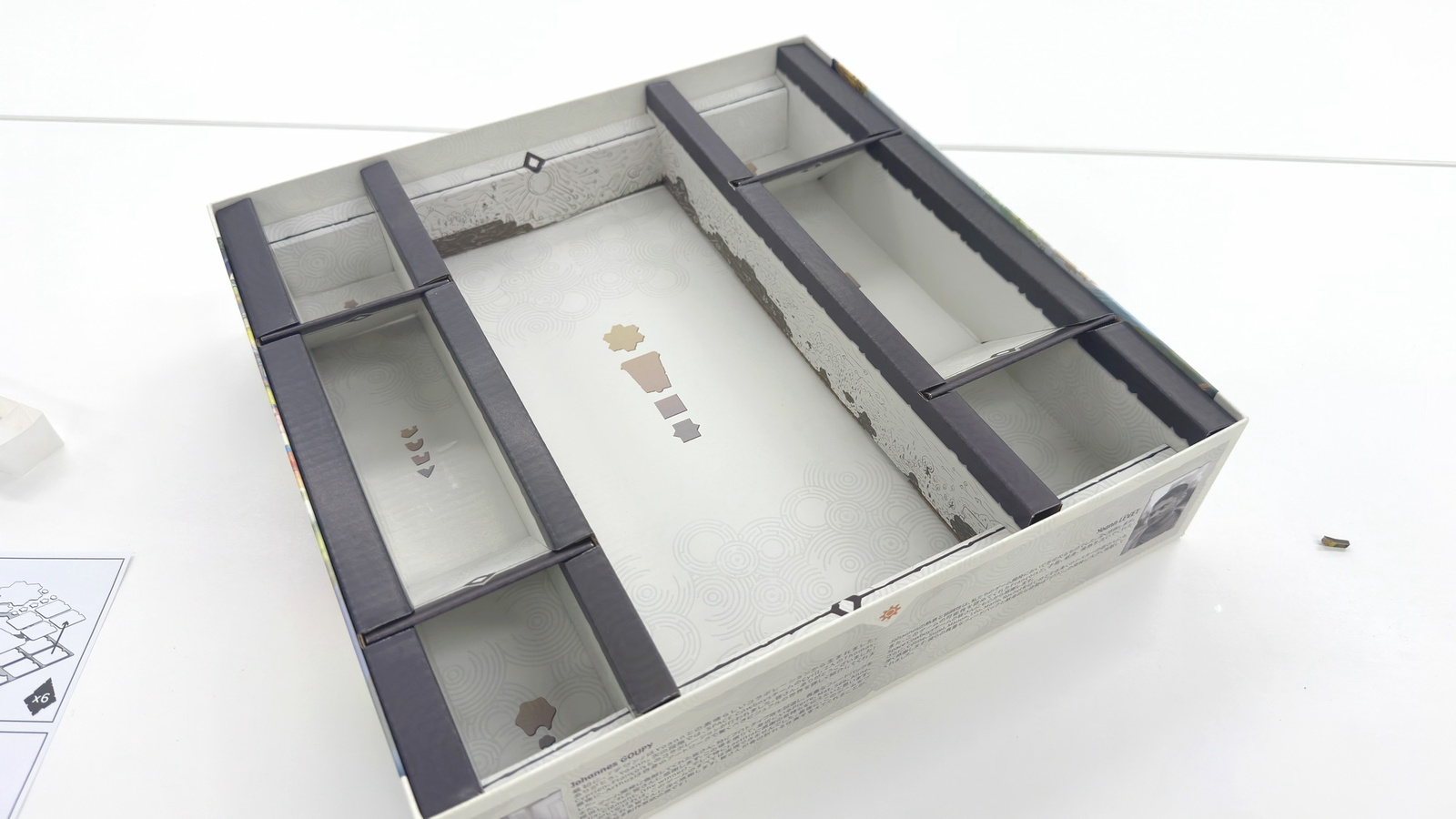
Four tribal boards and a score sheet.
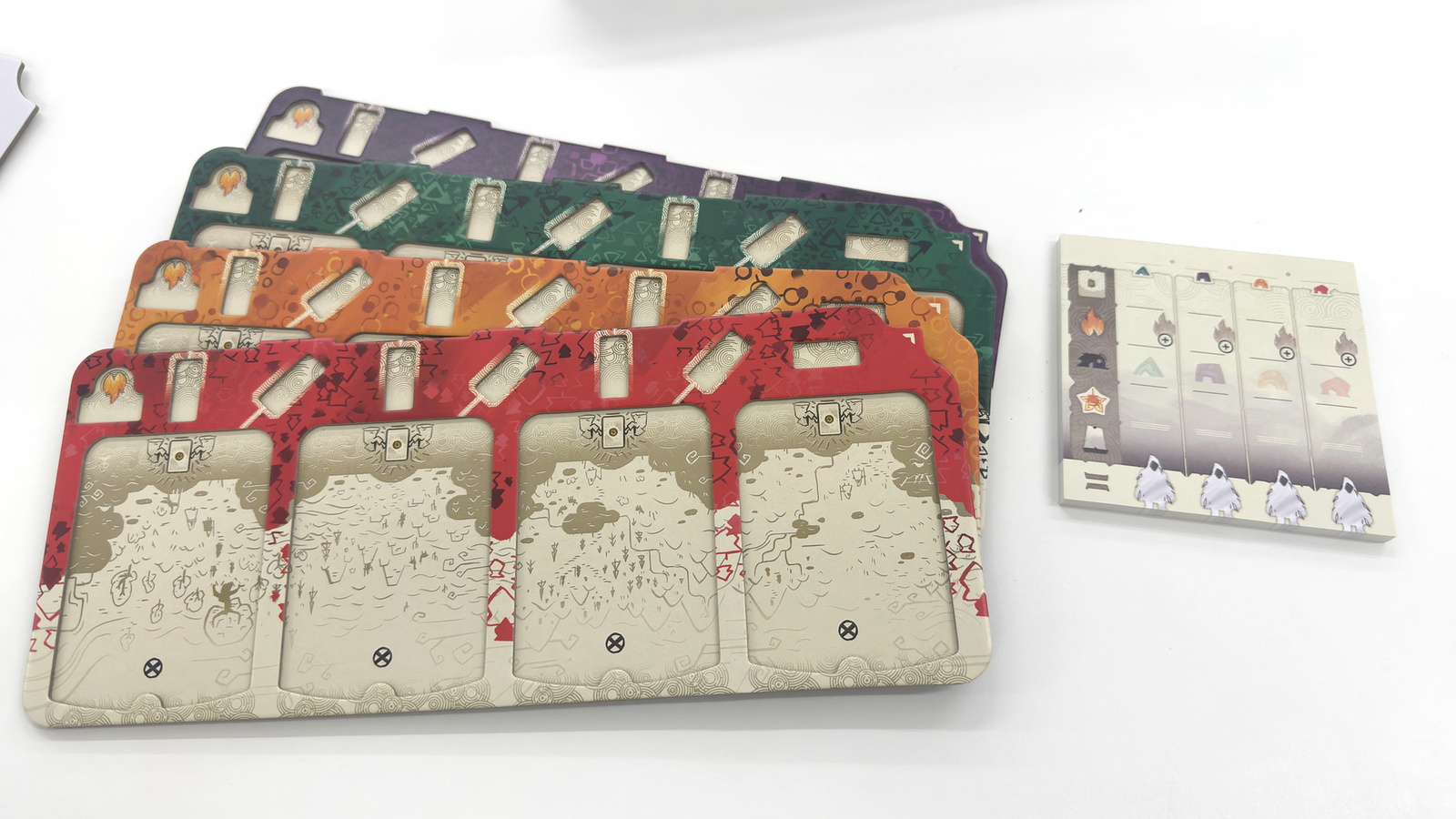
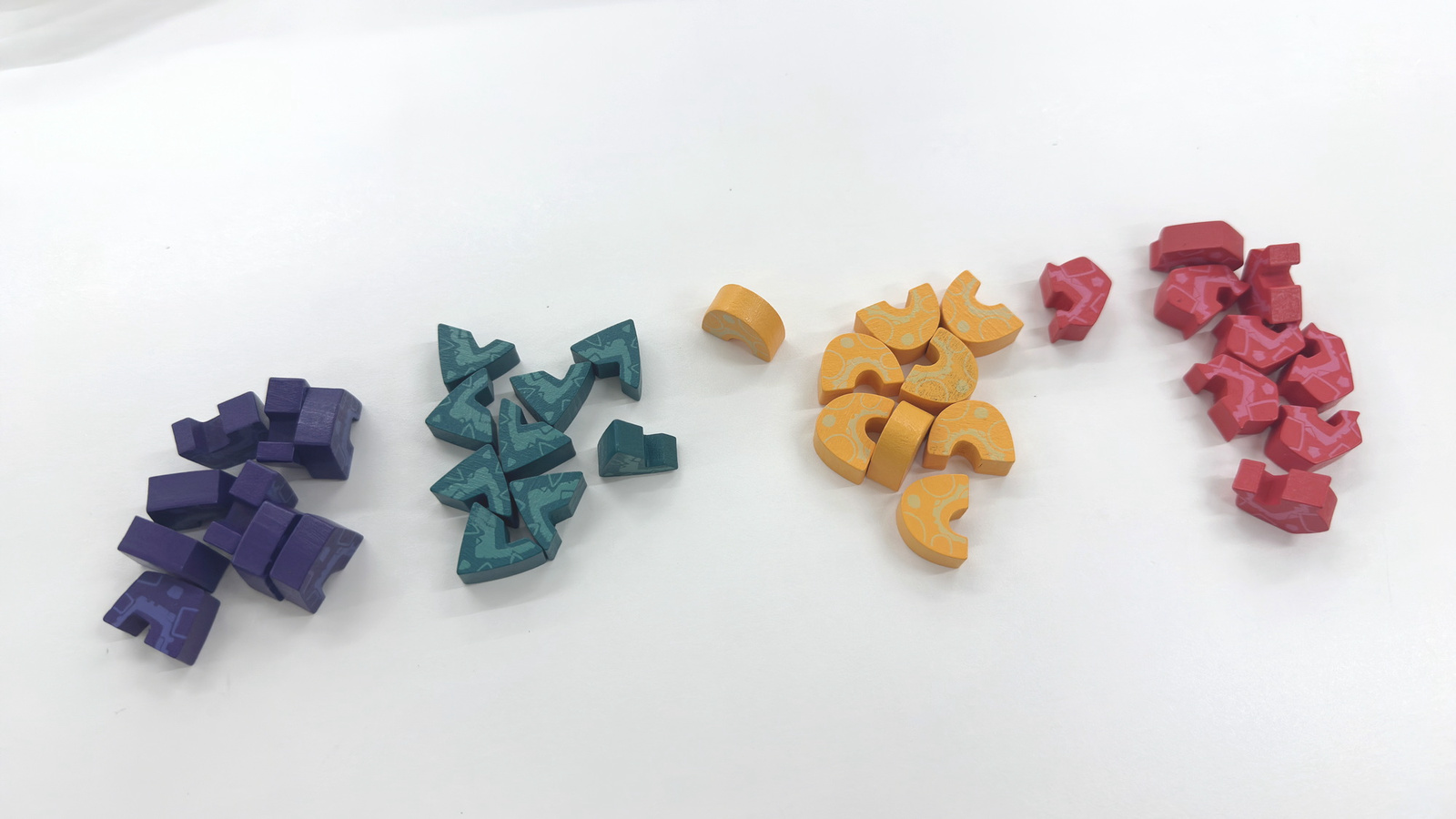
There are 9 campsite pieces in 4 different colors.
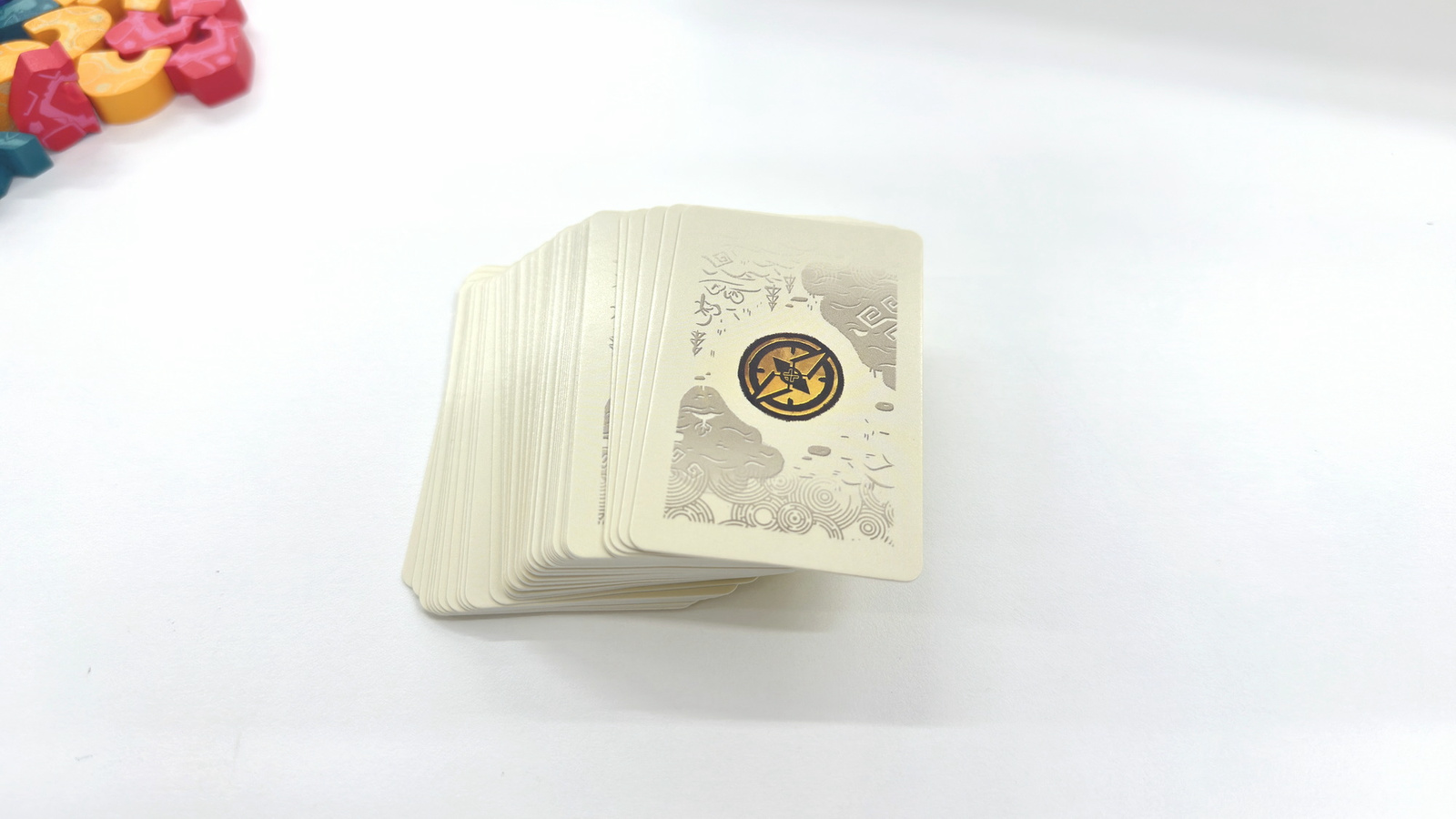
55 terrain cards
The contents can all be neatly stored in the inner box.
◆Preparing to play
This time, we'll be playing with three people. First, we'll place the scenario tiles on the table.
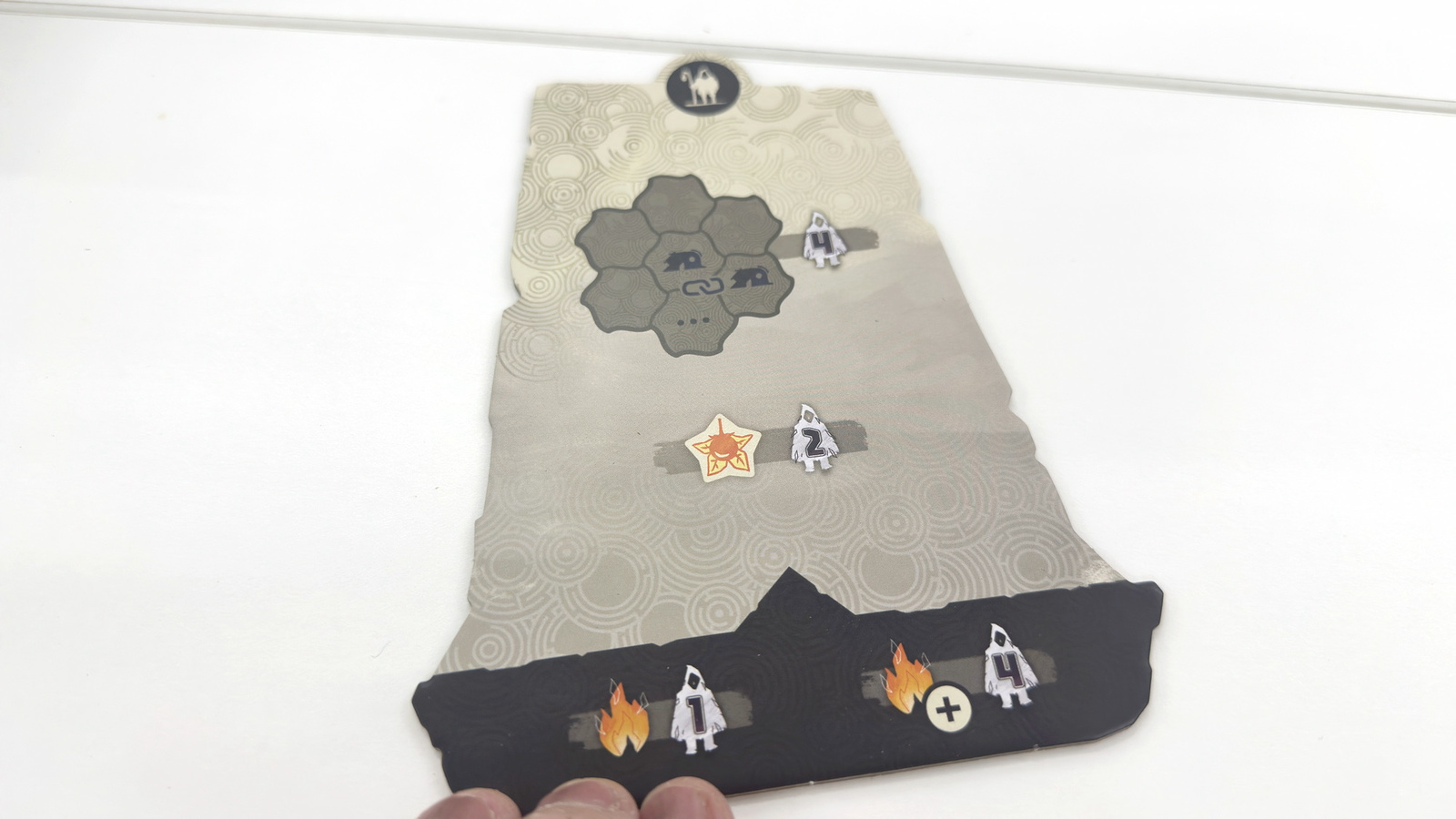
Each player is dealt one initial tile, and then one neutral tile. So, each player receives a total of two tiles.
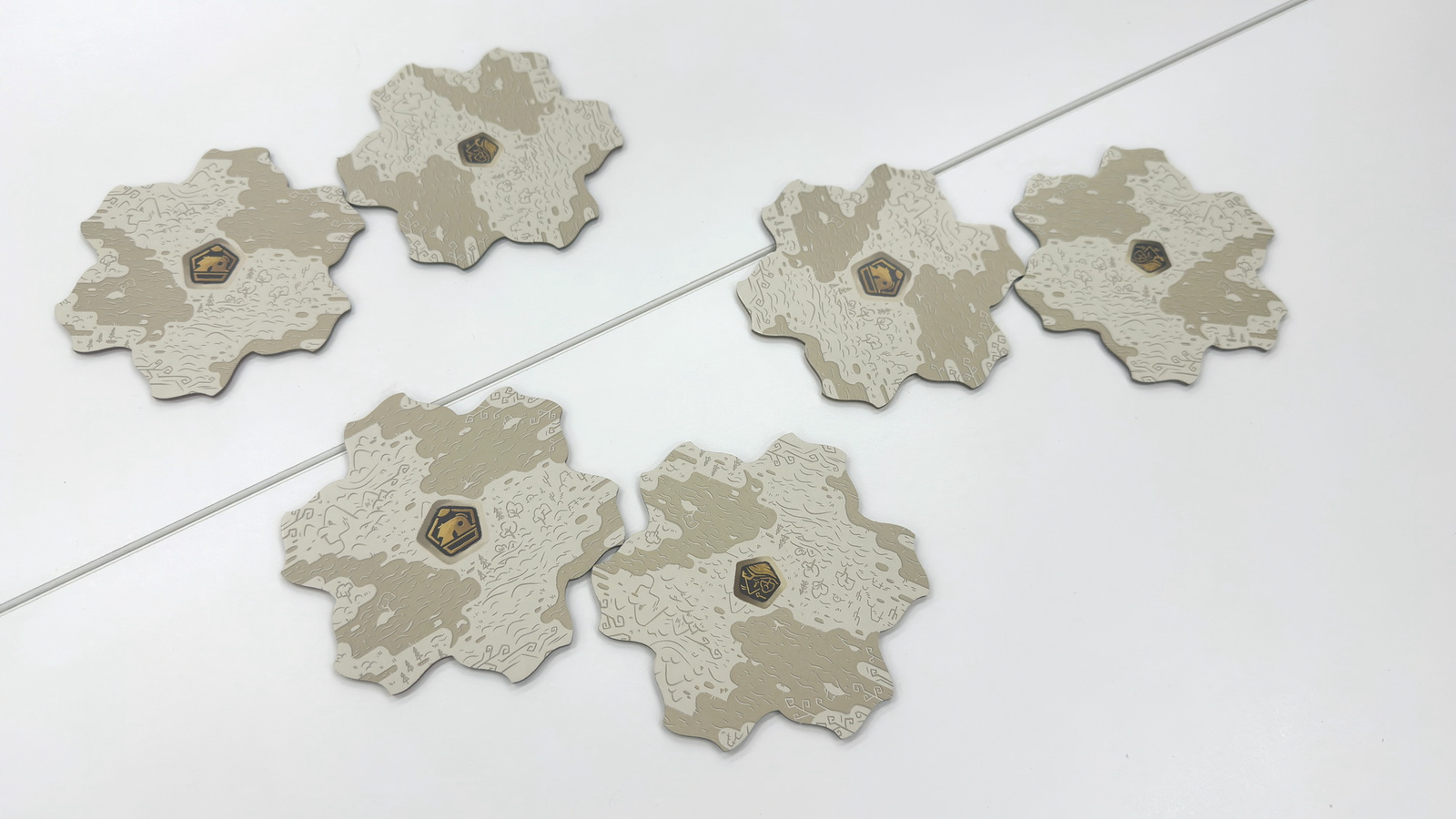
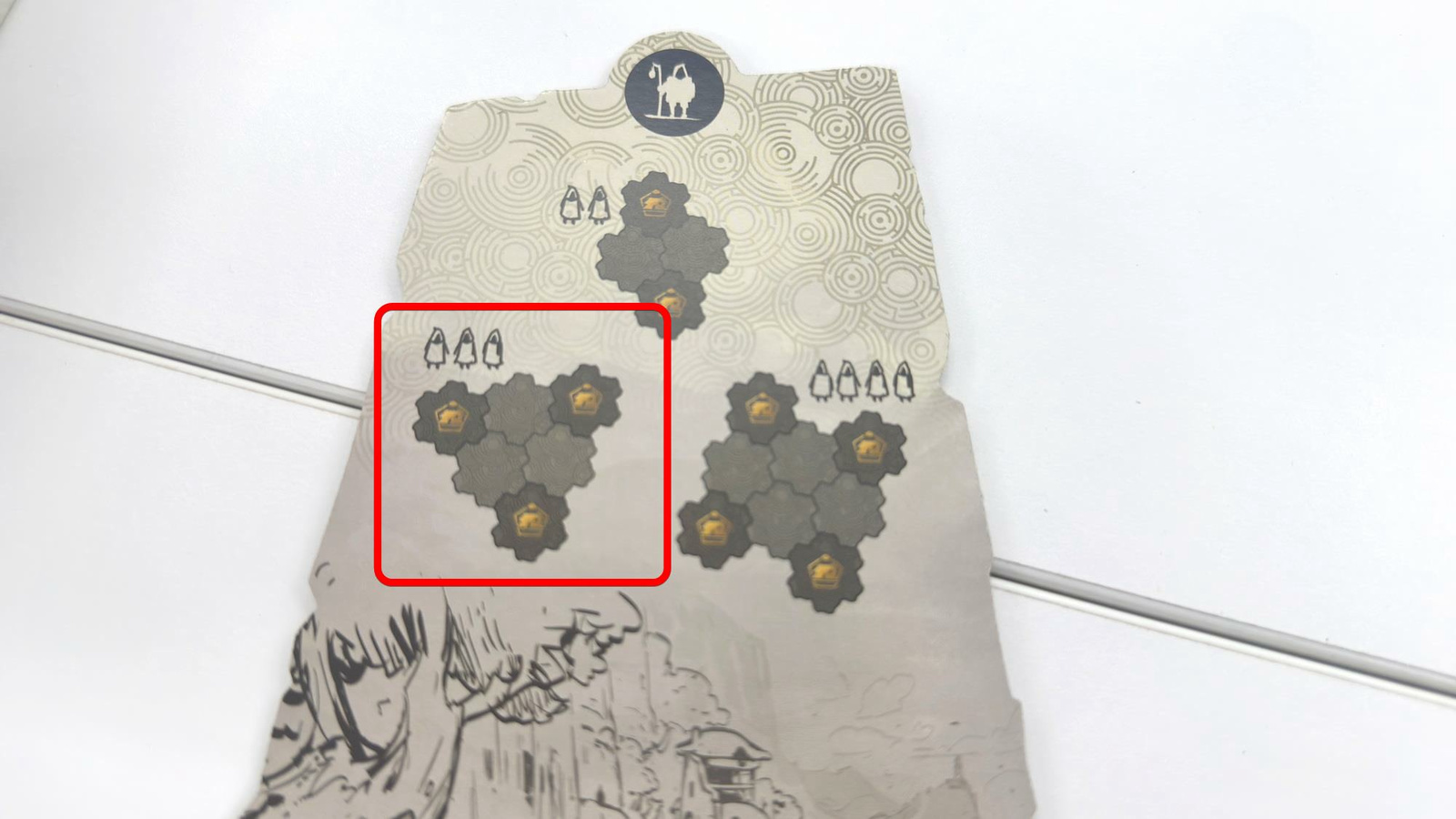
The tiles you are dealt should be placed according to the number of players, as written on the scenario tile. In this case, there are 3 players, so place them as shown in the red box below.
This is what they look like when placed. Each tile has seven hexagonal 'spaces' arranged in a row. The initial tile has random terrain drawn on six of the spaces excluding the center, while the neutral tile has random terrain drawn on all seven spaces, including the center. In the game, 'how the terrain is arranged' is very important, so if you want to increase the randomness, it's a good idea to place them face down and then flip them all over at once.
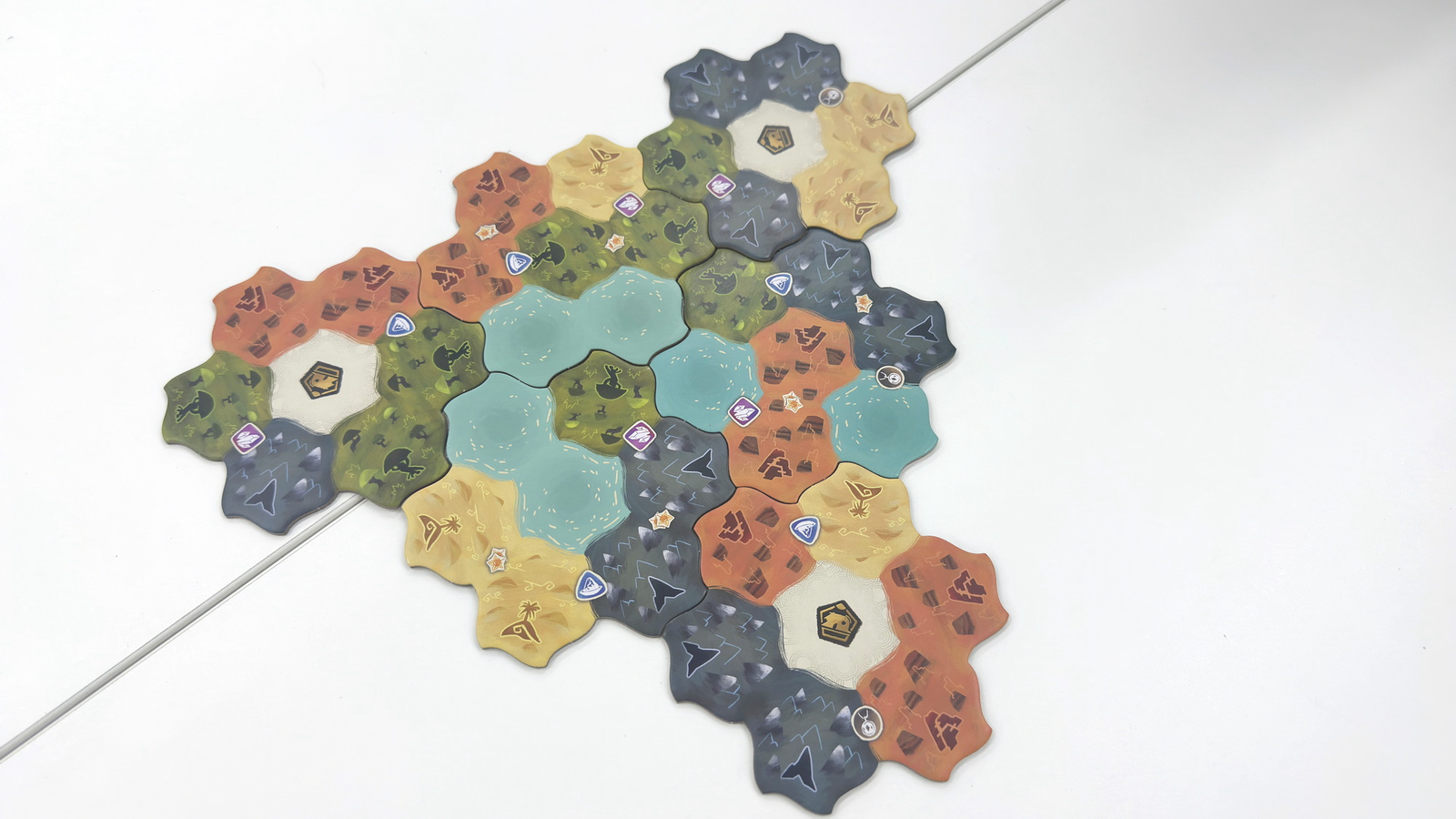
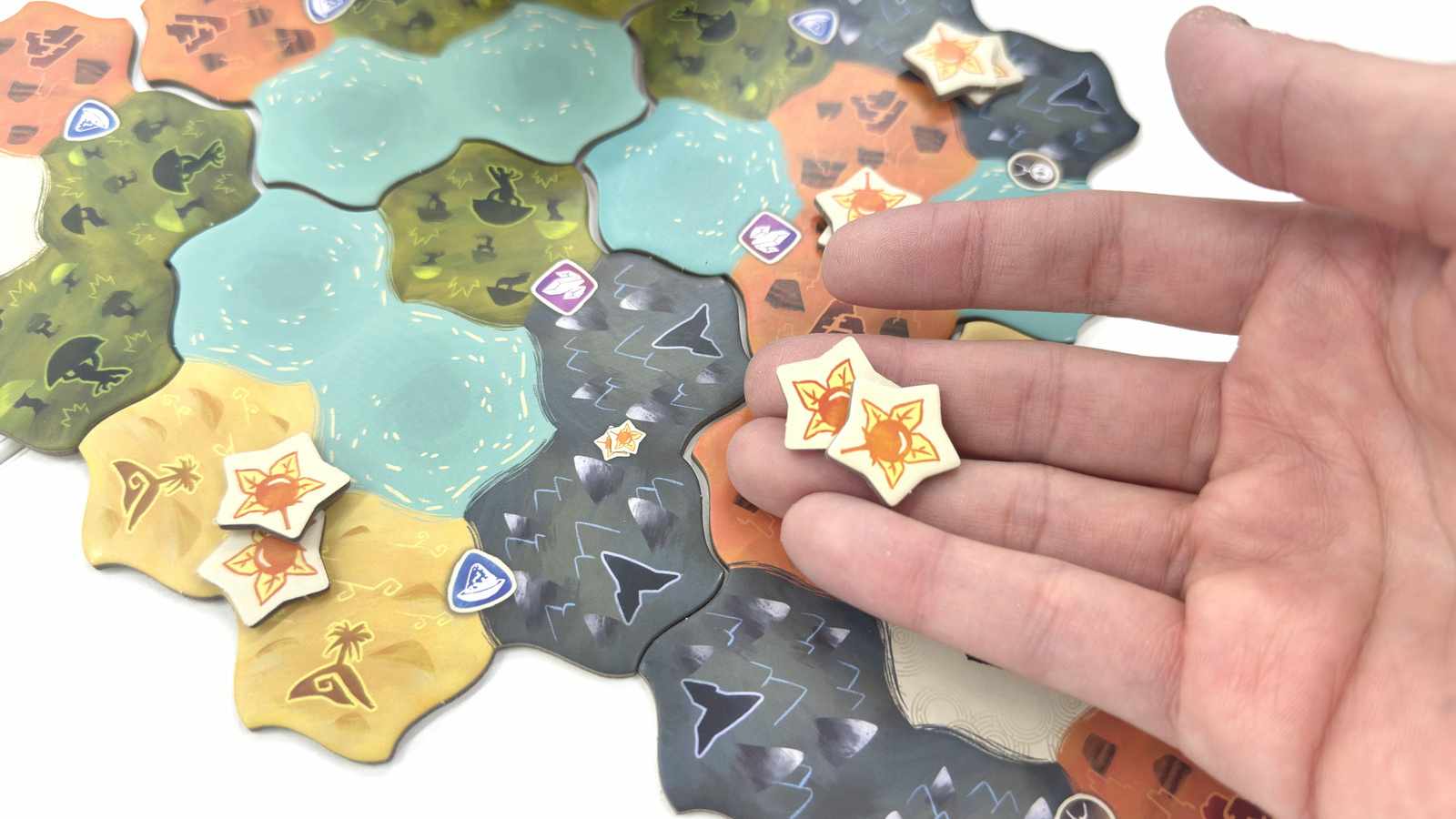
Symbols are drawn on the boundaries between spaces, depending on the location. Place two 'berry' tokens on each of the spaces marked with the orange 'berry' symbol.
Each player is given a tribe board and camp tokens of the same color. There are nine camp tokens in total, and eight of them are placed below the tribe board.
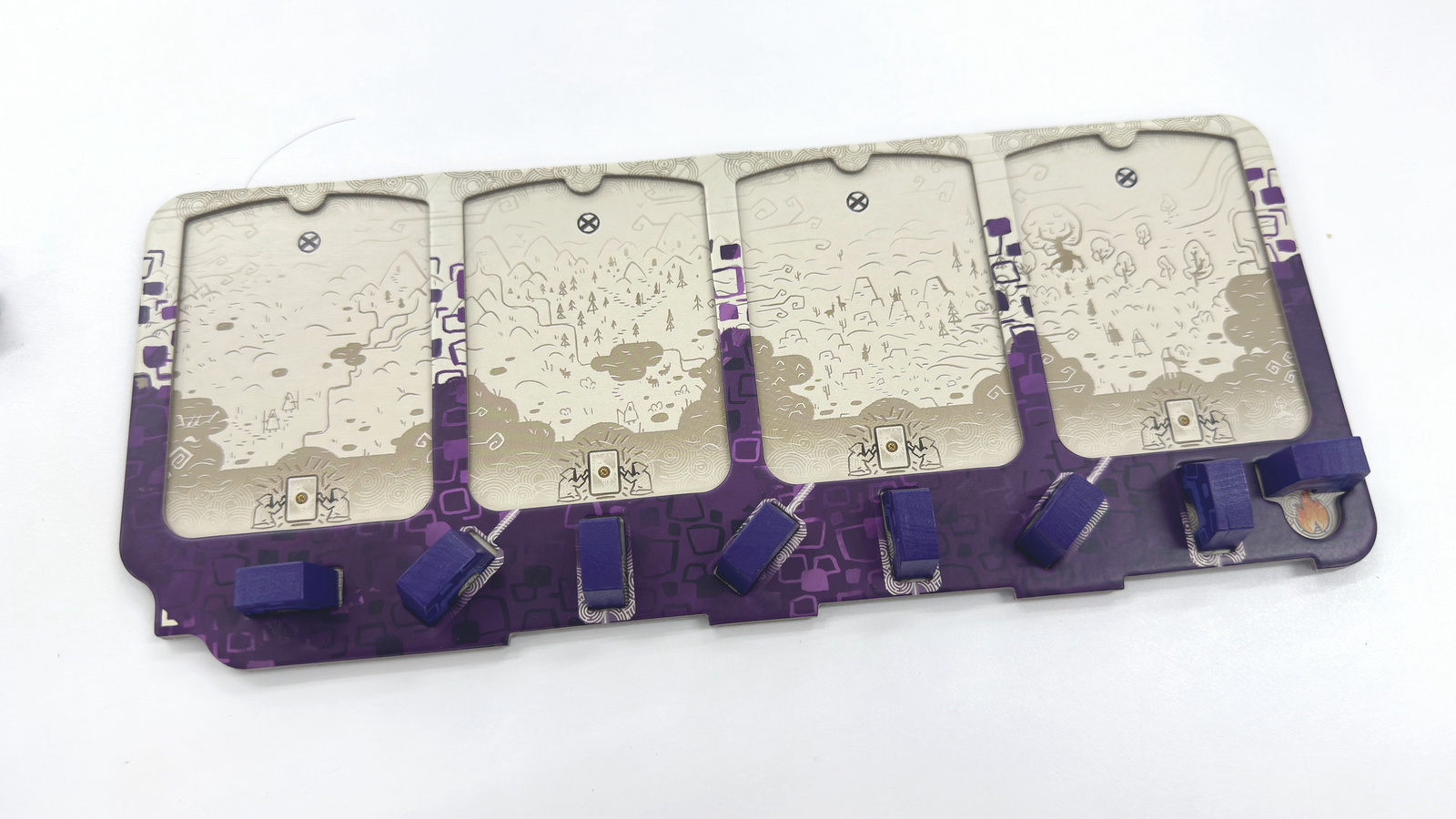
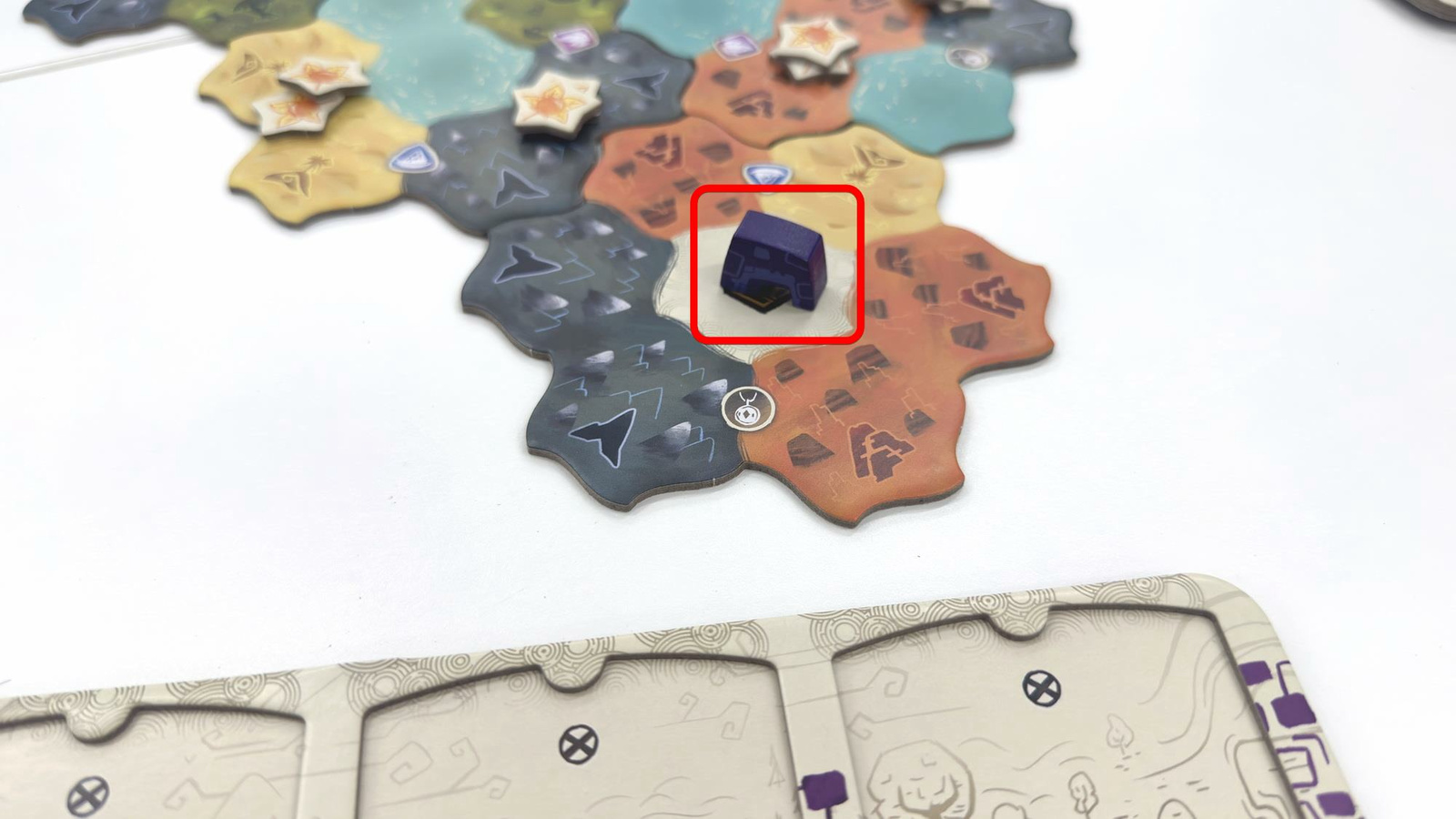
Then, any remaining campsite tokens are placed in the center of the initial tile you placed.
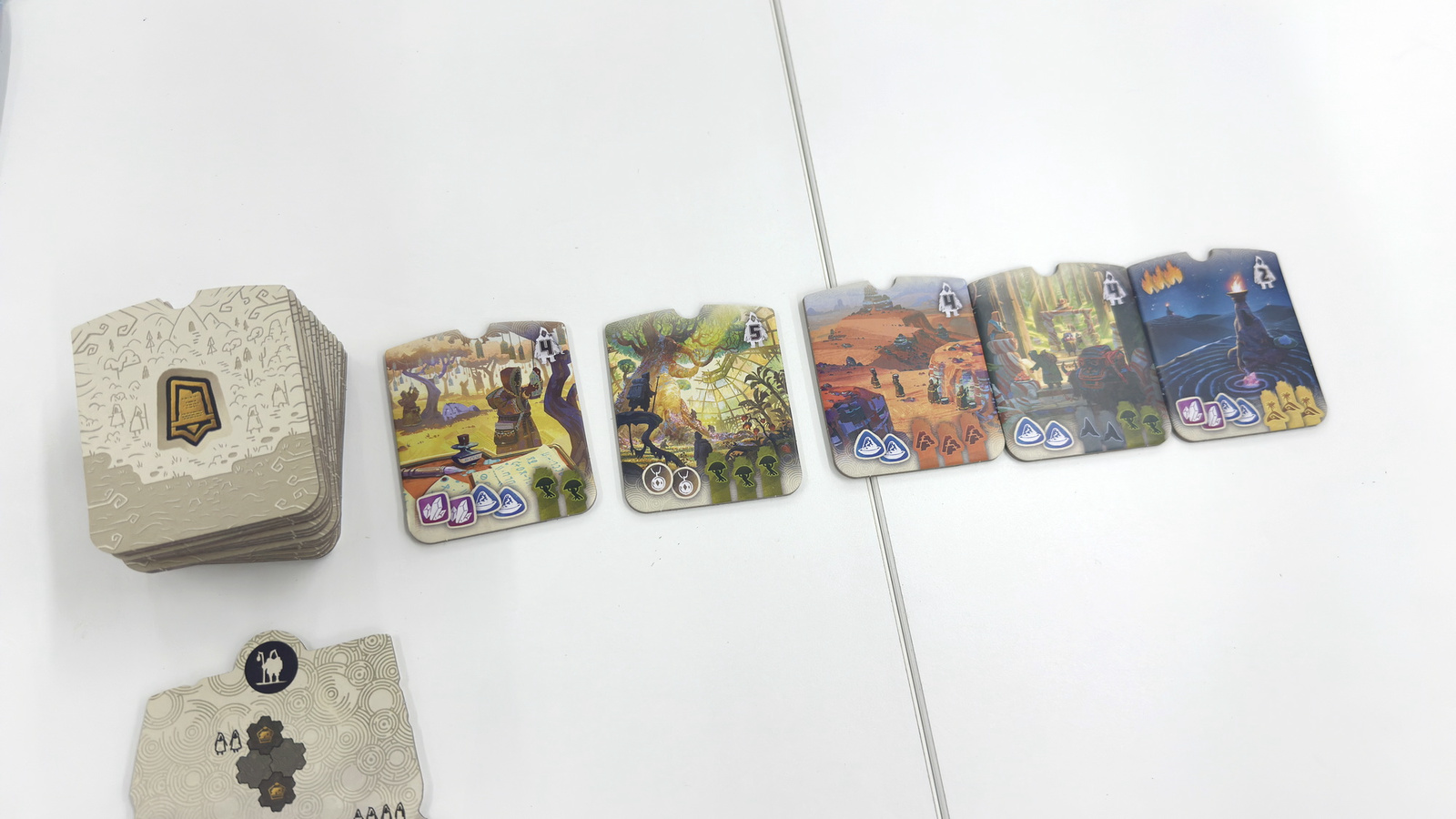
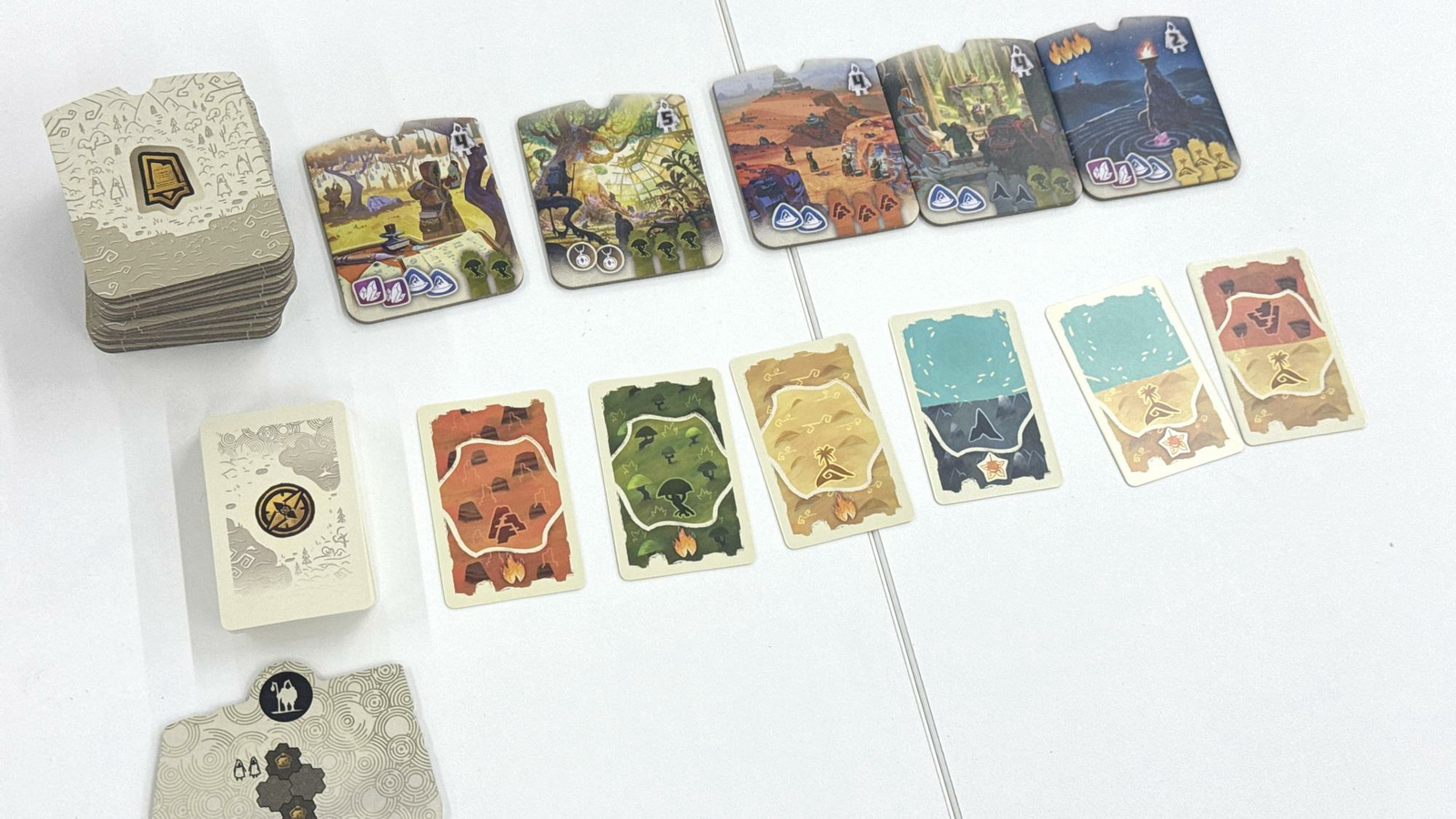
Shuffle the 24 story tiles well and place 5 of them on the table. Set the remaining story tiles aside as a draw pile.
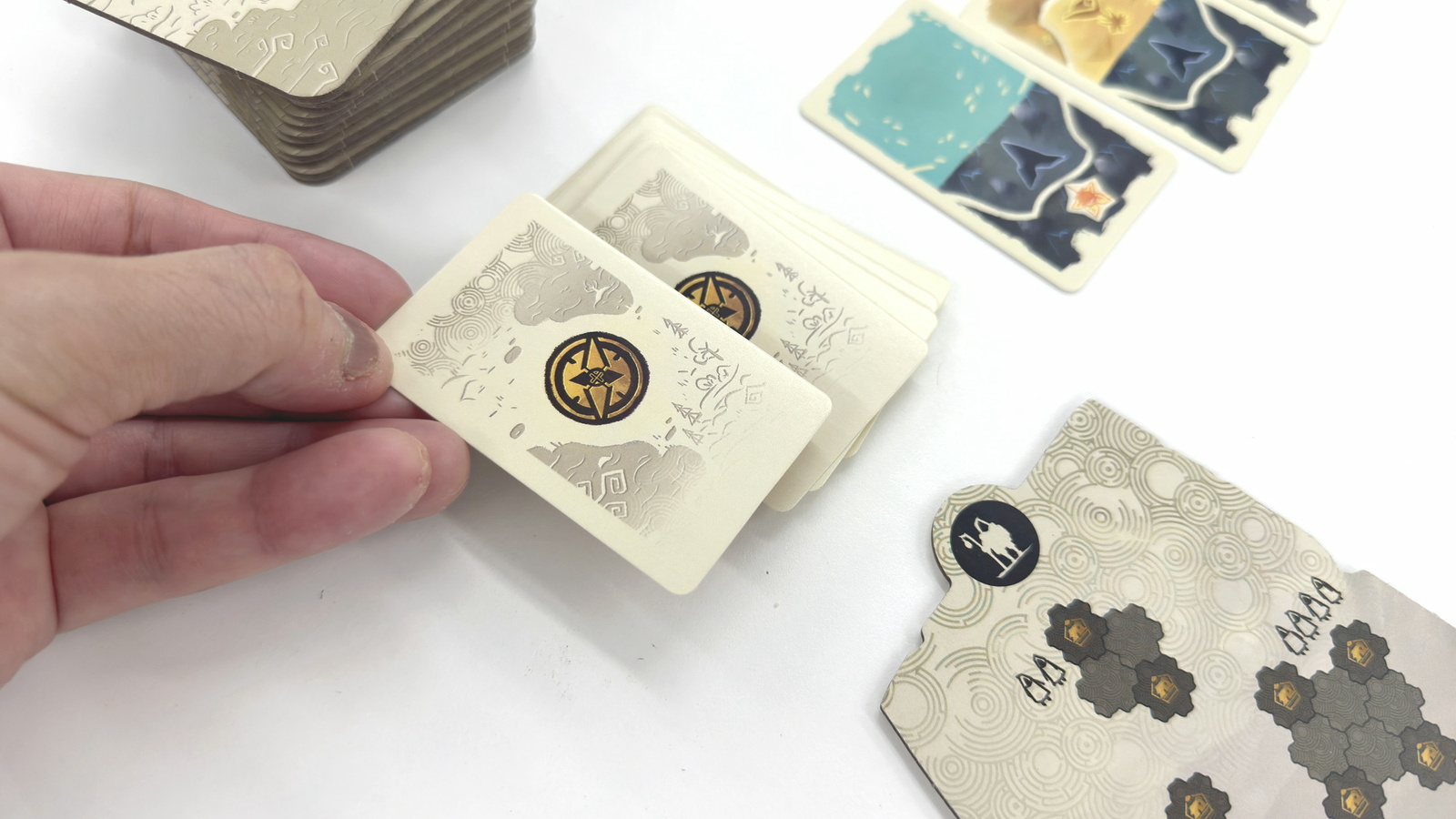
Each player is dealt two terrain cards as their hand.
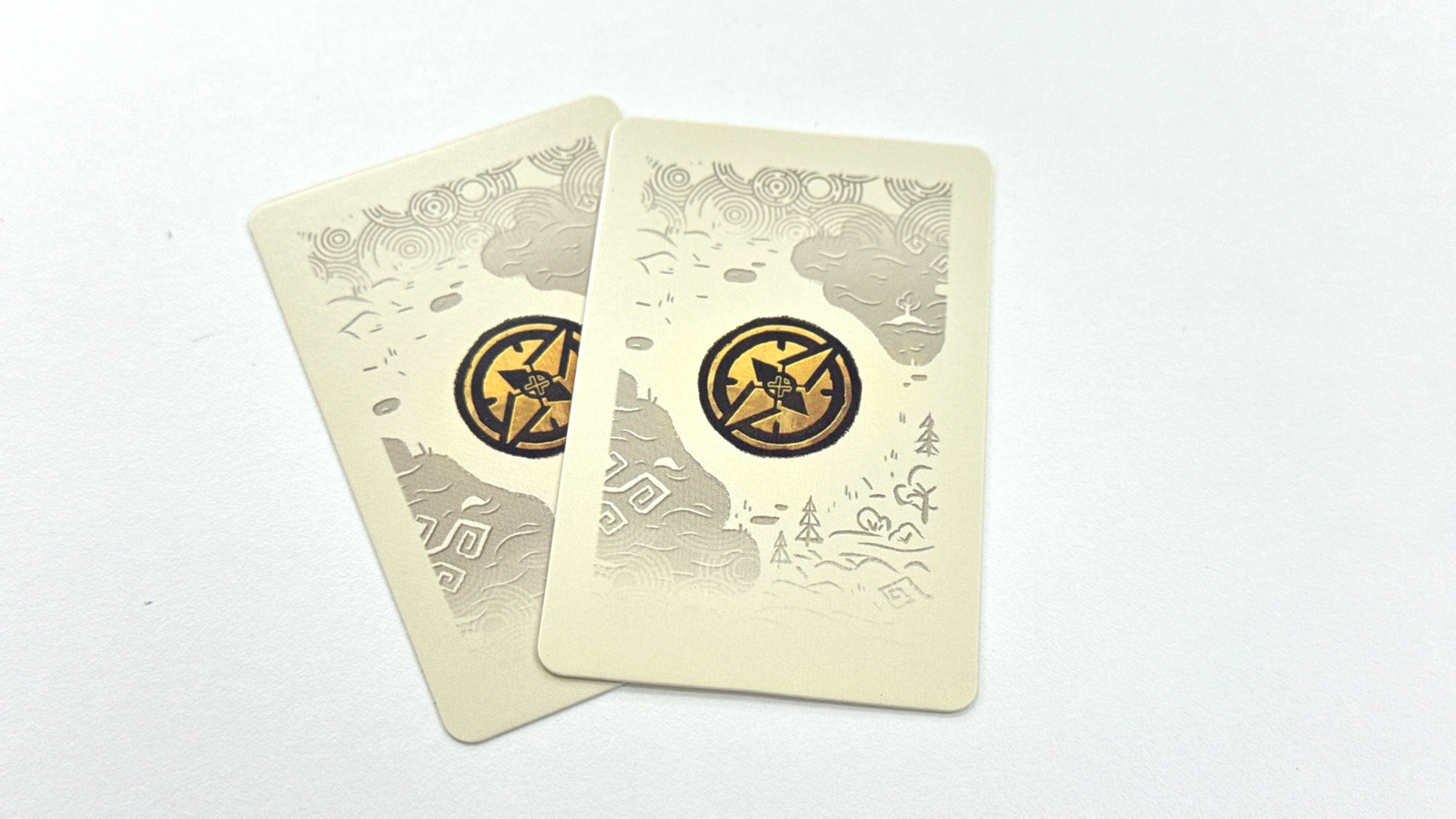
The remaining terrain cards are set aside as a draw pile. Then, draw 6 cards from the top and place them on the table.
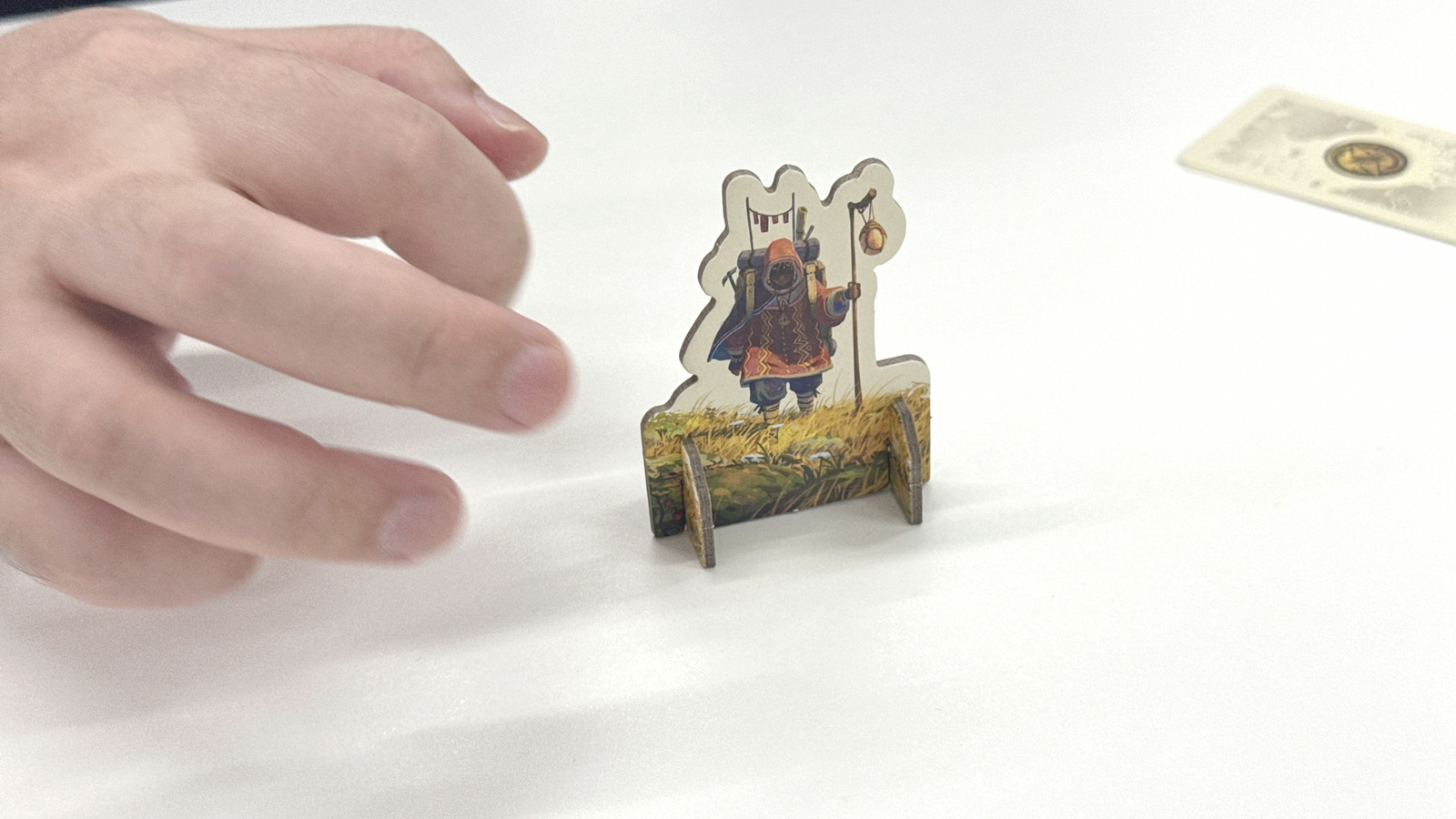
This is a Dewan token, and you give it to the starting player.
Next, starting with the player to the right of the starting player and proceeding counterclockwise, each player chooses and draws one story tile from the table, then replaces an empty space with one from the deck. Story tiles are directly related to victory, so choosing the right ones here is crucial. More details will follow later.
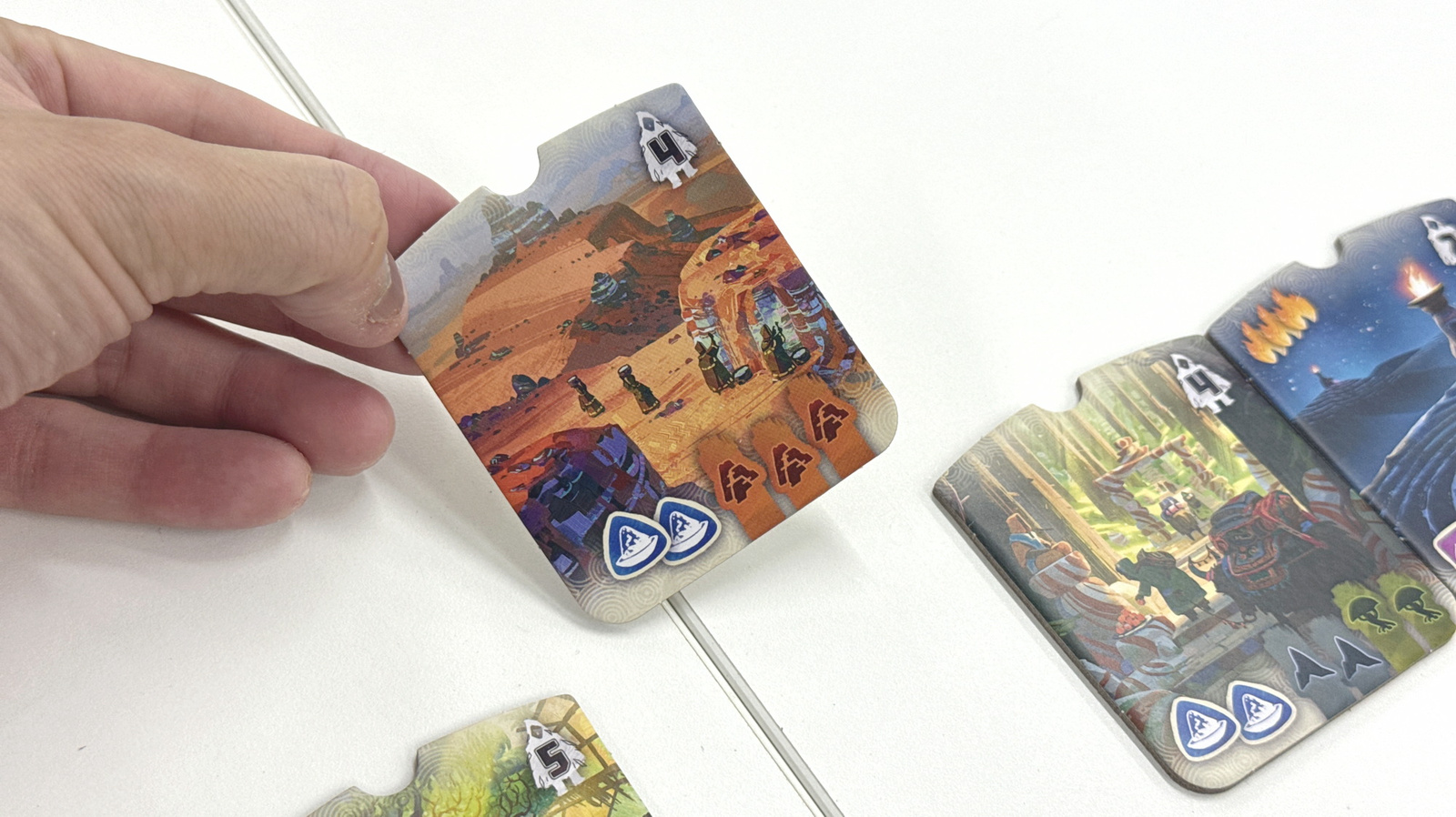
Place the selected story tile on the far left of the tribe board.
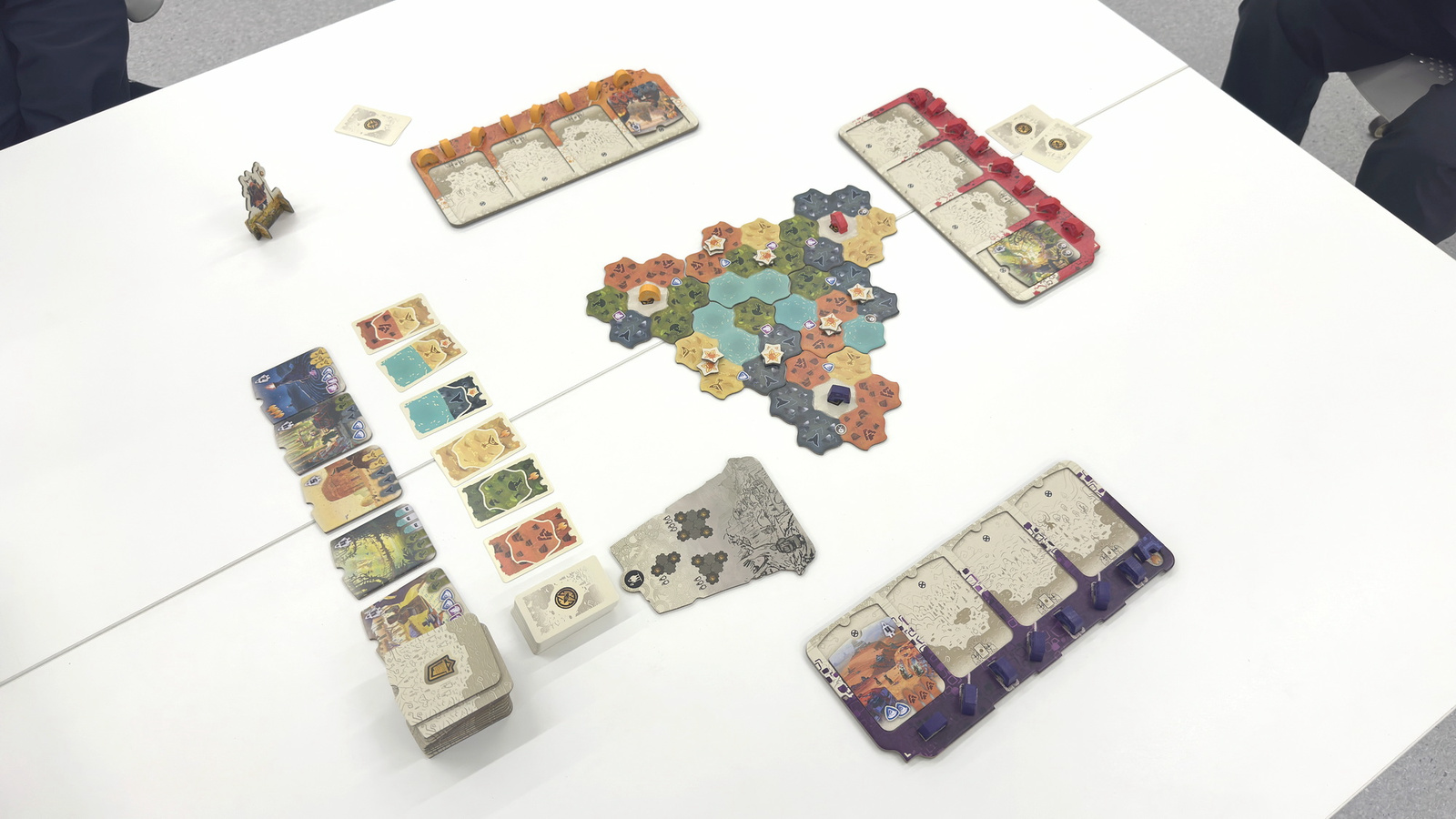
The game is now ready.
◆Play the game
In 'Dewan,' each player takes on the role of a tribe, building camps, completing story tiles, and collecting fire and berries to accumulate victory points. The game ends when someone places all of their camp tokens. The player with the most victory points at the end wins.
The game is very simple to play, with the starting player holding the Dewan token taking the first turn. On your turn, you can only do two things: 'draw a terrain card' or 'place a campsite.'
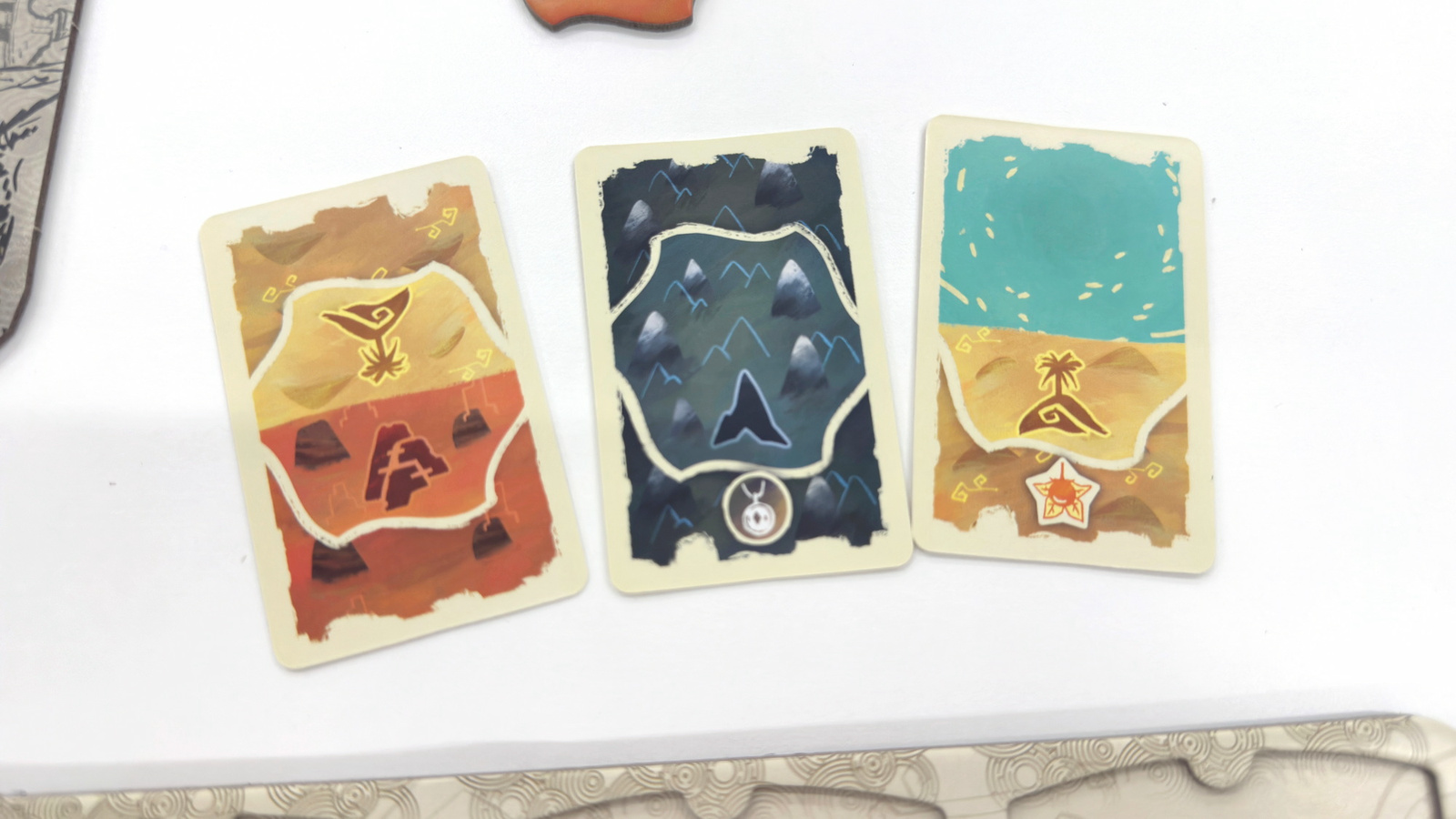
'Draw terrain cards' means you take two adjacent terrain cards from the six terrain cards laid out on the table and add them to your hand. The key point is that you can't just choose any two terrain cards you want; they must be adjacent to each other.
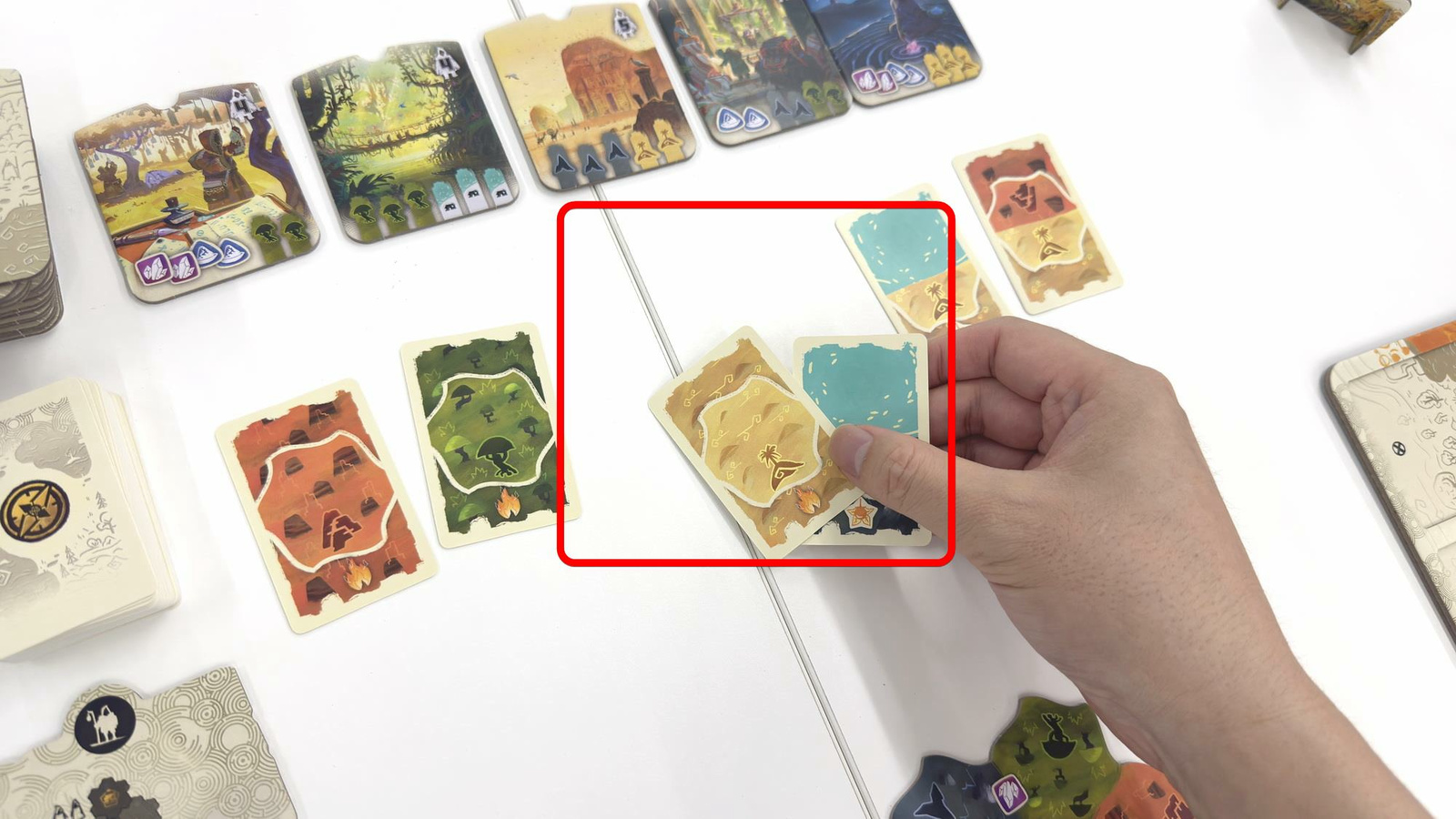
After adding a card to your hand, fill the two empty spaces with cards from the deck. When doing so, you must start filling the spaces closest to the deck.
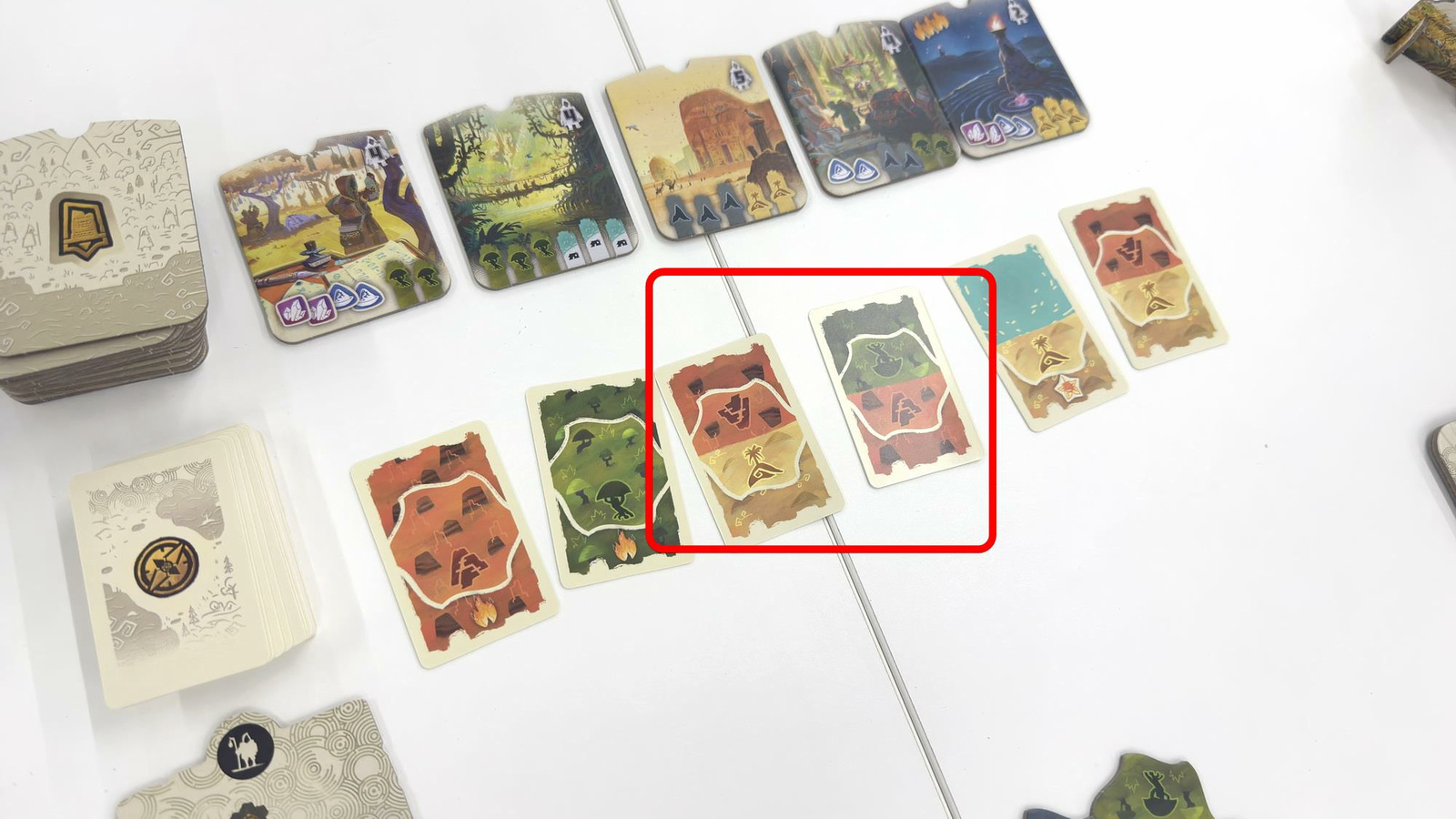
In 'Place a Camp,' you can take one camp token from the leftmost position on the tribe board and place it on a terrain tile. However, you cannot place a new camp on a tile that already has a camp, so it's first come, first served. To place a camp token, you must play a terrain card from your hand that covers the distance from where an existing camp token is located to where you want to place the new one.
For example, consider the following case. Suppose you want to place a campsite on a yellow desert square beyond a black cave, starting from a campsite in a red mountainous area.
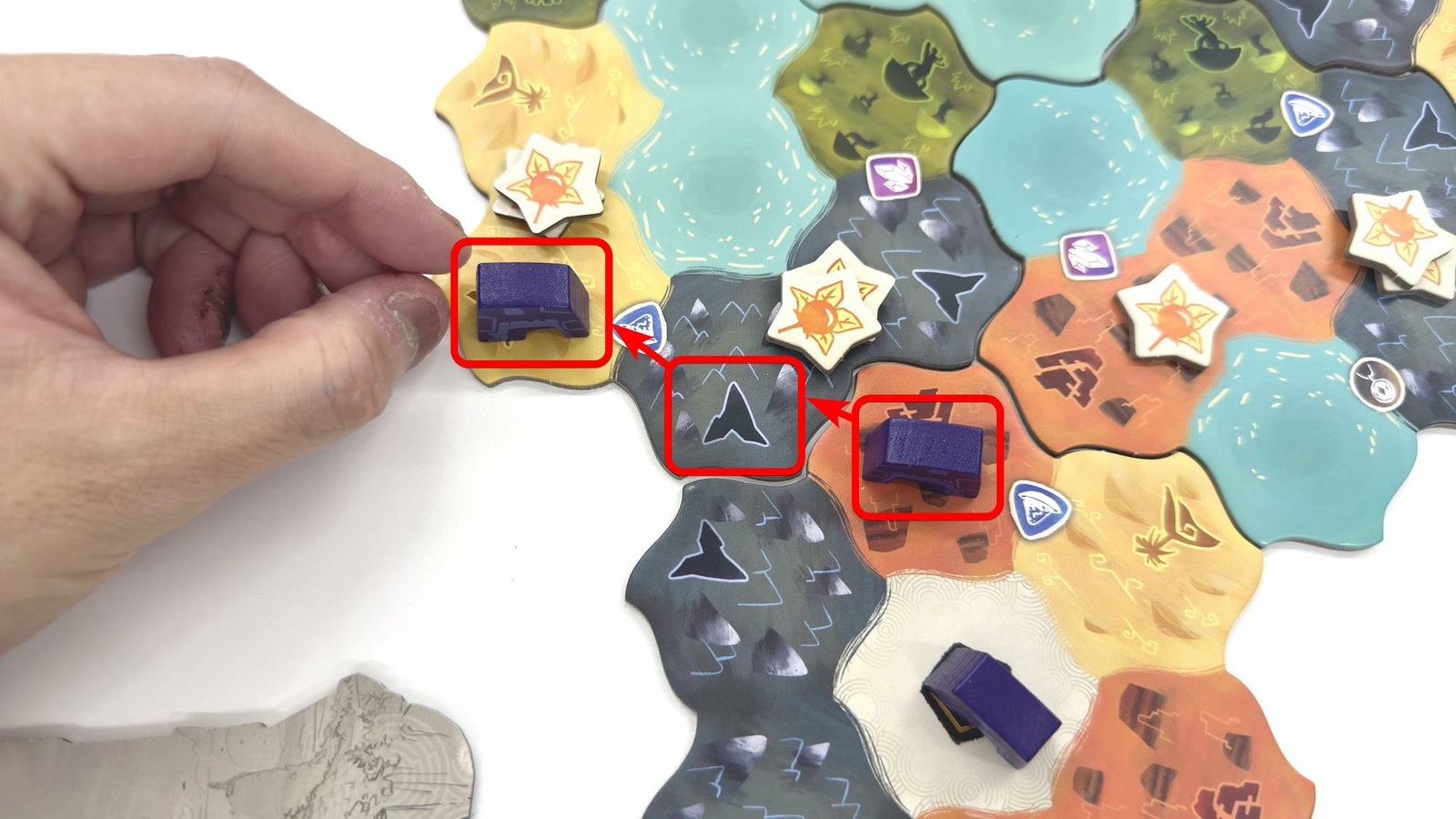
At this point, you need to spend a total of three cards from your hand: mountain, cave, and desert. In short, the key to this game is to draw and collect terrain cards, and then use those cards to place camps on terrain tiles. You can pass through terrain spaces where other tribes have placed camps, but in that case, you will need to pay the necessary terrain cards to that tribe as a kind of toll. If you start from your initial camp, you can use any terrain card for your first step.
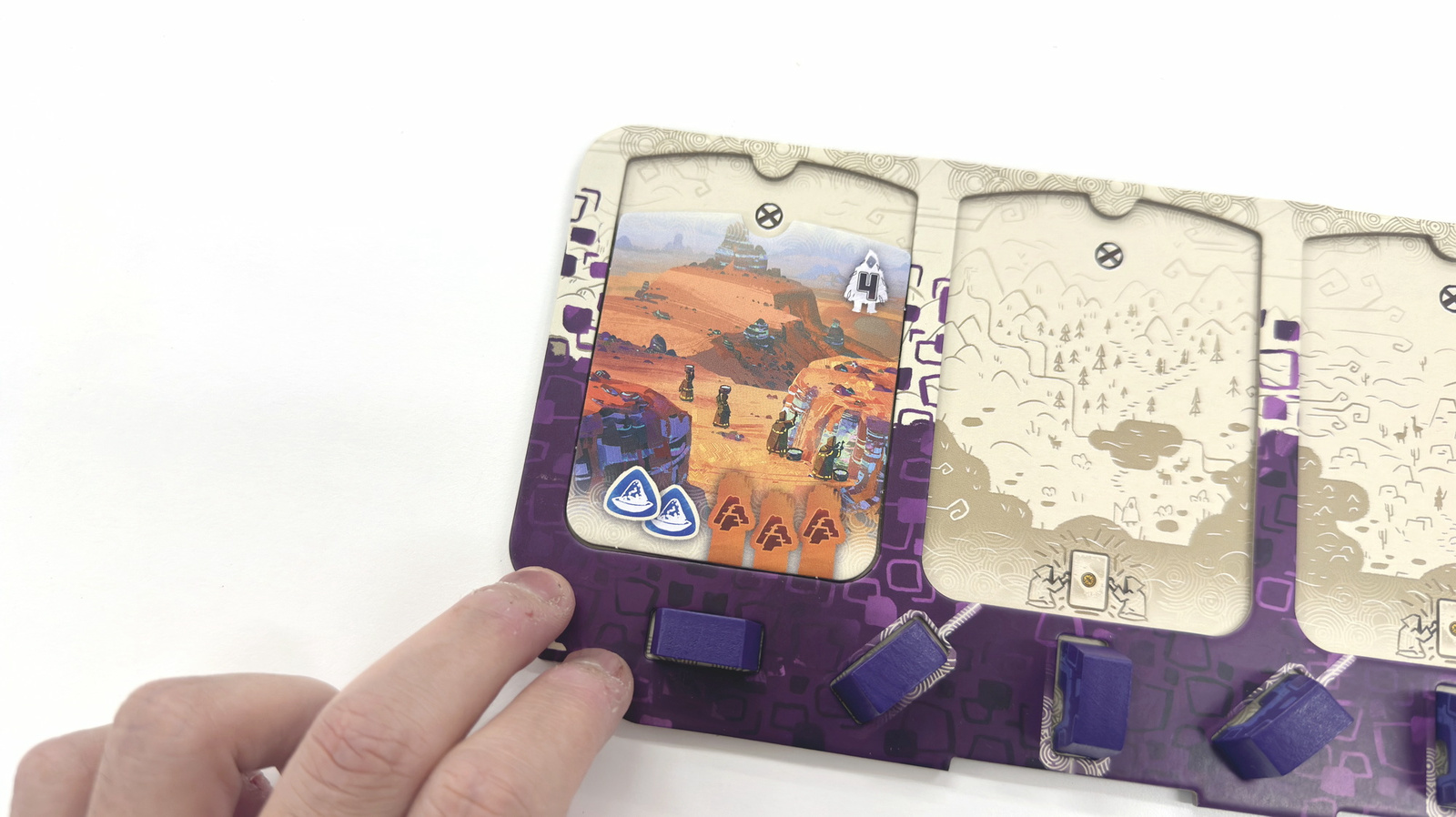
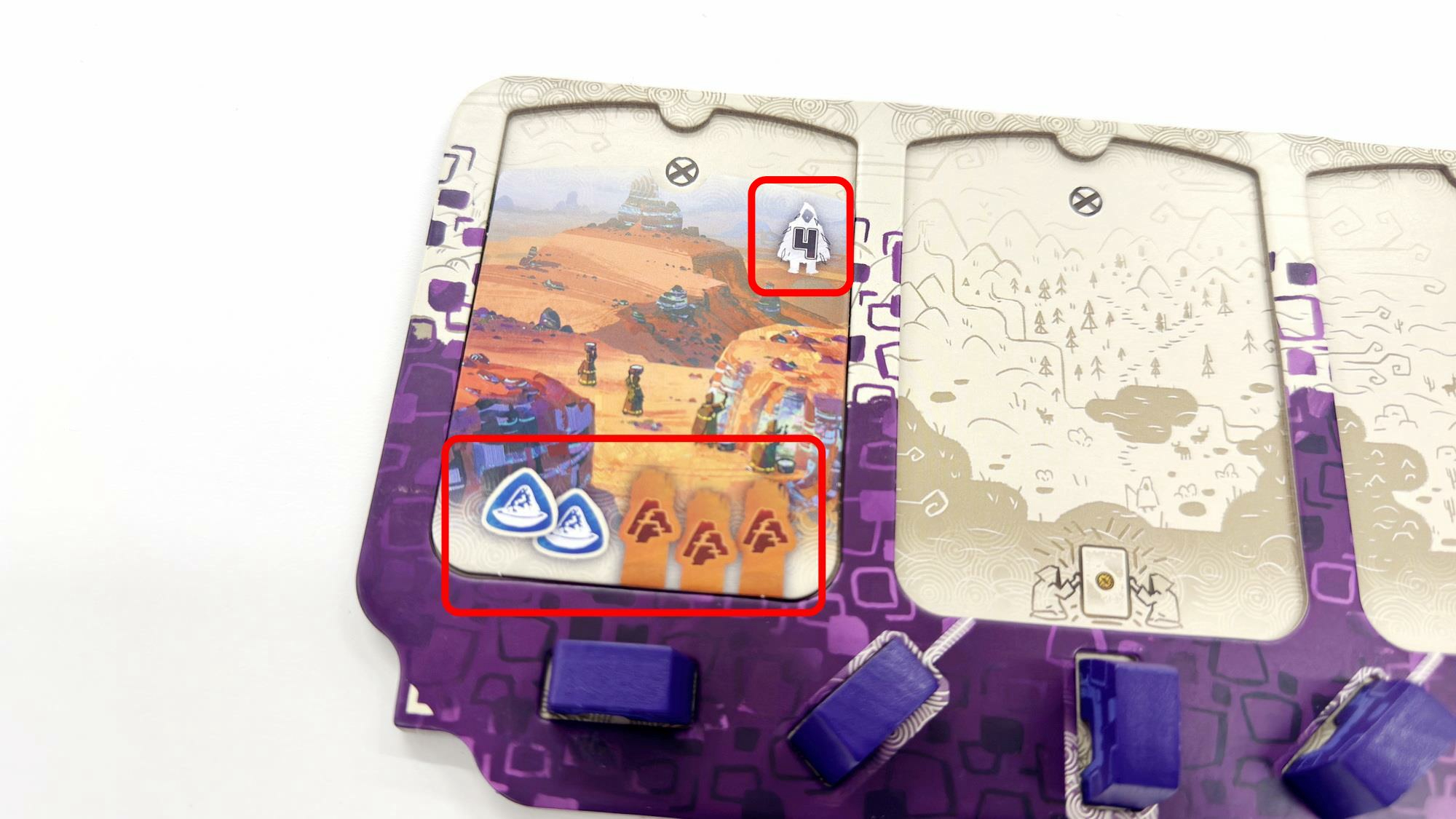
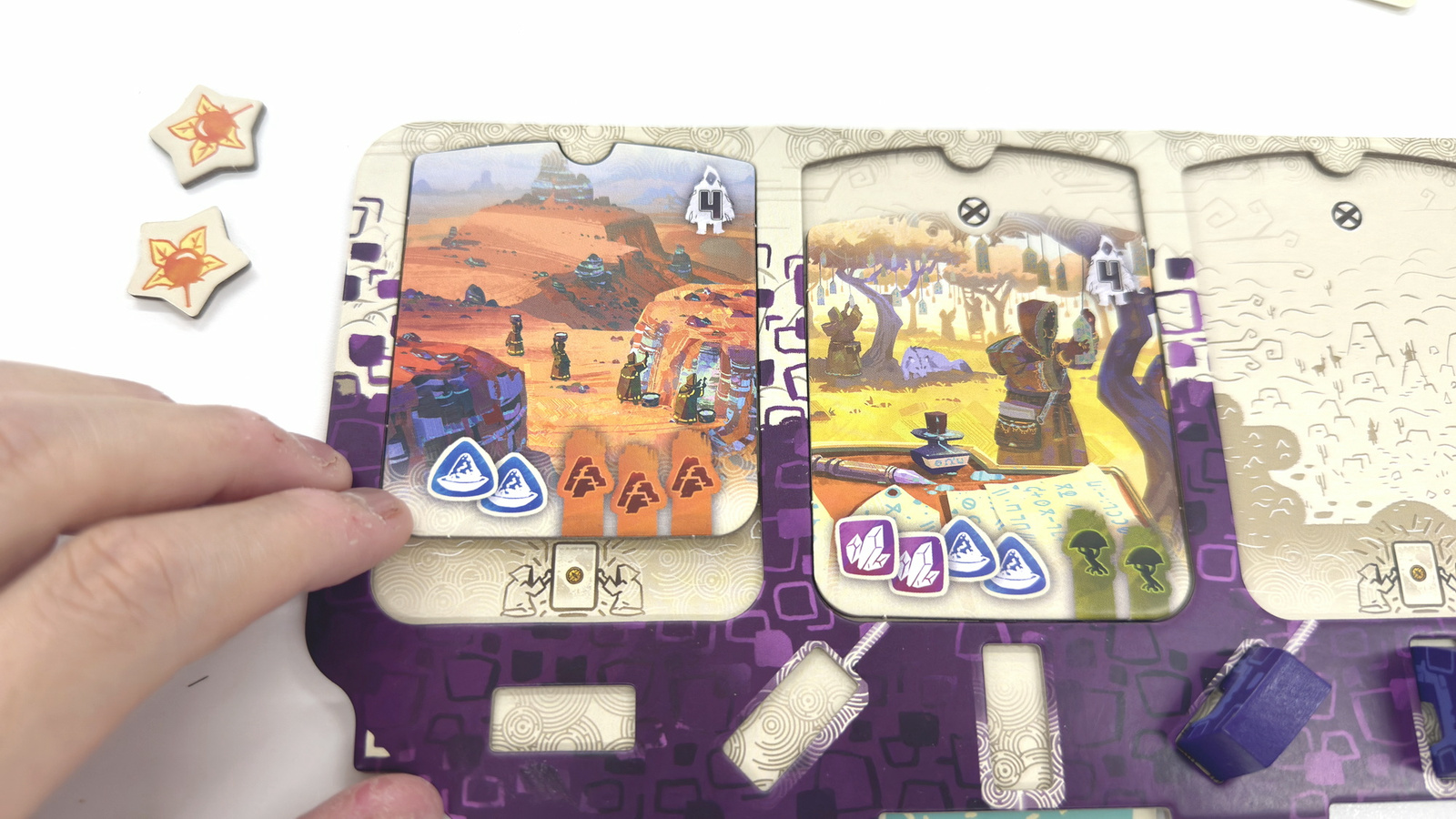
The reason why placing campsites is important is that activating story tiles is crucial for accumulating victory points. The upper right corner of each story tile has a number indicating the points it will earn. However, in order to earn points from a story tile, you must fulfill the 'conditions' depicted below it to activate it. For example, the following story tile is worth 4 points. The conditions for achieving this are two blue triangular 'pigment' symbols and three red 'mountain' symbols.
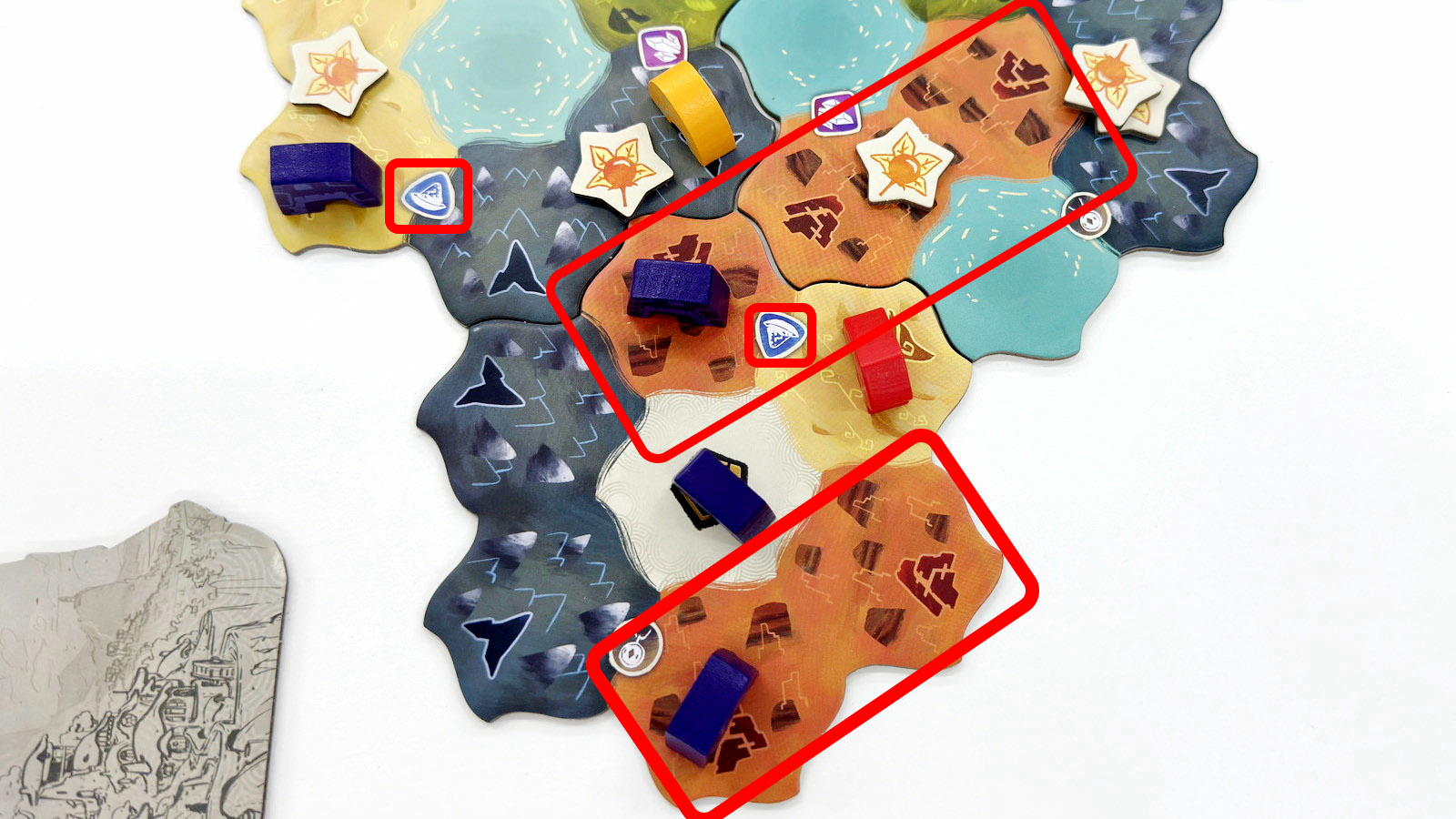
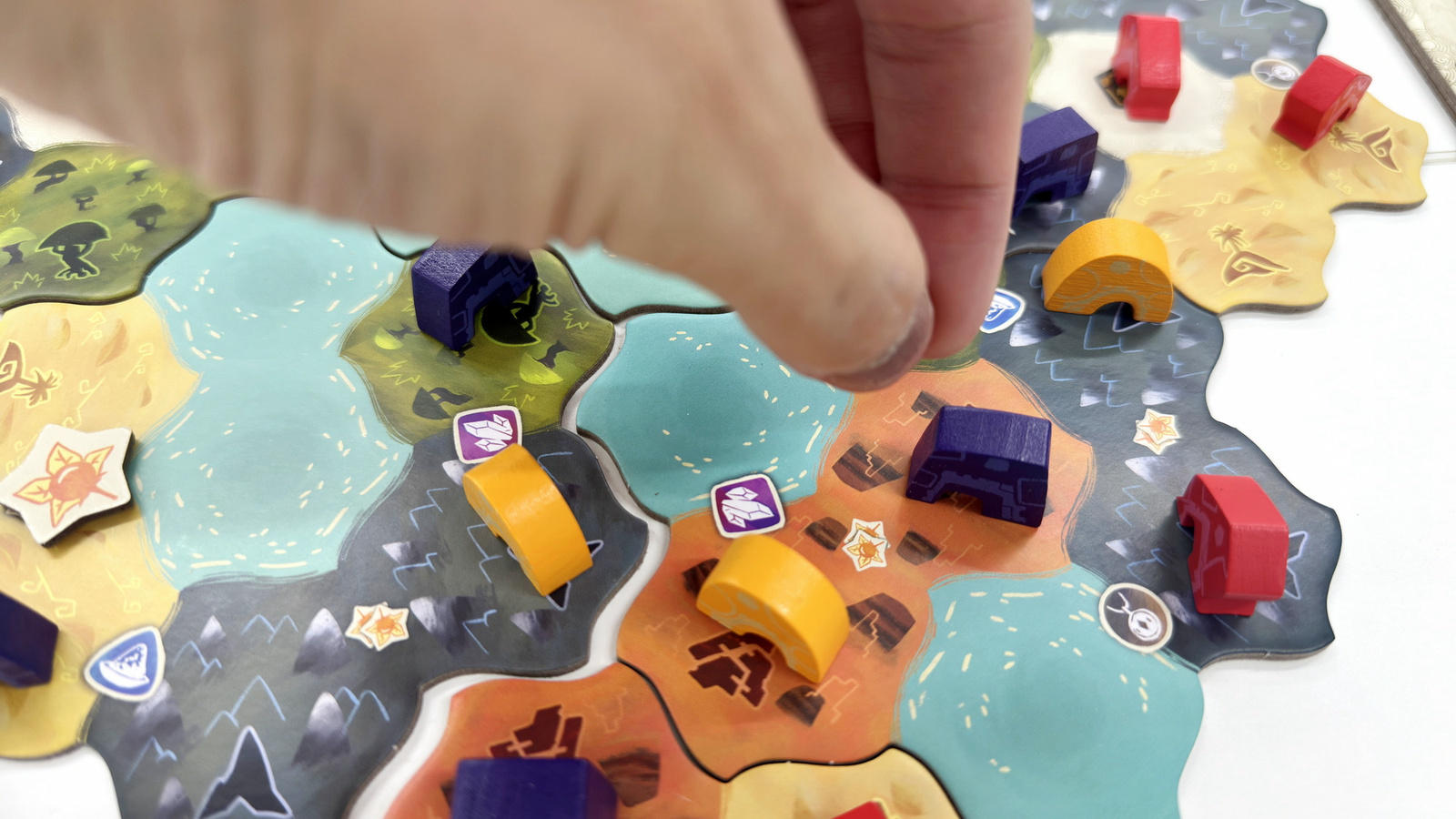
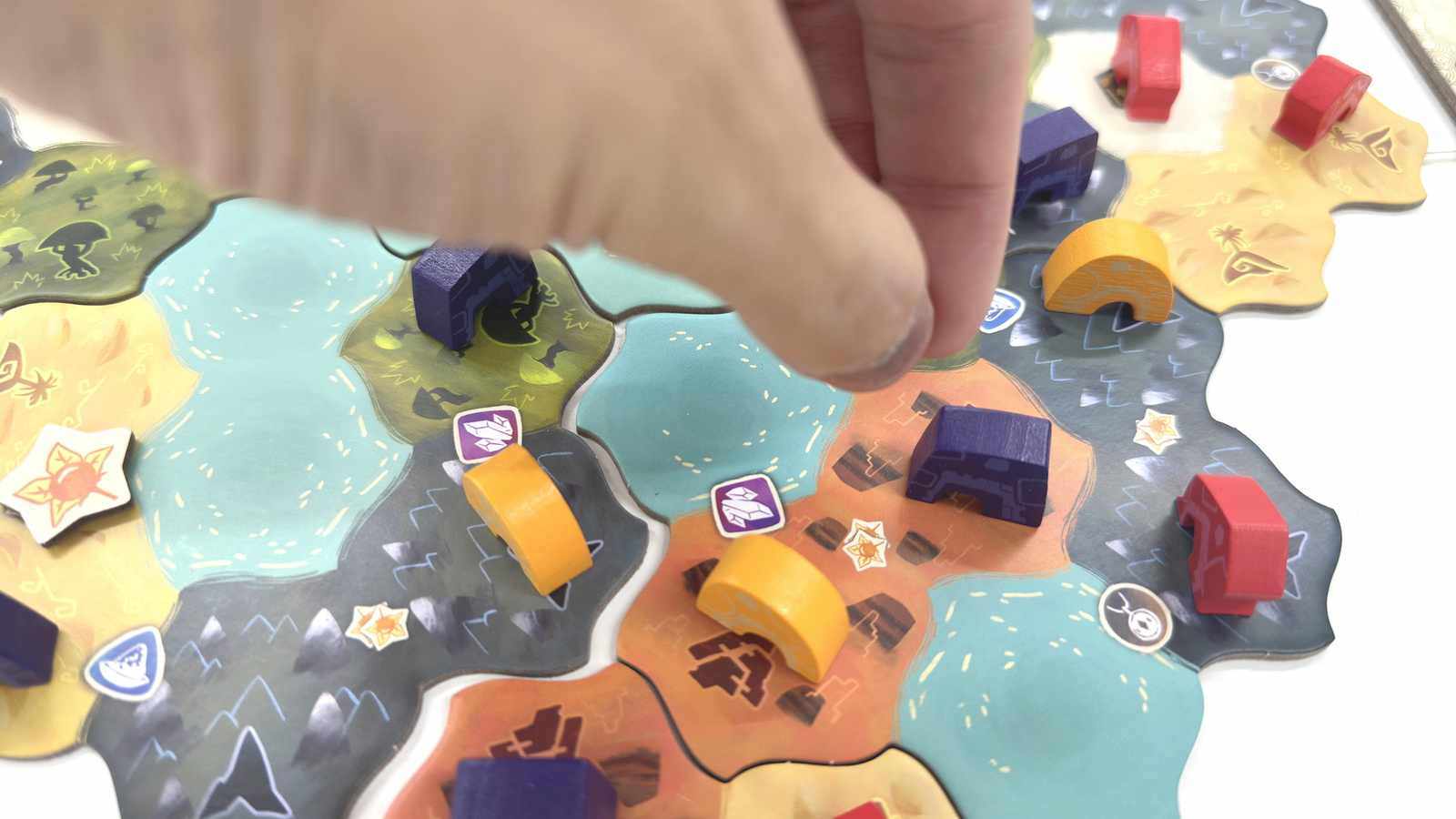
Symbols are considered secured when a campsite is established in an adjacent space. In the following picture, the purple tribe has placed campsites adjacent to each of the two 'pigment' symbols, thus fulfilling the 'pigment x 2' condition of the story tile. On the other hand, adjacent terrains of the same type are treated as one 'zone,' and the terrain required to fulfill the condition is indicated by the number of zones. The fulfillment condition is 'mountain x 3,' and the purple tribe has established campsites in two of the mountain zones.
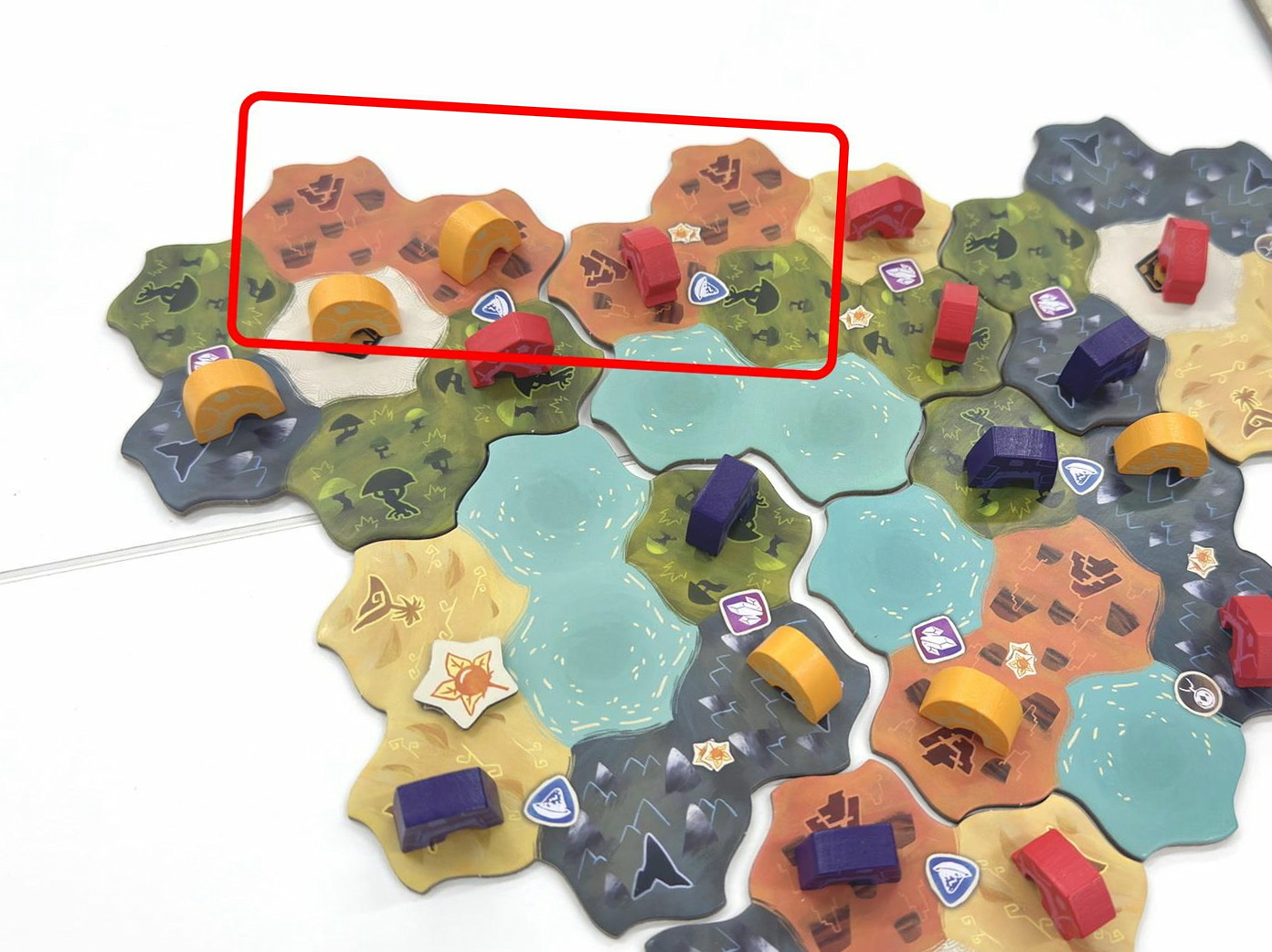
In short, the purple tribe can fulfill the conditions of the story tile if they can place a camp in another mountain zone. However, in this tile, there is only one mountain zone left. Moreover, it is far from the area where the purple tribe has many camps, so it will be difficult to extend their camp there without collecting a considerable number of terrain cards. Furthermore, the fact that the yellow and red tribes have placed camps in the center of the red mountain zone is quite troublesome, making it even more difficult to place a camp. Where you place your camp will have a big impact on your opponents' actions.
Additionally, when you place a campsite, there may be Berry Tokens placed in that zone. If you place a campsite in a zone where Berry Tokens are placed, you can receive one Berry Token.
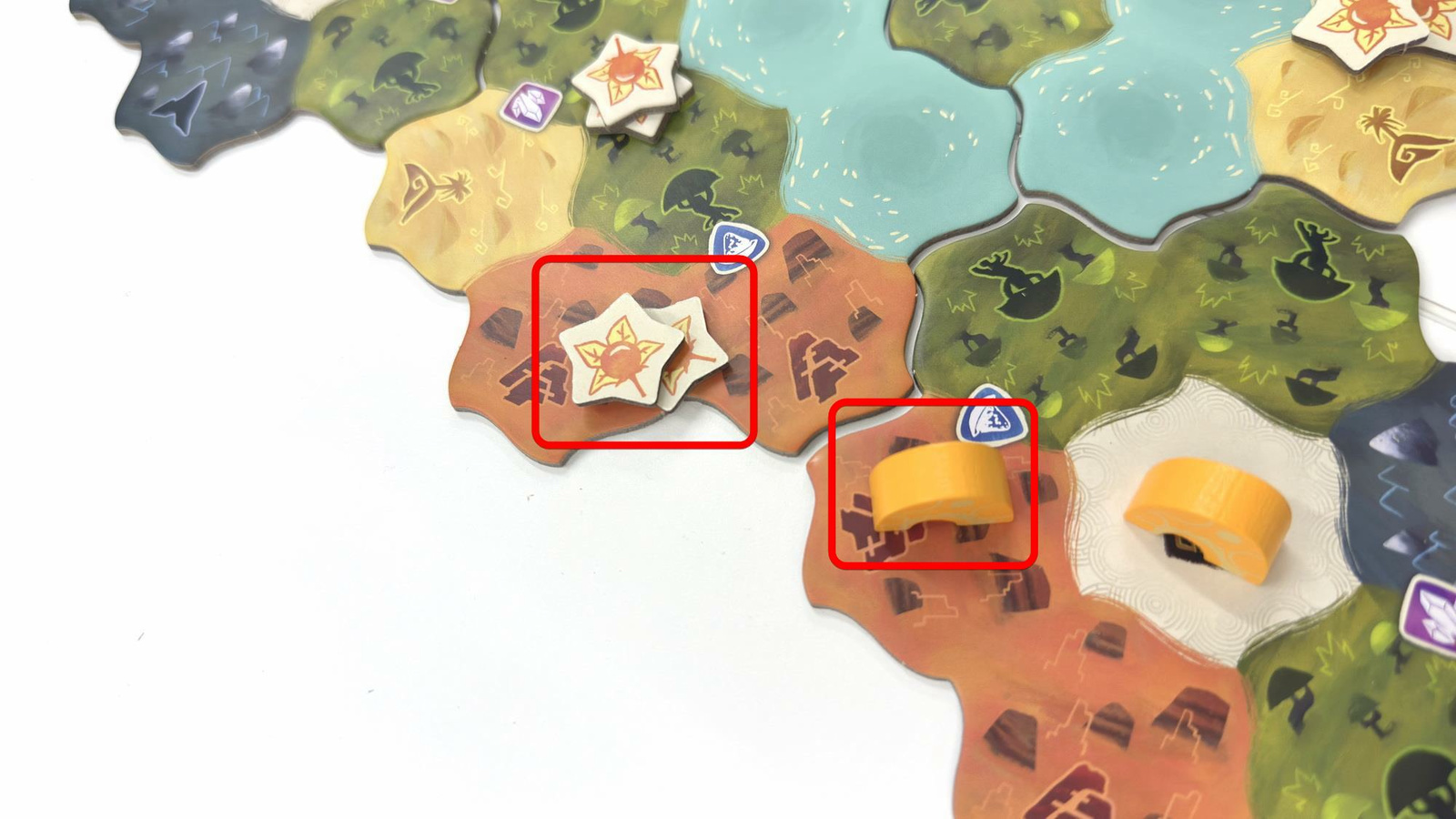
Each Berry Token is worth 2 victory points, so you'll want to collect them if possible.
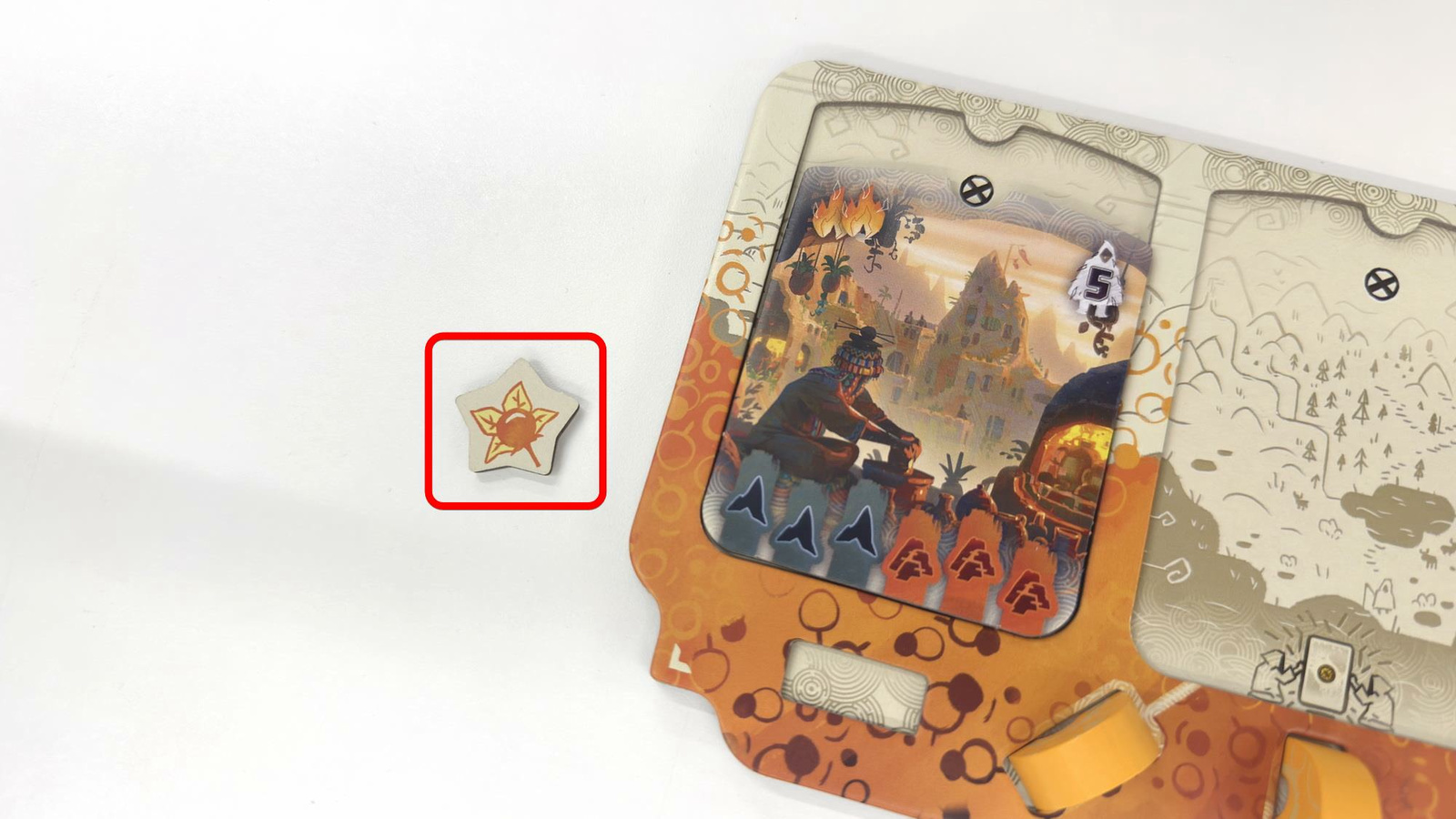
You place your camp tokens starting from the leftmost position on the tribe board. Each time you place two or more camp tokens from the tribe board, you receive a bonus. For example, after placing your second camp token, you can place an additional story tile.
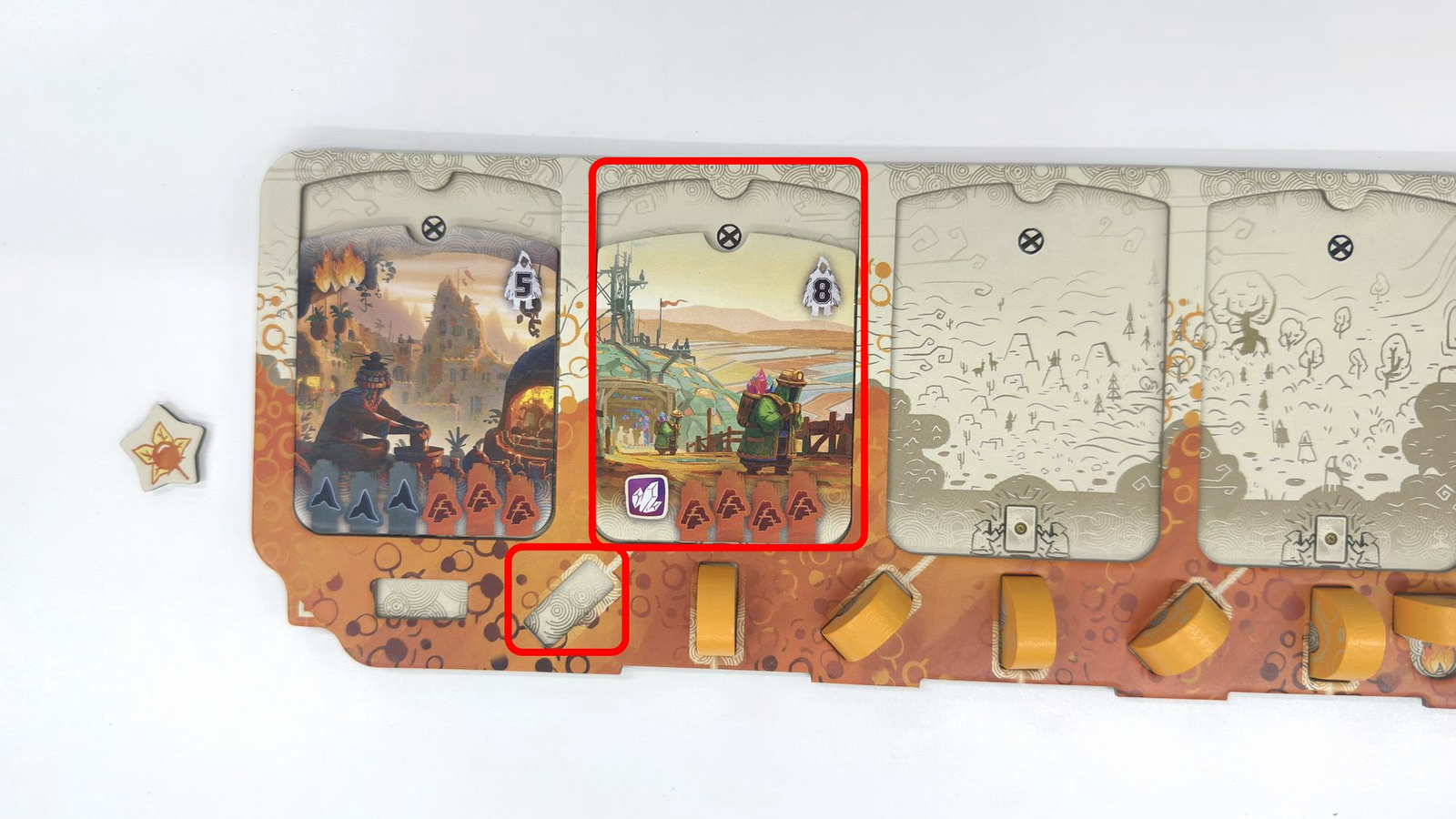
Then, once you've placed your third camp token, you can slip one terrain card from your hand under your tribe board. Only the bottom half of the inserted terrain card will be visible, and the terrain and symbols visible from here are considered to represent the terrain zone and resources that your story tile corresponds to.
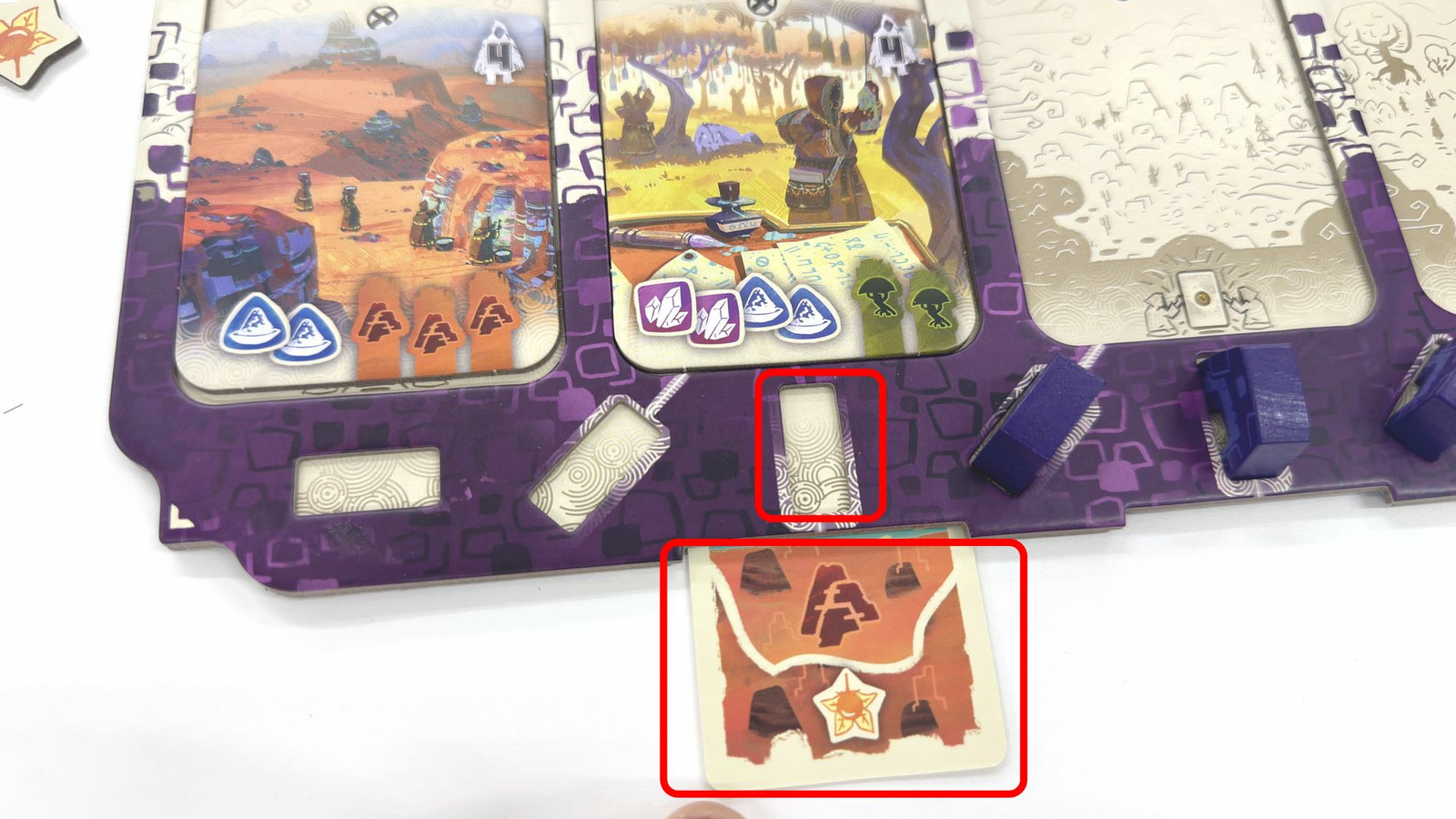
The purple tribe only needed one more red mountain zone, but they decided it would be difficult to place a campsite there. However, by inserting a terrain card, they were able to acquire a red mountain zone. This fulfilled the conditions for the story tile. Once the conditions are met and the story tile is activated, it slides upwards.
Furthermore, activating one story tile allows you to draw an additional terrain card.
In this way, you progress through the game by placing campsites and drawing cards.
As the game progresses, you'll encounter a series of problems, such as 'someone else placed a campsite where I wanted to,' 'someone placed a campsite in a place I wanted to pass through,' and 'the symbols and terrain zones I want are far away and difficult to reach.' Additionally, groups of two or more campsites earn 4 points each, so to aim for a high victory score, you'll need to consider 'where to place your campsites within the terrain zones.'
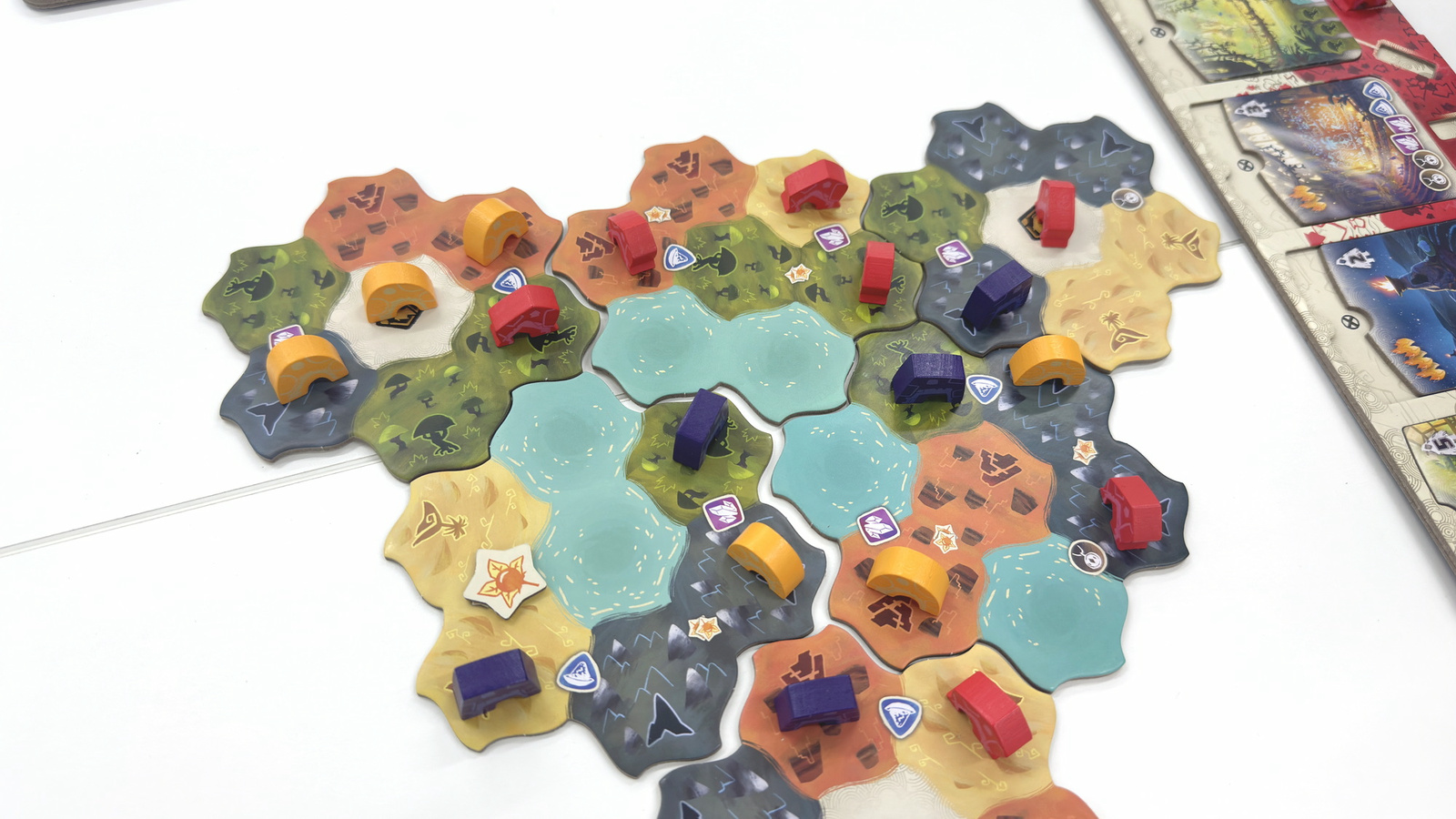
Of course, the strategy of 'preemptively placing a camp in a location you don't want your opponent to place one' is effective, but camps are valuable pieces that provide resources and victory points, so using them for obstruction is quite wasteful. Therefore, it is far more important to think about 'how efficiently you can deploy your tribe's camps' rather than trying to obstruct your opponent.
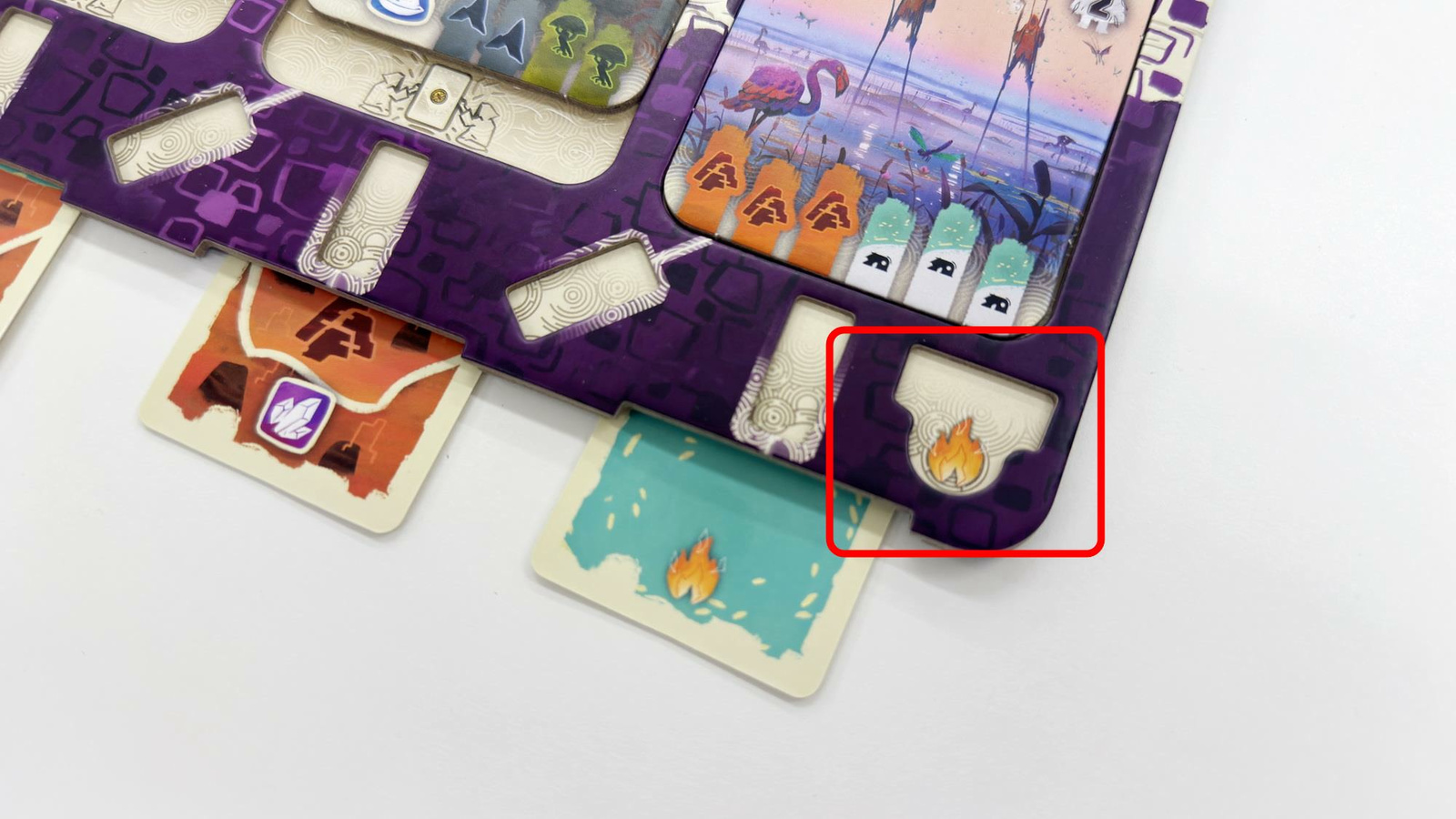
The game ends in the round when someone has placed all of their camp tokens. Points are then calculated. Each fire symbol on the story tiles and terrain cards is worth 1 victory point, and the player who collects the most fire symbols receives an additional 4 points. Since placing the last camp token grants a 'fire' symbol, the player who places their camp token first has a slight advantage.
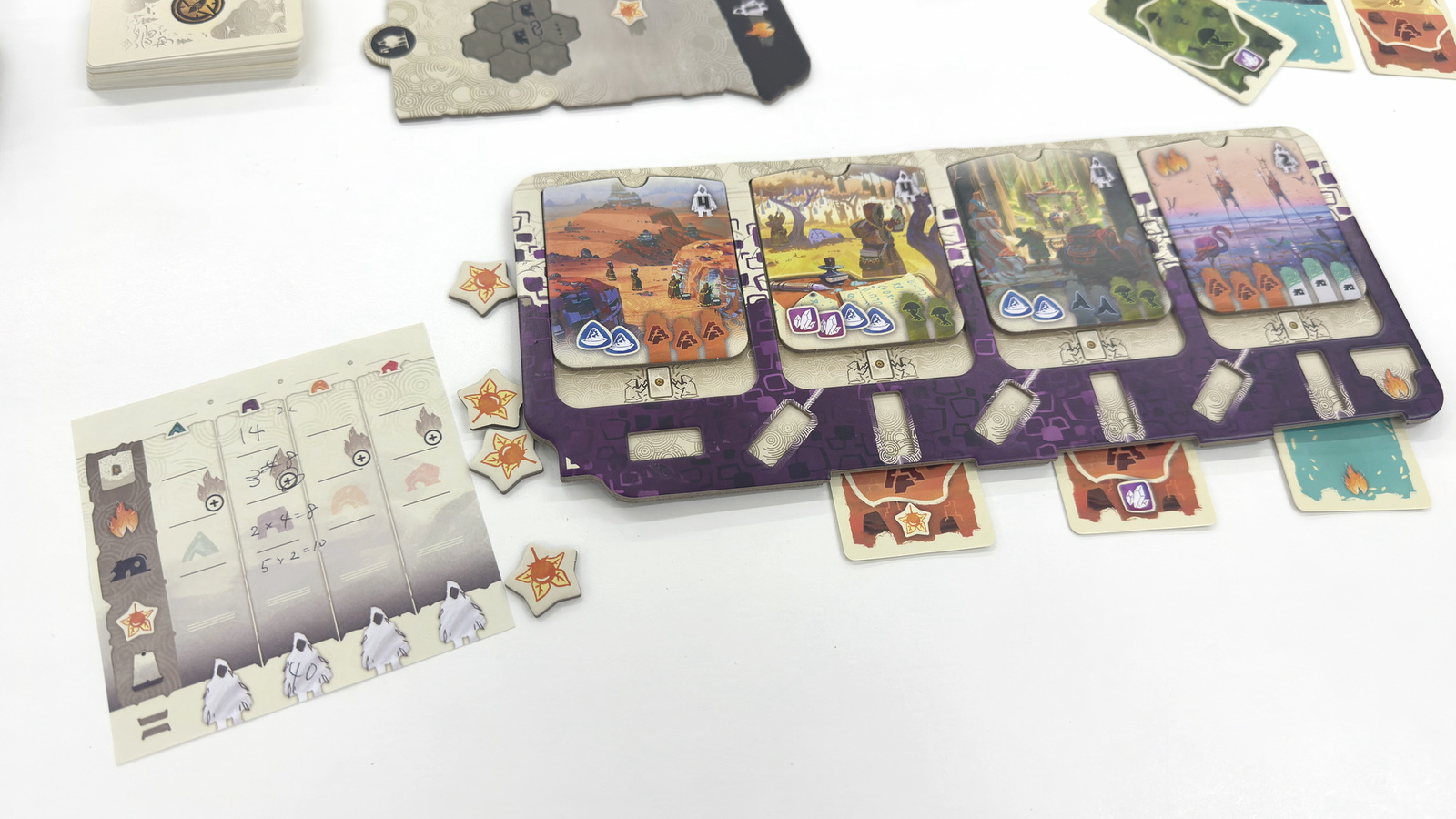
Once the game ends, we move on to scoring. The score is calculated as follows: 'Points from completed story tiles' + 'Victory points from the 'Fire' symbol' + 'Victory points from group camps' + 'Victory points from berry tokens'.
The game took about an hour with three players, including checking the rules along the way. The gameplay consists of only two actions: 'drawing cards' or 'placing campsites.' While the scoring and campsite placement methods are unique, the game progresses quickly once you get the hang of it. The basic rules and gameplay are simple, and it doesn't require much advanced negotiation or deduction, so even board game beginners can easily play it.
Furthermore, the terrain tiles are randomized each time, and changing the scenario tiles ensures a different gameplay experience each time, making it highly replayable. The key feature is 'getting two adjacent terrain cards from the field,' which allows you to choose rather than simply drawing from the deck, and the fact that you don't necessarily get only the cards you want makes predicting the outcome more challenging. The inclusion of team play rules is also a welcome feature, ensuring that the game remains engaging even after multiple play sessions.
The suggested retail price for the Dewan is 6,600 yen (tax included). At the time of writing, it was available on Amazon.co.jp for 6,050 yen (tax included).
Amazon | Board Game Dewan (Japanese Version) | Board Games | Toys

Related Posts: