Eating only carbohydrate-rich foods like wheat and rice can lead to weight and fat gain, even if calorie intake remains the same.
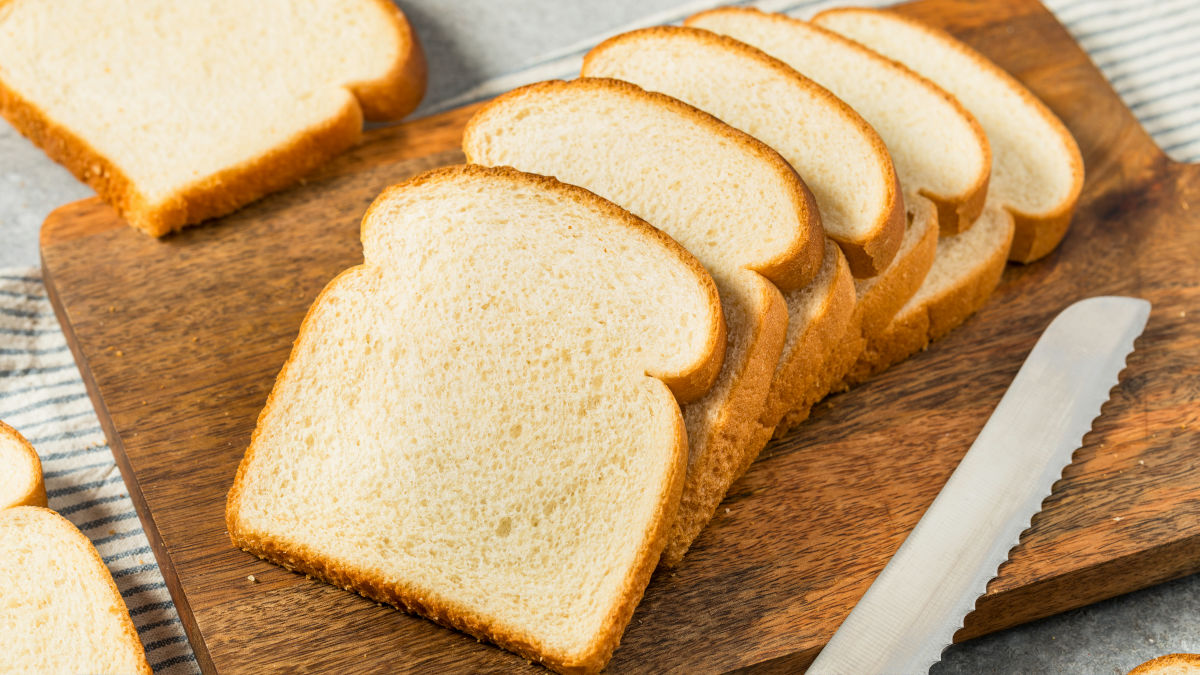
It is generally believed that eating only carbohydrate-rich foods such as bread, noodles, and rice is not good for dieting. A research team at Osaka Metropolitan University conducted experiments with mice and showed that when mice ate carbohydrate-rich foods such as wheat and rice, their weight and body fat increased even though their total calorie intake remained almost the same.
Wheat Flour Intake Promotes Weight Gain and Metabolic Changes in Mice - Matsumura - 2026 - Molecular Nutrition & Food Research - Wiley Online Library
People who love carbohydrates tend to gain weight easily – It has been found that even with the same calorie intake, weight and body fat increase – | Osaka Metropolitan University
https://www.omu.ac.jp/info/research_news/entry-22502.html
Scientists Reveal Why Bread Can Cause Weight Gain Without Overeating : ScienceAlert
https://www.sciencealert.com/scientists-reveal-why-bread-can-cause-weight-gain-without-overeating
Obesity is a major risk factor for diabetes and cardiovascular disease, and various studies have been conducted on the impact of diet on obesity. However, previous studies have tended to focus on excessive intake of 'lipids,' and many experiments have been conducted using high-fat diets, while the relationship between high-carbohydrate foods such as wheat and rice, which are consumed as staple foods, and obesity has not been studied much.
Therefore, a research team led by Associate Professor Shigenobu Matsumura of Osaka Metropolitan University conducted experiments on mice to investigate the effects of high-carbohydrate foods such as wheat and rice on obesity. The research team divided the mice into groups such as 'a group that ate only normal feed,' 'a group that ate normal feed and a mixture of wheat flour and baked food in their preferred proportions,' and 'a group that ate normal feed and a mixture of rice flour and baked food in their preferred proportions,' and investigated changes in body weight, energy expenditure, liver fat accumulation, and gene expression.
The experiment revealed that mice showed a strong preference for wheat flour and rice flour, and almost completely stopped consuming standard feed. Furthermore, it was found that mice that consumed large amounts of wheat flour and rice flour gained weight and fat mass, even though their total calorie intake was almost the same as the group that ate regular feed.
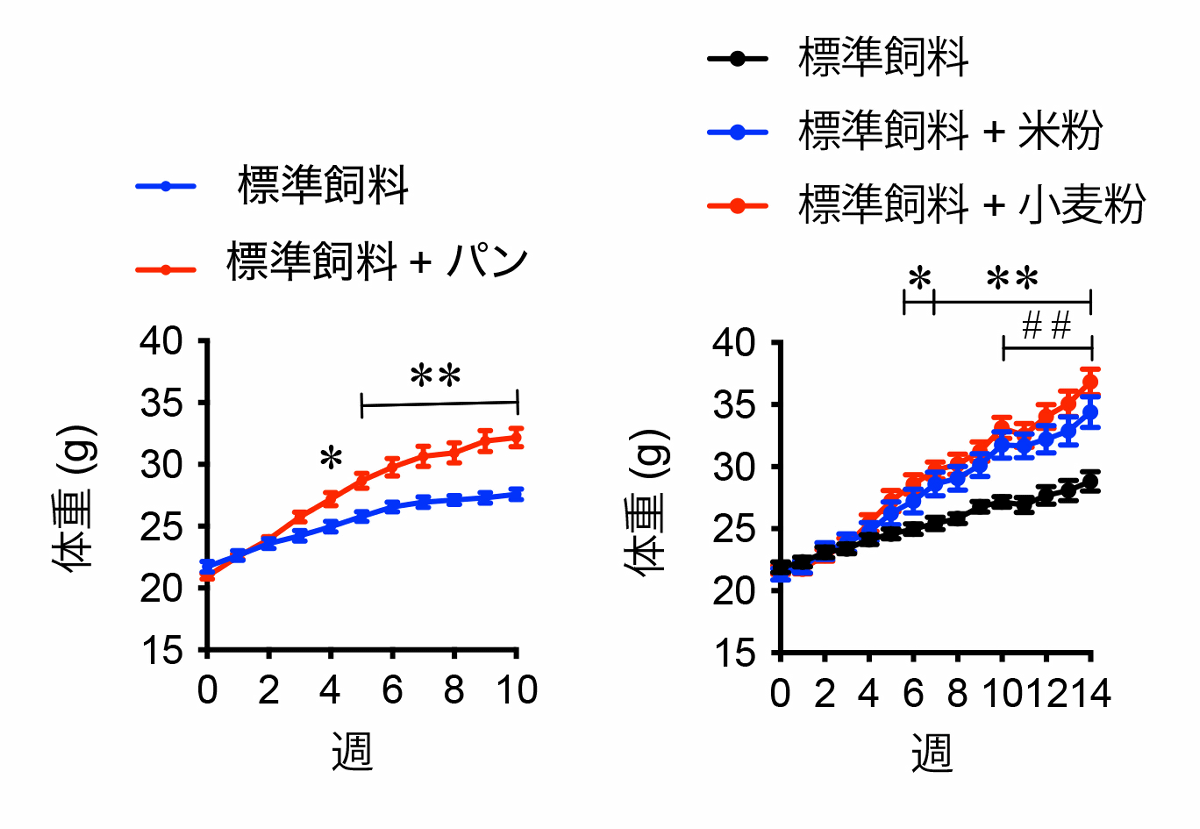
In the graphs below, the vertical axis represents body weight and the horizontal axis represents the elapsed time (weeks) since the start of the experiment. In the graph on the left, blue represents mice that ate the standard diet, and red represents mice that ate the standard diet and bread. In the graph on the right, black represents mice that ate the standard diet, blue represents mice that ate the standard diet and rice flour, and red represents mice that ate the standard diet and wheat flour. In all graphs, it is clear that the groups that consumed rice flour or wheat flour gained more weight compared to the group that ate only the standard diet.
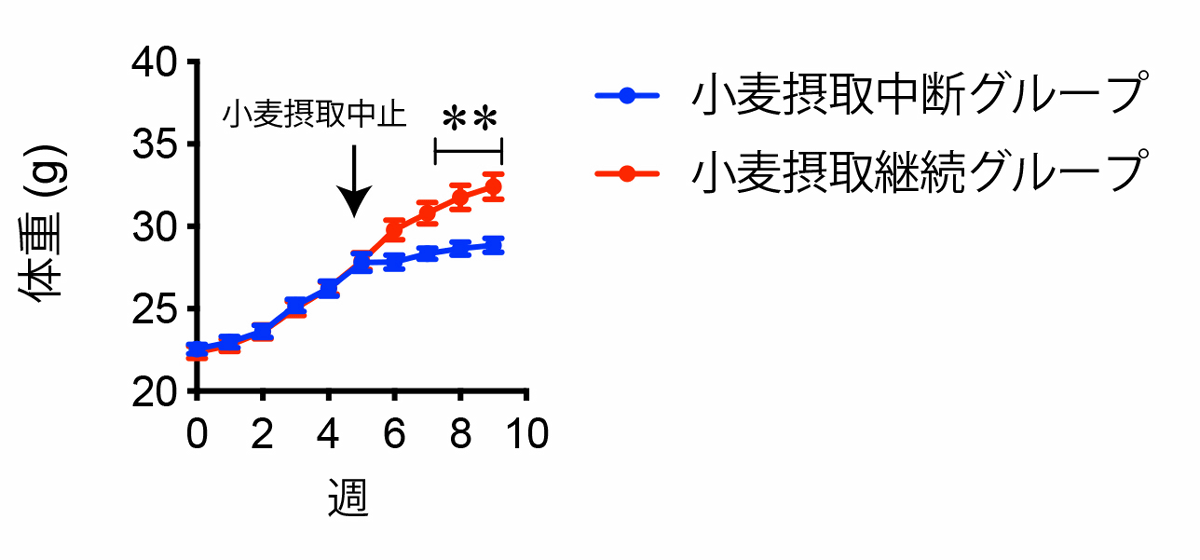
Furthermore, for the first five weeks of the experiment, all mice were given standard feed and wheat flour. Partway through, they were divided into two groups: one that stopped consuming wheat flour and ate only standard feed, and another that continued to eat both standard feed and wheat flour. As can be seen in the graph below, the group shown in red, which continued to eat standard feed and wheat flour, continued to gain weight, while the group shown in blue, which stopped consuming wheat flour, stopped gaining weight.
The research team analyzed the exhaled gases of mice to measure oxygen consumption and other factors, and found that the group that consumed wheat flour also had lower energy expenditure. This suggests that weight gain due to wheat flour consumption is not due to 'overeating,' but rather to a 'decrease in energy expenditure.'
Furthermore, measurements of metabolites in the blood revealed an increase in fatty acids and a decrease in essential amino acids. In addition, in the liver, fat accumulation was observed, along with an increase in the expression levels of genes involved in fatty acid synthesis and lipid transport.
Matsumura commented, 'What this study shows is not that 'a specific food is bad,' but rather that 'a diet that is excessively tasty may affect metabolism and weight.' This is an important perspective that applies not only to bread, but also to all staple foods and luxury foods, such as rice, noodles, and sweet foods.'
The research team plans to investigate how closely the metabolic changes caused by carbohydrate intake relate to real-life human experiences. They also intend to clarify the effects of factors such as 'whole grains, unrefined grains, and fiber-rich foods,' 'combinations with proteins and fats,' and 'food processing methods and timing of consumption' on metabolic changes associated with carbohydrate intake.
Related Posts:






in Free Member, Science, Food, Posted by log1h_ik