China conducts tests of electrostatic hydraulic actuator capable of cutting submarine cables at a depth of 3,500 meters.

Submarine cables are bundles of optical fibers laid on the seabed to transmit communication data such as the internet, and are indispensable for global communication networks and national security. It has recently been reported that China's research vessel 'Ocean Dizhi 2' has tested an electrostatic hydraulic actuator capable of cutting submarine cables at depths of several thousand meters.
China tests submarine cable cutter at 3,500-metre depth | South China Morning Post
https://www.scmp.com/news/china/science/article/3350174/china-tests-submarine-cable-cutter-3500-metre-depth
China tests deep-sea electro-hydrostatic actuator that can cut undersea cables at a depth of 3,500 meters — state hails successful trial and hints at deployment readiness | Tom's Hardware
https://www.tomshardware.com/tech-industry/china-tests-deep-sea-electro-hydrostatic-actuator-that-can-cut-undersea-cables-at-a-depth-of-3-500-meters-state-hails-successful-trial-and-hints-at-deployment-readiness
The South China Morning Post, a Hong Kong English-language newspaper, reported on April 15, 2026, that China's research vessel 'Haiyang Dizhi 2' completed its first deep-sea scientific survey of 2026 on April 11. The survey included testing of an electrostatic hydraulic actuator, which is said to be usable for cutting deep-sea submarine cables, and the vessel reportedly succeeded in a cutting test at a depth of 3,500 meters.
Electrostatic actuators integrate hydraulics, electric motors, and control units into a single device, eliminating the need for long, cumbersome external oil piping. The actuators used in this test are said to have enhanced resistance to deep-sea pressure and corrosion, enabling more precise mechanical work.
The China Science Daily , a newspaper jointly produced by the Chinese Academy of Sciences and other organizations, reported that 'this ocean test has overcome the 'last mile' from development to practical application of deep-sea equipment,' suggesting that preparations are underway for the practical application of an electrostatic hydraulic actuator that can be used to cut submarine cables.
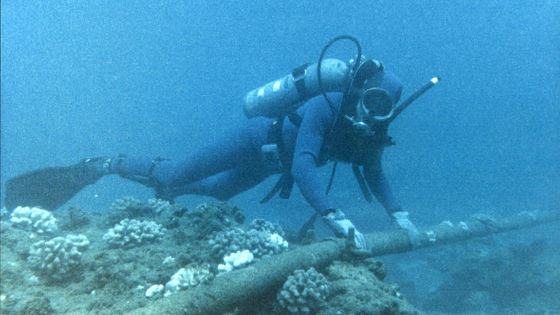
While the idea of 'being able to cut submarine cables' might sound dangerous, in recovery efforts after submarine cables are severed due to natural disasters or ship negligence, it's necessary to cut the damaged cable and connect it to a spare. Actuators capable of cutting deep-sea submarine cables could be useful in such recovery operations.
However, given recent global developments surrounding submarine cables, there are concerns that high-performance actuators could be misused. Three submarine cable severance incidents occurred in the Baltic Sea in quick succession between 2023 and 2024, and 27 submarine cable severance incidents occurred off the coast of Taiwan in the five years leading up to 2023.
Why do undersea cable severance incidents continue to occur all over the world? - GIGAZINE
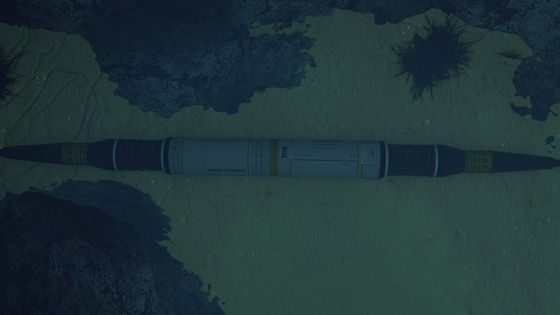
An April 2026 article in the financial newspaper The Wall Street Journal pointed out that while there have been no reported cases of intentional submarine cable severance by nations, some instances of severance may have been intentional. The article reported that countries are conducting patrols to protect submarine cables, and cable operators are considering routes that avoid disputed waters such as the South China Sea, where China and the Philippines have territorial claims.
Submarine cables are under threat of sabotage, necessitating the development of new technologies and routes to protect them - GIGAZINE
Related Posts:

in Note, Posted by log1h_ik