The AI revolution in mathematical research is upon us, but mathematicians believe 'this is just the beginning.'
Advances in AI are benefiting not only business and entertainment, but also various fields of research. In recent years, AI has been increasingly used in mathematical research, and mathematicians are expressing high hopes for it, according to the science media outlet Quanta Magazine.
The AI Revolution in Math Has Arrived | Quanta Magazine
https://www.quantamagazine.org/the-ai-revolution-in-math-has-arrived-20260413/
In July 2025, several AIs, including an enhanced version of Google's 'Gemini Deep Think,' attempted problems from the International Mathematical Olympiad, a competition for the world's top high school students, and successfully solved 5 out of 6 problems perfectly. This is a level that would earn a human a gold medal at the International Mathematical Olympiad, and it brought the attention of many mathematicians to AI.
Google's enhanced Gemini reaches the performance level to win a gold medal at the International Mathematical Olympiad, operating in natural language and finding solutions within the same time limit as a human - GIGAZINE
AI was once thought to be prone to errors and unsuitable for mathematical research, but by 2025, there were increasing instances of using AI to tackle unsolved mathematical problems and quickly find or prove new solutions. Terence Tao, a renowned mathematician at the University of California, said, '2025 was the year when AI truly began to be useful for a variety of tasks.'
The summer of 2025 marked a turning point in AI's mathematical capabilities, but AI development companies and some mathematicians had been working on using AI to solve mathematical problems even before that. Google DeepMind had been trying to solve mathematical problems using AI since 2018, and in January 2025, mathematicians including Tao collaborated with Google DeepMind to begin developing an AI system called ' AlphaEvolve .'
AlphaEvolve uses Gemini to create programs with hundreds of lines of Python code, and then uses a technique called a genetic algorithm to 'evolve' these programs and find the optimal solution to mathematical problems.
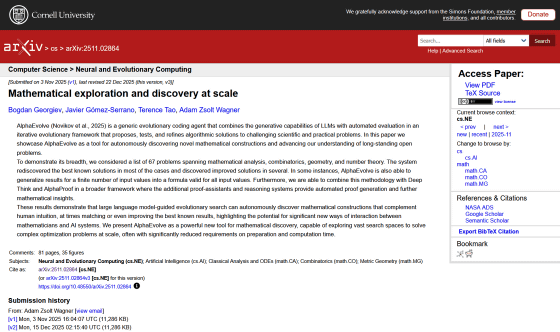
Four mathematicians applied AlphaEvolve to new mathematical problems every one to two days over several months. As a result, they found that in 67 different problems spanning various fields of mathematics, AlphaEvolve slightly improved the known best solution in 23 problems and produced results equivalent to the known solution in 36 problems. The research team reported these results in a paper titled 'Mathematical exploration and discovery at scale.'
[2511.02864] Mathematical exploration and discovery at scale
https://arxiv.org/abs/2511.02864
Tao stated that current AI models are 'very good at simply finding solvable problems from a vast list of issues. It's a tedious and unrewarding task, not something humans want to do.' He also argued that while there are many unreported failures behind the sporadic successes, the success of AI in the field of mathematics is still remarkable.
Javier Gomez-Serrano, a mathematician who worked with Tao and others on the development of AlphaEvolve, says that at the time of writing, he spends about two-thirds of his available time on AI. Gomez-Serrano states, 'AI is reaching a stage where it is useful and practical. This is the beginning of a new way in which we do mathematics.'
Johannes Schmidt, a mathematician at the Swiss Federal Institute of Technology Zurich, also says that conversations with AI are beneficial in research. While acknowledging that AI makes many mistakes and spouts nonsense, Schmidt said, 'There must be something to be gained from these conversations. Not all ideas are good, but we can ignore the bad ones and take only the good ones.'
Ernest Liu, a mathematician at the University of California, Los Angeles, primarily conducts research in the field of applied mathematics known as optimization theory. After hearing the news that AI had solved a problem in the International Mathematical Olympiad, Liu began using AI himself and noticed a significant improvement in its mathematical capabilities. Since then, Liu has been using AI for tasks such as creating lecture notes.
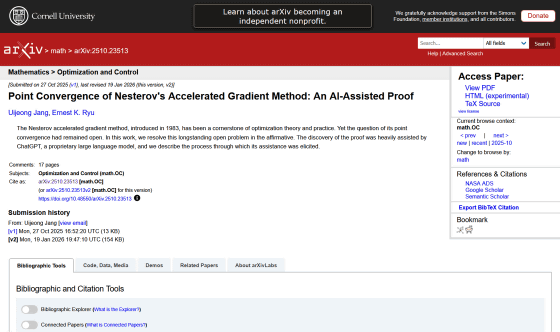
One day in October, Mr. Liu began working on an unsolved problem in optimization theory that he had attempted to solve several times before, using ChatGPT. When he asked ChatGPT about this problem, which was proposed in 1983 by Russian mathematician Yuri Nesterov, he received only incorrect proofs. However, there were interesting steps in the process leading to these errors, and some parts seemed potentially useful. As a verifier, Mr. Liu examined ChatGPT's answers, keeping only the correct parts and providing feedback, and after three days he arrived at a simplified proof.
A few months after publishing his research findings in a paper, Mr. Liu took a leave of absence from the university and joined OpenAI as a technical staff member. Mr. Liu stated, 'This wasn't the most original or the most complex thing. But it certainly wasn't easy. This is a concrete example of how using ChatGPT really accelerated discovery.'
[2510.23513] Point Convergence of Nesterov's Accelerated Gradient Method: An AI-Assisted Proof
https://arxiv.org/abs/2510.23513
While AI is expected to accelerate various mathematical research projects, concerns have also been raised about its potential negative impact on how mathematics is taught to students. Ken Ono, who took a leave of absence from the University of Virginia to work for AI development company Axiom, commented, 'I have a bright outlook on the potential of AI to benefit mathematical research, but I am deeply concerned about the role of AI in work and education at all levels.'
Joel David Hamkins, a mathematician at the University of Notre Dame, has given up on assigning homework because a significant portion of student assignments are generated by AI. 'I don't want to read assignments done by AI. I don't want to be an AI supervisor,' he said, pointing out that the situation where everything has to be completed through in-class quizzes and the like is a problem for academia as a whole. Another mathematician at a top university also stated, 'While AI accelerates the progress of serious mathematicians, it poses a serious risk of hindering the development of more mathematicians.'
While Tao expressed concern that AI could potentially rob students of their critical thinking skills, he also expressed optimism about the transformation AI will bring to mathematical research. 'With AI tools, we can solve thousands of problems at once and begin statistical research,' he said. 'It will look and feel completely different from traditional ways of doing mathematics.'
Related Posts: