The Writers Guild of America has agreed to a four-year interim contract with film studios, strengthening protections to prevent AI from learning their scripts.

It has been reported that
Writers Guild Reaches Tentative Four-Year Deal With Studios
https://www.hollywoodreporter.com/business/business-news/writers-guild-tentative-four-year-deal-studios-1236555949/
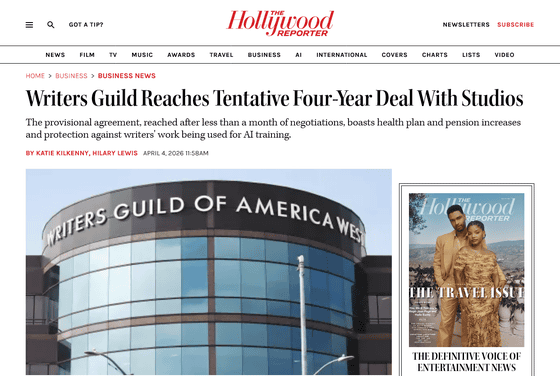
The WGA and AMPTP conducted contract negotiations for approximately one month starting in March 2026. After media reports on April 4, 2026, that a provisional agreement had been reached, a formal agreement was announced that same evening.
In a statement regarding the agreement, the WGA announced, 'Today, the WGA Negotiating Committee unanimously approved a tentative agreement with AMPTP on the 2026 Minimum Basic Agreement (MBA), which will be in effect for four years.' The WGA further explained that, 'Importantly, this agreement will protect the union's health insurance scheme and put it on a sustainable track. Employer contributions will increase in many areas, and the long-needed cap on health insurance contributions will be raised. This new agreement will also build upon the achievements of 2023 and help address challenges related to unpaid labor.'
In a statement on the interim agreement, AMPTP said, 'We hope to further develop this progress as we continue our efforts toward an agreement that will support long-term industry stability.'
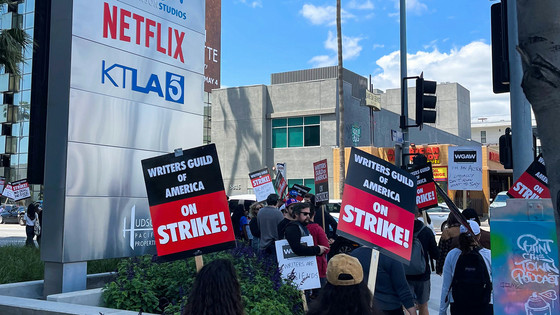
In Hollywood, three-year contracts have been common since 1940. However, following two strikes in Hollywood in 2023, the AMPTP (American Professional Union Patrol) was considering longer contract periods to increase job security. Therefore, if the WGA and AMPTP's four-year contract is approved, it will be considered an unusually long-term contract, which is attracting attention.
A tentative agreement has been reached in the Hollywood strike to allow film scripts to be used for AI training in exchange for paying royalties to screenwriters - GIGAZINE
Regarding the content of the provisional agreement, the WGA stated in a message to its members that 'the details of the agreement will be announced again after the leadership approves it,' so the specifics are not clear at the time of writing. Furthermore, the agreement reached on April 4, 2026, is a provisional agreement and will become final after a ratification vote by the members, so its contents may be changed or rejected.
As of the time of writing, the contract details that have been revealed include strengthening the health insurance fund. It has been reported in the past that the WGA's health insurance fund lost a total of $122 million (approximately 19.4 billion yen) in 2023 and 2024 due to soaring medical costs and a decrease in job opportunities in the industry, making it necessary to strengthen the health insurance fund jointly operated by the union and the studios.
In a pre-negotiation interview conducted in March 2026, the WGA also revealed that it was focused on strengthening safety measures regarding the use of generative AI. John August, co-chair of the negotiating committee, said, 'One of the goals of these negotiations is to establish the argument that employers must compensate members if they use material written by members to produce AI output. Specifically, we aim to regulate the training of AI tools with members' scripts and the licensing of scripts for use in training those tools.'
According to data released by the WGA, the employment of screenwriters in 2024 was projected to be 9.4% lower than in 2023, the year of the strike, and 24.3% lower than in 2022, indicating that the overall contraction of the industry has had a major impact on Hollywood screenwriters. The Hollywood Reporter, which reported on the matter, says that despite the plight of the screenwriting industry, the atmosphere for negotiations this year has been much calmer.
Related Posts: