Telegram founder reveals Russian government's attempt to restrict VPN usage is causing widespread banking system outages.

Telegram founder Pavel Durov has revealed that Russia's attempts to block virtual private networks (VPNs) have caused widespread problems in the country's payment systems. Durov also said that Russian authorities are pressuring media outlets to remove any reports linking VPNs to the system failures.
Telegram: View @durov
https://t.me/durov/477
Russia's banks face major service outages amid internet crackdown
https://kyivindependent.com/russias-banks-face-major-service-outages-amid-internet-crackdown/
On March 30, 2026, Russia's Digital Development Minister Maxusut Shadayev stated during a meeting with domestic companies that 'the government will work to reduce the use of VPNs.' According to reports, Shadayev has urged telecommunications companies and digital platforms to charge fees for using VPN services and block users.
Furthermore, on March 31, 2026, pro-government Russian media reported, citing anonymous sources, that 'the Federal Security Service (FSB) may begin monitoring the availability of VPN services by Russian IT companies.' According to a draft allegedly created by the Russian Ministry of Digital Development, companies found to be using VPN traffic may be removed from the national registry, which offers benefits such as tax breaks and deferral of military service for employees.
Furthermore, pressure on messaging platforms is increasing in Russia. Telegram, a messaging app widely used by Russian citizens, hadsome restrictions placed on calls in August 2025, and began restricting communication and access to Telegram in February 2026.
Russian authorities restrict access to messaging app Telegram, possibly to force users to switch to the state-run app MAX - GIGAZINE

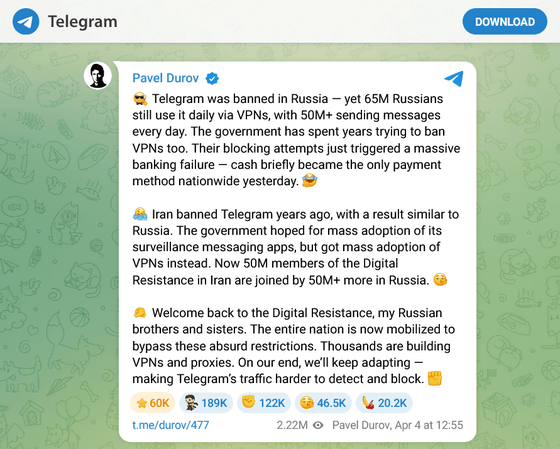
Meanwhile, on April 4, 2026, Telegram founder Pavel Durov posted on Telegram and X, 'Telegram has been banned in Russia, but 65 million Russians use it daily via VPN, and more than 50 million people send messages daily. The government has also been working for years to ban VPNs. These efforts caused a major system failure on April 3, which resulted in a large-scale banking system malfunction, making cash the only means of payment nationwide for a time.' This revealed that the government's VPN restrictions had caused a massive system failure.
Telegram was banned in Russia — yet 50M+ Russians still use it daily via VPNs. The government has spent years trying to ban VPNs too. Their blocking attempts just triggered a massive banking failure — cash briefly became the only payment method nationwide.
— Pavel Durov (@durov) April 4, 2026
According to the Ukrainian online media outlet Kyiv Independent , Sberbank, Russia's largest bank, reported a temporary service disruption on April 3, 2026. Other Russian financial institutions also reported similar problems, and data from bank monitoring services indicated a surge in outages across the Russian banking sector that morning. The disruption made it impossible to use mobile banking apps, send money, withdraw cash from ATMs, and even make credit card payments. In several cities, only cash payments were accepted, resulting in long queues at various stores.
Russian pro-government media reported that 'the problem was caused by a malfunction in Sberbank's payment services and may have been 'complexed' by customers' use of VPN services.' On the other hand, Fyodor Muzarevsky, technical director of IT security company RTM Group, pointed out that 'it is highly likely that the blocking of VPNs was a 'friendly fire' and contributed to the bank service outage on April 3.'
According to Durov, the Russian Federal Service for Supervision of Communications, Information Technology and Mass Media (Roskomnador) , the executive body responsible for monitoring, controlling, and censoring Russian mass media, demanded that Russian media outlets remove reports linking the large-scale banking system failure on April 3rd to the government's VPN blocking measures. In fact, some articles, including those in Forbes, were removed, citing 'technical overload of Roskomnador's filtering system' as the main cause. A Telegram channel with approximately 650,000 subscribers was also ordered to remove posts for 'destabilizing the political situation in Russia.'
Roskomnadzor demanded that Russian media remove reports linking a major banking outage on April 3 to government internet blocking measures. Articles from Forbes and the Mash Telegram channel disappeared after they cited technical overload of Roskomnadzor's filtering systems as…
— Aleksandar Djokic (Александар Джокич) (@polidemitolog) April 4, 2026
Durov said, 'Iran banned Telegram a few years ago, and the result is similar to what is happening in Russia today. The Iranian government hoped that the surveillance messaging app would become widespread, but instead, VPNs became widespread, and now Iran's digital resistance movement has 50 million members. Welcome to the digital resistance movement, brothers and sisters in Russia. Now the whole country is rising up to circumvent these unreasonable restrictions. Thousands of people are building VPNs and proxies. We too will continue to adapt to make it harder for Telegram traffic to be detected and blocked.'
Related Posts:



in Web Service, Posted by log1e_dh