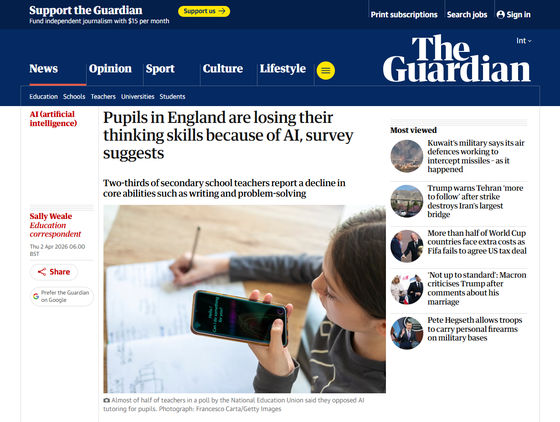
Two-thirds of middle school teachers believe that the use of AI is causing a decline in students' critical thinking skills.

A survey conducted by an education union among British secondary school teachers revealed that two-thirds of respondents believe that the use of AI is causing a decline in students' writing skills, problem-solving abilities, and critical thinking skills.
Pupils in England are losing their thinking skills because of AI, survey suggests | AI (artificial intelligence) | The Guardian
School students 'losing ability to have a conversation' due to AI | News UK | Metro News
https://metro.co.uk/2026/04/02/school-students-losing-ability-a-conversation-due-ai-27803916/
The British government is advocating a digital revolution that promotes the use of AI in school education, and in January 2026 announced plans to develop AI tools to provide individualized learning support to up to 450,000 underprivileged students.
Regarding this, British Education Secretary Bridget Phillipson said, 'AI-powered personalized tutoring tools have the potential to dramatically change access to personalized tutoring for young people, making it available to all children who need it, rather than being the privilege of only a select few, thus enabling all children to grow and succeed.'
However, a survey of 9,000 public school teachers conducted by the National Education Union found that 49% of respondents opposed the government-led plan to introduce AI-powered personalized tutoring tools. Only 14% supported the government's plan to use AI in the education sector.

Teachers who responded expressed concern that AI would be used to cut costs, with one respondent writing, 'Students who need tutoring often need more than just academic support. I don't think AI can meet those needs.'
Another respondent stated, 'Students won't be motivated by AI tutors,' while yet another responded, 'Students from disadvantaged backgrounds need instruction through interaction with humans, not AI. This can improve their social skills and reduce social isolation.'
Teachers who responded to the survey were skeptical about students using AI and complained that it would encourage cheating on exams and homework. On the other hand, some teachers reportedly said that they were increasingly relying on AI in their work.

In fact, 76% of those who responded to the survey said they 'use AI in their daily work,' a significant increase from 53% in a similar survey conducted in 2025. When asked what they use AI for, the three most common answers were creating teaching materials (61%), lesson planning (41%), and administrative tasks (38%). Only 7% said they use AI for grading.
In responses related to AI, 66% said that 'the spread of speech recognition technology has made children feel less need to memorize spelling, and related skills have declined.' Some respondents also said that '(due to the spread of AI) students are losing basic skills such as thinking ability, creativity, writing ability, and even how to converse.'
Another respondent stated that 'AI is destroying the essence of 'learning,' namely problem-solving ability,

Furthermore, the survey revealed that 49% of the schools where the participating teachers worked had no 'AI use policy' for teachers or students, and 66% of the schools had no AI use policy for students.
Teachers who responded to the survey commented, 'Staff are using AI without receiving training on how to use it properly, and as a result, low-quality AI content is being used in educational settings,' and 'If used correctly, AI can be a valuable educational tool. However, this requires regulation and guidance, and I think all schools should have training and policies in place for staff and students.'
Daniel Kebede, executive director of the National Education Union, commented on the survey results, saying, 'Students must be able to think for themselves. This is central to learning, but our research also shows that reliance on AI is impacting students' critical thinking skills.' He further criticized the UK government's AI policies, stating, 'The education industry does not believe that AI tutors are a panacea for closing the opportunity gap for underprivileged students. The government is taking risks by announcing the introduction of AI tutors before the impact of AI is fully understood.'
Meanwhile, a spokesperson for the UK government, in response to the National Education Union's findings, commented: 'Our mission is to break the link between home environment and success. The introduction of AI-powered personalized tutoring tools will help us achieve this. It will extend personalized learning support, which has previously only been available to a privileged few, to all children who need it. No technology should replace the foundational knowledge and academic thinking skills that students need to prepare for their future lives. At the same time, we need to prepare children to thrive in a digitized world. That is why our Schools White Paper presents a clear plan for the safe, critical, and responsible use of AI, and supports all young people in achieving success and thriving.'
Related Posts:







in AI, Posted by logu_ii