Following the Supreme Court ruling against an ISP that 'simply providing a service does not constitute aiding and abetting copyright infringement,' X also applied to the court to dismiss the lawsuit.
In March 2026, the U.S. Supreme Court ruled that 'ISPs cannot be held liable for aiding and abetting copyright infringement simply because they continued to provide services to subscribers suspected of copyright infringement.' Following this ruling, X applied for dismissal of the lawsuit that had been ongoing since the 2024 ruling that X was liable for intentionally turning a blind eye to copyright infringing users.
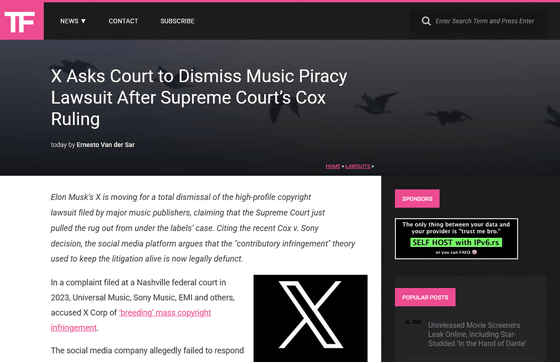
X Asks Court to Dismiss Music Piracy Lawsuit After Supreme Court's Cox Ruling * TorrentFreak
https://torrentfreak.com/x-asks-court-to-dismiss-music-piracy-lawsuit-after-supreme-courts-cox-ruling/
In June 2023, the National Music Publishers Association (NMPA), representing several music labels including Universal Music Group, Concord Music Group, Sony Music Publishing, and Warner Chappell Music, filed a lawsuit against X seeking $250 million (approximately 37.5 billion yen) in damages, alleging that X 'facilitated copyright infringement by allowing posts containing copyrighted music to be made, thereby harming creators.'
Twitter is facing a lawsuit from the National Music Publishers Association, seeking approximately 35 billion yen in damages for failing to address tweets infringing on music copyrights - GIGAZINE
X had requested the court to dismiss the lawsuit, but in March 2024, Judge Areta A. Trauger, while rejecting X's claim of 'agency liability' that X was directly involved in copyright infringement, allowed the trial to continue , acknowledging the possibility of 'contributory infringement' where X was aware of the copyright infringement but failed to take sufficient measures.
In this context, regarding the case in which the telecommunications company Cox Communications was sued in 2018 by a major record company group on the grounds that it 'failed to completely eliminate users who repeatedly infringed copyrights and was profiting from piracy,' the Supreme Court ruled on March 26, 2026, that 'Cox Communications is not jointly liable for the copyright infringement activities of users of pirated content.' The judgment stated that in order to hold someone liable, it is necessary to prove that the service provider intended to infringe copyrights, and to prove this, it is necessary that either 'the service provider actively induced the infringing activity' or 'the service in question had no substantial non-infringing use,' but the court concluded that neither of these conditions applied to Cox Communications.
In a lawsuit seeking to hold ISPs liable for copyright infringement, the Supreme Court ruled that 'simply providing a service does not constitute aiding and abetting' - GIGAZINE
Following this Supreme Court decision, on March 27, 2026, X filed a case with the Federal Court of Tennessee arguing that, 'based on the new 'Cox precedent,' the claim that the service provider is guilty of contributory infringement is not legally valid, and the entire lawsuit should be dismissed.' According to X's argument, based on the standard established by the Supreme Court in the Cox case, which states that 'to hold a service provider liable, it must be proven that the service provider intended to infringe copyright,' X has not met any of the requirements.
Elon Musk had previously stated that the Digital Millennium Copyright Act (DMCA) was a 'plague on humanity,' and the music label group cited this as 'evidence of a hostile stance against copyright' in their initial complaint. In a statement filed with the U.S. Court of Tennessee, X said, 'Cox even made disparaging remarks about copyright law, such as sending emails with comments like 'To hell with the DMCA.' Despite these facts, the Supreme Court overturned the jury's verdict of complicity infringement because even disparaging remarks about copyright do not constitute 'clear evidence of promotion, marketing, or intent to promote infringement.''
This petition goes beyond simply citing a Supreme Court ruling; it calls on the court to review the entire course of the lawsuit. As of the time of writing, neither X nor the NMPA have issued a detailed official statement on this matter. This development could influence the debate surrounding the scope of copyright liability on online platforms, and the outcome of the ruling will be closely watched.
Related Posts:


in Web Service, Posted by log1e_dh