Artemis II can use laser communication to live stream 4K video from lunar orbit at 260Mbps.

NASA's Artemis II mission, which successfully launched on April 1, 2026, is planned to send humans out of Earth's orbit for the first time in half a century to perform a lunar flyby. The Artemis II mission also includes the task of 'transmitting high-resolution 4K video of the moon taken from the Orion spacecraft orbiting the moon.'
Exploration and Space Communications: LEMNOS - NASA
https://www.nasa.gov/goddard/esc/o2o/
Artemis II will use laser beams to live-stream 4K moon footage at 260 Mbps — one giant step beyond the S-band radio comms of the Apollo era | Tom's Hardware
https://www.tomshardware.com/networking/artemis-ii-will-use-laser-beams-to-live-stream-4k-moon-footage-one-giant-step-beyond-the-s-band-radio-comms-of-the-apollo-era
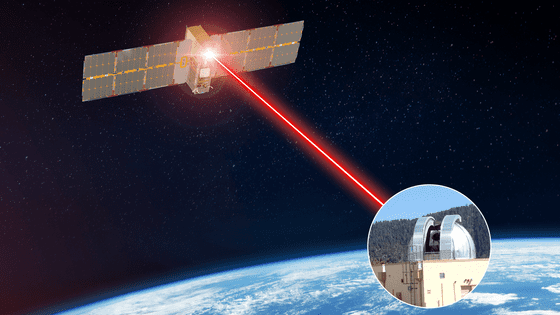
This video transmission mission is called the Orion Artemis II Optical Communication System (O2O). While data is typically transmitted and received using radio waves when traveling to distant locations on Earth, O2O uses infrared light instead of radio waves to transmit and receive data.
As of the time of writing, the four astronauts participating in the Artemis II mission are live-streaming from the Orion spacecraft, and it is possible to view their streams in up to 4K resolution.
NASA's Artemis II Live Mission Coverage (Official Broadcast) - YouTube
As NASA missions become more sophisticated, the amount of data that can be transmitted from space to Earth is rapidly increasing. To meet this need, NASA has begun using a wider bandwidth radio frequency spectrum. However, achieving high data rates with radio frequency (RF) communications requires larger antennas and increased power output from radio transmitters, and there are limits to how much these can be increased. Therefore, NASA is developing optical communications to address the limitations of RF communications, namely the challenges of bandwidth, spectrum, overall frequency packet size, and power consumption.
NASA explains, 'As mission instruments evolve and collect vast amounts of scientific and exploration data, spacecraft will need to enhance their means of transmitting information back to Earth. Traditionally, NASA missions have used RF communications to send and receive data to and from space. Laser communications use infrared light instead of radio waves, allowing for the transmission of more data in a single communication.'
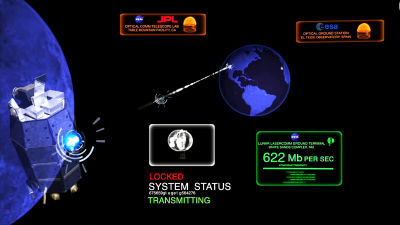
The O2O module to be installed on the Orion spacecraft can be seen in the following video. This O2O module can achieve a data rate of 260Mbps and will be used not only to transmit lunar images in 4K high definition, but also to send and receive flight plans and photo data.
O2O Optical Module - YouTube
Infrared laser communication systems have the advantage of being smaller in volume, weight, and power consumption compared to equivalent wireless communication systems. However, laser communication can be interfered with by problems such as clouds and turbulence.
Ground stations that communicate with the O2O modules using lasers are located in Las Cruces, New Mexico, Table Mountain, California, and Haleakala, Hawaii. According to NASA, these locations were chosen because of their high altitudes and the clear weather conditions essential for high-speed and reliable laser communication.
Furthermore, when the Orion spacecraft orbits the moon, if it passes over the far side of the moon, both laser communications and depth satellite communications (DSN) will be cut off. According to NASA, this 'dark period' during which both communications are cut off will last approximately 41 minutes.
Related Posts: